

Should I Sell My House Now or Wait Until Next Fall in the Inland Empire?
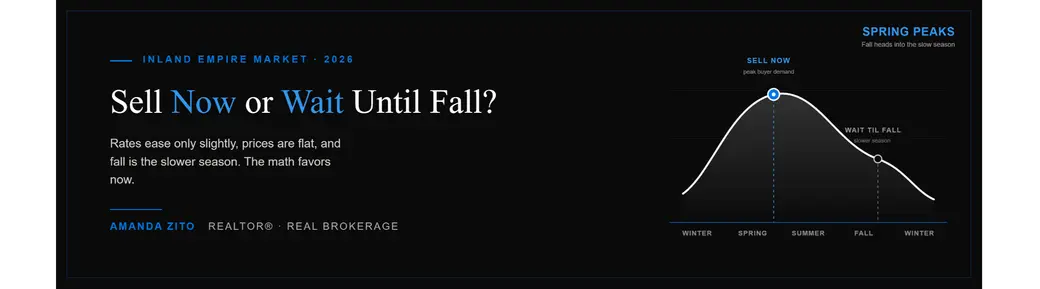
For most Inland Empire sellers, waiting until fall 2026 offers little clear upside: mortgage rates are forecast to ease only modestly, prices are roughly flat, and fall is a seasonally slower selling window than spring. The right move depends on your equity and timeline — not the calendar.
The question every Inland Empire homeowner is asking right now
You've watched your equity climb over the last few years, and now you're wondering whether to cash in this year or hold out for a "better" market next fall. Maybe a neighbor told you rates are about to drop and buyers will come flooding back. Maybe you're just tired of guessing.
Here's the honest version, from someone who works these Riverside and San Bernardino County neighborhoods every week: waiting for a dramatically better market in fall 2026 is a bet — and the data doesn't strongly support that bet. That doesn't mean you should sell tomorrow. It means the decision should come down to your numbers, not a headline about interest rates.
Let's walk through both sides so you can decide with clear eyes.
The case for waiting until next fall
There's a real argument here, so let's give it a fair hearing.
The logic goes like this: mortgage rates are still in the mid-6% range, which keeps some buyers on the sidelines. If rates drift lower by late 2026, more buyers qualify, demand picks up, and you sell into a stronger pool of competition. Wait a few months, the thinking goes, and you list into a warmer market.
There's also the "let my equity keep growing" angle — if Inland Empire home values rise between now and fall, waiting means a bigger check at closing.
Both points are reasonable. The problem is that the numbers behind them are softer than most sellers assume.
What the data actually says about fall 2026
Let's pressure-test the "wait" argument with real figures.
On mortgage rates: As of early July 2026, the 30-year fixed averaged about 6.5%, according to Freddie Mac's weekly survey. Forecasts do point lower — a mid-year Reuters poll of housing economists, summarized by Forbes Advisor, projected roughly 6.4% in Q3 and 6.3% by year-end. That's real, but it's a drift, not a plunge. A move from 6.5% to 6.3% changes a buyer's monthly payment only slightly. It's unlikely to unleash a wave of new demand strong enough to bid your price up meaningfully.
On prices: Inland Empire values have essentially been treading water. Zillow data cited in recent market reporting shows median home values in both Riverside County and San Bernardino County slipped about 1.5% over the year ending in spring 2026. Nationally, Redfin and Zillow forecasts call for only about 1% price growth for the year. So the idea that your home will be worth noticeably more by fall isn't well supported — flat-to-slightly-down is the more realistic picture across most IE submarkets.
On the "buyers will flood back" theory: If rates do ease, something else happens too. Lower rates loosen the "lock-in effect" — the reason so many homeowners with 3% mortgages have stayed put. When those owners finally list, inventory rises. More competing listings can offset the extra buyers, which is why a small rate dip rarely turns into a seller windfall.
Put simply: the conditions that would make fall 2026 dramatically better than today mostly aren't in the forecast.
Why "fall," specifically, may be the weakest time to wait for
Here's the part that gets overlooked. Even if you do want to time the market, fall is an odd target.
The Inland Empire follows a fairly predictable seasonal rhythm. Buyer activity is strongest in spring and early summer, then cools as the year winds down. Historically, December and January are the slowest, most challenging months to sell across Riverside and San Bernardino Counties — fewer buyers out looking, longer days on market, more price flexibility expected from sellers. Fall sits on the downslope of that curve, heading into the slow season, not out of it.
So if your real goal is to wait for a better selling window, next fall is arguably the wrong one. Spring 2027 would line up far better with peak buyer demand than October or November of this year. Waiting until fall often means combining an uncertain rate benefit with a seasonally weaker market — the worst of both timing bets.
The case for selling now
The current Inland Empire market is best described as balanced, with a slight tilt toward sellers in most submarkets. Well-priced, well-presented homes in desirable areas — think Rancho Cucamonga, Corona, Eastvale, Redlands, Murrieta — are still drawing strong interest and, in many cases, multiple offers. What's changed from the frenzy years is that buyers are more discerning. Overpriced listings sit; sharp ones move.
Selling now also means:
- You're not competing with a future inventory wave. List while supply is still tighter than pre-pandemic norms, rather than after lock-in eases and more homes hit the market.
- You lock in today's equity. With prices flat-to-soft, there's little evidence that waiting grows your proceeds — and some risk it shrinks them.
- You control your timeline. If you're buying next, moving in one market beats trying to perfectly straddle two.
The questions that matter more than timing
Honestly? The rate forecast and the seasonal chart matter less than your own situation. Before you decide, work through these:
- How much equity do you have, and what will you do with it? If you're rolling it into your next purchase, a "lower price now, lower rate later" market can actually work in your favor as both a seller and a buyer.
- What's your timeline? Needing to move for work, family, or space is a far better reason to act than a 0.2% rate prediction.
- How's your home positioned? Condition, pricing, and presentation drive your outcome in this market far more than the month you list.
- Can you buy and sell in the same market? Coordinating both transactions often matters more to your bottom line than chasing the "perfect" week.
If the numbers and the timeline point to now, waiting for a fall market that may not materialize just delays your plans. If they point to later, then let's build a real plan around it — not a hope about rates.
Frequently asked questions
Will home prices in the Inland Empire go up by fall 2026? Current forecasts suggest modest change at best. Riverside and San Bernardino County values have been roughly flat to slightly down over the past year, and national outlooks call for only about 1% growth in 2026. A significant jump by fall isn't the expected scenario.
Should I wait for mortgage rates to drop before selling? Rates affect buyers more than sellers, and forecasts point to only a gradual easing into the low-6% range — not a sharp drop. Lower rates can also bring more competing listings onto the market, which can cancel out the benefit of extra buyer demand.
When is the best time to sell a house in the Inland Empire? Spring and early summer typically bring the most buyer activity across the region, while late fall and winter are the slowest. If you're weighing when to list, spring generally offers stronger conditions than fall.
Let's figure out your actual best move
Every home and every seller is different, and the "now vs. wait" answer changes based on your equity, your timeline, and how your property is positioned in your specific Inland Empire neighborhood. I'd rather give you a straight answer for your situation than a generic one.
Call or text me directly — [insert your phone number] — and we'll run your numbers together. No pressure, no pitch. Just a clear read on what selling now versus waiting really means for you.
Amanda Zito, REALTOR® — Real Brokerage | Serving the Inland Empire (Riverside & San Bernardino Counties) | DRE #[insert license number]
Categories
Recent Posts











“Your goals come first. My job is to help you make the right move.”