

What Happens During a Home Value Consultation? A Guide for Inland Empire Homeowners
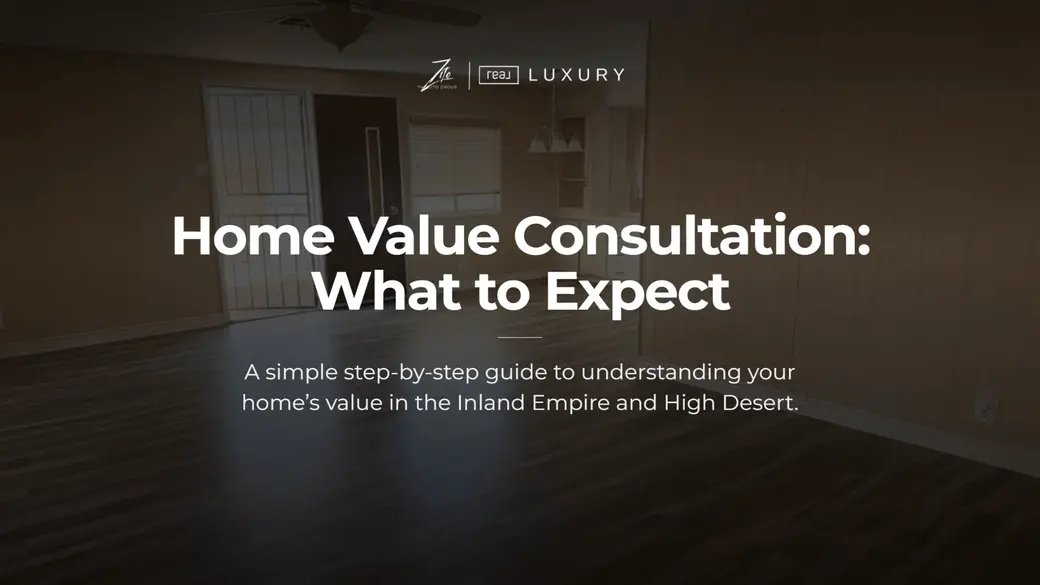
Thinking about selling your home? Or maybe you're just curious how much it's worth in today's market?
One of the best places to start is with a home value consultation.
Many homeowners in the Inland Empire and High Desert aren't quite sure what to expect. Will someone come to their home? Do they need to make repairs first? Are they expected to list their property afterward?
The good news is that a home value consultation is simply a chance to understand your home's current market value and explore your options.
There's no pressure to sell, and you don't need to have a moving date in mind.
Whether you're planning to sell soon, thinking about moving in the next year, or just want to know how much equity you may have, here's what you can expect when we meet.
Step 1: I Research Your Home Before We Meet
Before visiting your property, I start by reviewing information about your home and the local real estate market.
I look at details such as:
-
Your home's square footage and lot size
-
Number of bedrooms and bathrooms
-
Year the home was built
-
Recent home sales in your neighborhood
-
Homes currently listed for sale
-
Properties that are under contract
I also look at what buyers are currently looking for in your area.
For example, a home in Rancho Cucamonga may attract a different group of buyers than a property in Victorville or Phelan.
Even homes in the same city can have different values depending on the neighborhood, location, condition, and nearby competition.
My goal is to understand your local market before we even walk through your front door.
Step 2: We Talk About Your Home and Your Goals
When we meet, I like to start with a simple conversation.
I'll ask a few questions about your home, including:
-
Have you made any recent upgrades or improvements?
-
Have you replaced the roof, air conditioner, or other major systems?
-
Have you added any rooms, converted a garage, or built an ADU?
-
Do you have solar panels? Are they owned, leased, or financed?
-
Are there any repairs or projects you're considering?
We'll also talk about why you're interested in your home's value.
Maybe you're thinking about downsizing, buying a larger home, relocating out of state, or simply exploring your options.
You might not even know what your next step looks like yet. That's perfectly fine.
Understanding your goals helps me give you advice that actually fits your situation.
Someone planning to sell next month may need a different strategy than someone considering a move two years from now.
Step 3: We Walk Through Your Home
Next, we'll take a look around your property.
And don't worry. Your home doesn't need to be spotless, staged, or ready for professional photos.
I'm not there to judge your furniture or how you've decorated. I'm looking at the features and overall condition that may affect what buyers are willing to pay.
Some of the things I pay attention to include:
-
Layout: Is the floor plan functional? Is it a single-story or two-story home?
-
Condition: Does the home need major repairs or mostly cosmetic updates?
-
Upgrades: Have the kitchen, bathrooms, flooring, or other areas been improved?
-
Major systems: What is the condition of the roof, HVAC system, and windows?
-
Outdoor space: Does the property have a pool, covered patio, RV parking, or a larger lot?
-
Additional living space: Are there permitted additions, garage conversions, or ADUs?
What Features Matter in the Inland Empire and High Desert?
Certain property features may appeal to buyers depending on the area.
For example, buyers in parts of the High Desert may place more value on larger lots, RV access, detached garages, or additional usable space.
In other Inland Empire neighborhoods, buyers may be looking for updated kitchens, single-story homes, energy-efficient features, or low-maintenance yards.
Solar panels can also affect how buyers view a property, especially when comparing owned systems with leased or financed systems.
But here's something important to remember:
Not every upgrade adds the same amount of value.
Just because you spent $30,000 remodeling your backyard doesn't automatically mean your home is worth $30,000 more.
That's why we look at what buyers in your specific market are actually paying for.
Step 4: I Compare Your Home to Recently Sold Properties
This is one of the most important parts of determining your home's value.
After learning more about your property, I compare it to similar homes that have recently sold in your area.
These are called comparable sales, or "comps."
I look for properties with similar characteristics, including:
-
Location and neighborhood
-
Square footage
-
Lot size
-
Bedrooms and bathrooms
-
Age and style
-
Overall condition
-
Upgrades and special features
For example, let's say your home has four bedrooms, three bathrooms, and a three-car garage.
It wouldn't make sense to compare it directly to a much smaller two-bedroom home simply because both properties are in the same ZIP code.
I also review homes that are currently for sale and properties that are under contract.
Why?
Because sold homes tell us what buyers have paid, while active listings show what your home may be competing against.
Pending sales can also provide clues about buyer activity, although their final selling prices may not be available yet.
By looking at all three, I can better understand where your home fits in today's market.
Step 5: We Review Your Estimated Home Value
Once I've reviewed your property and the comparable sales, I'll put together an estimated market value range.
Rather than simply giving you one number, I want you to understand how your home's condition, features, and competition may affect its selling price.
Here's an example of how we might discuss your home's value:
| Estimated Value | What It Means |
|---|---|
| Lower range | What the home may sell for in its current condition |
| Expected range | Where similar homes are selling based on current market activity |
| Upper range | What may be possible with the right preparation, pricing, and buyer demand |
These aren't guaranteed prices. They're estimates based on available market information.
Your final selling price will depend on several factors, including buyer demand, the condition of your home, competing listings, and negotiations.
Why Is My Home Value Different From Zillow?
This is a question I hear quite often.
Online home value estimates can be helpful as a starting point, but they don't always tell the full story.
For example, an online estimate may not know that you've recently replaced your roof, remodeled your kitchen, or added a permitted living space.
It may also miss things like a busy street, needed repairs, or differences between nearby neighborhoods.
That's why I use a combination of local market data and what I learn about your property during the consultation.
A home value estimate is much more useful when it's based on your actual home, not just an online calculation.
Step 6: We Talk About What Could Help Your Home Sell
If you're considering selling, I'll also share which improvements may be worth making before putting your home on the market.
And here's something I always want homeowners to understand:
You don't have to remodel your entire home to sell it.
Sometimes, simple improvements can make a difference, such as:
-
Fresh paint in certain rooms
-
Minor repairs
-
Deep cleaning and decluttering
-
Improving curb appeal
-
Fixing items that may concern buyers
Other times, spending money on major renovations may not make financial sense.
For example, if similar homes in your neighborhood are selling without fully remodeled kitchens, you may not need to spend thousands updating yours.
We'll discuss which improvements could help your home attract buyers and which projects may not be worth the cost.
The goal is to help you make smart decisions without spending money unnecessarily.
Step 7: We Discuss Your Options and Next Steps
Once you understand your estimated home value, we can talk about what that information means for you.
Maybe you're ready to sell.
Maybe you want to wait until next year.
Or maybe you're simply happy knowing where your home stands financially.
If you're considering selling, we can also review an estimate of your potential proceeds.
This means looking at your estimated selling price and subtracting expenses such as your mortgage payoff, selling costs, and other applicable fees.
Your home's value and the amount of money you'll walk away with are two different numbers.
Understanding both can help you decide whether selling makes sense for your plans.
And if you're not ready to move?
That's okay too.
You can use the information to plan ahead, make improvements over time, or simply keep track of your home's value.
What Do You Get From a Home Value Consultation?
By the end of our consultation, you'll have a better understanding of:
-
Your home's estimated market value
-
Recent comparable sales in your neighborhood
-
What makes your property stand out
-
Which features or conditions may affect its value
-
Whether repairs or improvements may be worthwhile
-
What you could potentially walk away with if you sell
-
Your options if you're considering a move
Most importantly, you'll have information you can use to make a more confident decision.
You don't need to figure everything out during our first meeting.
Is a Home Value Consultation the Same as an Appraisal?
No. They're two different things.
A home value consultation provides an estimate of what your property may sell for based on recent comparable sales, market conditions, and your home's features.
An appraisal is a formal opinion of value completed by a licensed or certified appraiser. Appraisals are often required by lenders during a purchase or refinance.
A consultation is especially helpful when you're exploring the idea of selling and want to understand your options before making a decision.
Home Value Consultation vs. Pre-Listing Meeting
Although they may cover some of the same information, these meetings have different purposes.
A home value consultation is focused on understanding your property's current market value.
It's a good starting point if you're curious, planning ahead, or thinking about selling sometime in the future.
A pre-listing meeting goes further into the actual selling process.
We discuss things like your asking price, marketing plan, home preparation, listing timeline, and how to attract qualified buyers.
If you're still exploring your options, a home value consultation is a great place to begin.
If you've already decided to sell, we can start putting together a plan to get your property ready.
How to Prepare for Your Home Value Consultation
You don't need to spend days preparing for our meeting.
However, having a few things available can help me provide a more accurate estimate.
If possible, gather:
-
A list of recent upgrades or renovations
-
Information about major repairs or replacements
-
Permits for additions or conversions, if applicable
-
Solar panel information
-
HOA fees or special assessment information
-
Any questions you have about selling or your home's value
If you'd like to discuss how much money you could potentially receive after selling, having an approximate mortgage balance is also helpful.
But don't worry if you don't have everything ready.
We can still have a productive conversation without a stack of paperwork.
Frequently Asked Questions
Is a home value consultation free?
Yes! I offer free home value consultations for homeowners in the Inland Empire and High Desert.
There's no obligation to list your property or make any decisions afterward.
How long does a home value consultation take?
Most home walkthroughs and conversations take less than an hour, depending on the size of the property and your questions.
I'll also review the market information and comparable sales so you have a clearer understanding of your estimated value.
Do I need to make repairs before the consultation?
No. I actually prefer seeing the home in its current condition.
That way, we can discuss which improvements may be worth making and which ones you can skip.
Can I request a home value consultation if I'm not ready to sell?
Absolutely!
Many homeowners request a consultation months or even years before they're ready to move.
Knowing your home's estimated value can help you plan for future financial and real estate decisions.
Will I have to sign a listing agreement?
No. A home value consultation doesn't require you to sign a listing agreement.
If you decide you're ready to sell, we can discuss the next steps and what working together would look like.
Curious What Your Inland Empire Home Is Worth?
Whether you're thinking about selling soon or just exploring your options, understanding your home's value is a great first step.
I've been helping homeowners buy and sell real estate since 2006, and I know that every home and every situation is different.
My goal is to help you understand where your property stands in today's market, what may affect its value, and what options make sense for your next move.
I work with homeowners throughout the Inland Empire and High Desert, including Rialto, Fontana, Rancho Cucamonga, Ontario, Corona, Moreno Valley, Redlands, Victorville, Hesperia, Phelan, and surrounding communities.
Thinking about selling? Or just curious what your home could be worth?
Let's start with a conversation.
📞 Call or text: 949-484-9486
🌐 Visit: SoldByZito.com
No pressure. Just helpful information so you can plan your next move with confidence.
Amanda Zito, REALTOR®
Real Broker, LLC
CA DRE #01740063 | TX TREC #840088
Categories
Recent Posts








“Your goals come first. My job is to help you make the right move.”