

What Happens If My Home Doesn't Sell? | Inland Empire
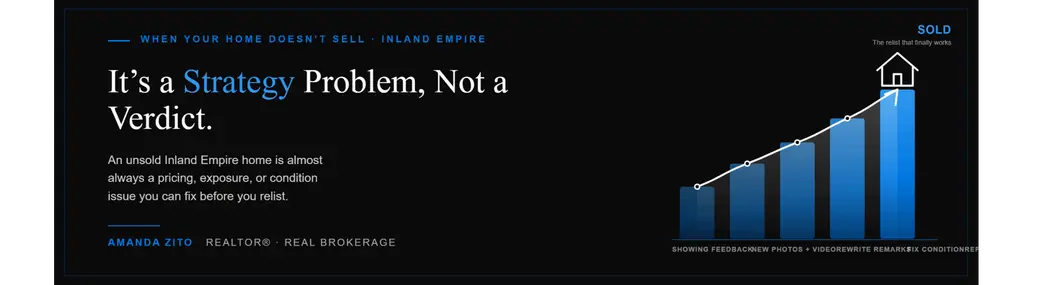
What happens if my home doesn't sell? If your listing expires without an offer, your contract with your agent ends and the home comes off the MLS. Nothing bad happens automatically — but in the Inland Empire, an unsold home is almost always a pricing, exposure, or condition problem you can fix before relisting.
It's a Strategy Problem, Not a Verdict
There's a particular kind of quiet that settles in around day 60 of a listing. The showings have slowed down. The weekend open house drew two neighbors and one person who "was just curious." Your agent hasn't called in a while. And you're starting to wonder whether something is wrong with your house.
Almost always, something is wrong with the strategy — not the house. Homes in Riverside County and San Bernardino County sell every single week, including homes in the same tract, on the same street, with the same floor plan as yours. The difference between the one that sold and the one that didn't usually comes down to a handful of decisions that were made before the sign ever went in the yard.
Here's exactly what happens when a listing doesn't sell, why it happens, and what your options are from here — so you can make the next round count.
What Actually Happens When a Listing Expires
First, some vocabulary, because these terms get used interchangeably and they mean different things:
- Expired — The listing agreement reached its end date without a sale. The listing drops off the MLS and your agreement with your agent ends.
- Withdrawn or cancelled — You and your agent agreed to pull the listing before the end date. The contract may still be in force depending on how it was cancelled.
- Back on market — You had an accepted offer that fell apart, and the home returned to active status.
If your listing expires, here's what to expect in practical terms. Your home no longer appears as active on the MLS or on the portals that pull from it. Your obligations under the listing agreement end, though most agreements include a protection period — a window during which your agent is still owed a commission if you sell to a buyer they introduced. Read that clause before you sign with anyone new.
You should also brace yourself for the phone. Expired listings are public information, and agents across the Inland Empire mine that list daily. You'll get calls, texts, postcards, and door knocks — sometimes within hours. That volume is not a signal about your home's value. It's just how prospecting works.
Why Homes Don't Sell — the Three Real Reasons
1. Price
This is the big one, and it's uncomfortable, so people look for other explanations first. But price is the variable buyers weigh against every other home they're touring that weekend in Eastvale, Corona, or Rancho Cucamonga.
The tell is in the showing data. Lots of showings and no offers means buyers are seeing something in person they don't like — condition, layout, location factors like a busy street or power lines. Very few showings at all means buyers filtered you out before they ever got in the car, and that's a price and photo problem.
There's also a math problem with sitting too long. Buyers watch days on market, and a home that's been listed for 90 days invites lowball offers because the assumption is that you're motivated. Pricing high "to leave room to negotiate" often produces exactly the opposite of what it's supposed to.
2. Exposure and Marketing
Your first week on the market is the most valuable inventory you will ever have, and you only get it once. If the photos were shot on a phone, if there was no video, if the remarks were four sentences of abbreviations, that week was wasted.
Buyers today start on a screen, and increasingly they start with an AI-generated summary or a portal's search filters. If your listing doesn't clearly name what it is — the neighborhood, the square footage, the upgrades, the lot, the parking — you're invisible to a chunk of the market before a human ever evaluates the home.
3. Condition and Terms
Buyers in this market have limited cash after down payment and closing costs. A home that needs a roof, HVAC, or flooring is competing against a similar home that doesn't, and buyers will discount your price by more than the repair actually costs.
Terms matter too. Flexibility on closing timeline, a rent-back, a repair credit, or a seller-paid rate buydown can be worth more to the right buyer than a price cut of the same dollar amount — and they don't reset your list price in the public record.
Your Options If It Didn't Sell
Relist with a new strategy. The most common path, and the right one for most sellers. This means fresh photography, a rewritten description, a repositioned price, and a real marketing plan — not the same listing with a new expiration date. Ask any agent you interview how the California Regional MLS handles days on market when a home is relisted, because that detail affects how your listing looks to buyers on day one.
Take it off the market and wait. If you don't have to move, waiting is a legitimate strategy. Use the time to knock out the repairs that scared buyers off, and watch mortgage rates — buyer demand across the Inland Empire moves quickly when financing gets cheaper. You can track the weekly average on Freddie Mac's Primary Mortgage Market Survey.
Rent it out. Riverside and San Bernardino counties have real rental demand, and holding the home as a rental can bridge you to a better selling window. Understand what you're signing up for first: California's Tenant Protection Act limits rent increases and just-cause terminations on many properties, and a tenant-occupied home is harder to sell later. Talk to a tax professional about how converting to a rental affects your capital gains exclusion.
Sell to an investor or cash buyer. Fast, certain, and no repairs — in exchange for a meaningfully lower net. This makes sense when speed and certainty are genuinely worth more to you than the last 10–15%, which happens with inherited properties, out-of-state ownership, or homes needing major work. Get at least one traditional market opinion before you accept an investor offer, so you know exactly what you're trading away.
Adjust price and terms and keep going. If you're mid-contract and not yet expired, you don't have to wait for the clock to run out. A meaningful correction — one that moves you into a new search bracket rather than shaving $5,000 off — plus a concession package can restart activity.
Stay put. Not selling is an outcome, not a failure. If the numbers don't work, they don't work.
What to Fix Before You Relist
- Get honest showing feedback in writing and look for the repeated comment
- Reshoot photos, and add video and a floor plan
- Rewrite the listing remarks so they actually name the neighborhood, upgrades, and lot features
- Address the one or two condition issues that came up most often
- Reprice against what has closed in the last 60–90 days, not what's currently listed
- Review market data yourself — Realtor.com's research center and NAR's research hub both publish free local and national trends
FAQ
How long is a typical listing agreement in California? Most run three to six months, though the term is negotiable and should be discussed before you sign. Shorter terms give you an earlier exit if the strategy isn't working; longer terms give an agent room to execute a full marketing plan.
Can I switch agents if my home didn't sell? Yes. Once the listing expires, you're free to hire anyone. Check the protection period in your old agreement first — if a buyer your previous agent introduced later purchases the home, that agent may still be owed a commission.
Does a home that didn't sell lose value? The home doesn't, but the listing's reputation does. Buyers and their agents notice long days on market and repeated price drops, and they negotiate accordingly. That's why relisting with a genuinely different approach matters more than simply relisting.
Will lowering the price fix it? Sometimes, but only if the cut is large enough to move you into a different buyer search range. A small reduction on an overpriced home just signals more reductions are coming and encourages buyers to wait.
Let's Figure Out What Actually Went Wrong
If your home didn't sell, the useful next step isn't another opinion on price — it's a look at the showing data, the photos, the remarks, and the competition together, so you know which of the three problems you're actually solving.
Schedule a private consultation and I'll walk through your previous listing with you and give you a straight answer on what to change before you go back on the market.
Amanda Zito REALTOR® | Real Brokerage Serving the Inland Empire — Riverside, Corona, Eastvale, Ontario, Rancho Cucamonga, Redlands, Murrieta, and Temecula
Categories
Recent Posts











“Your goals come first. My job is to help you make the right move.”