

Is Real Brokerage Worth Joining in 2026?
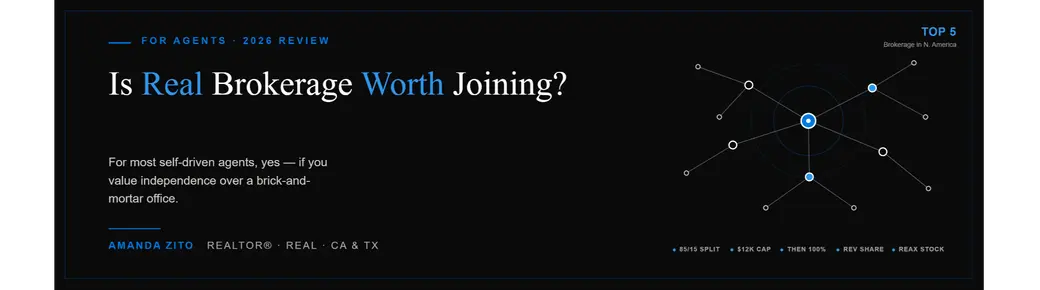
I get asked this constantly — by newer agents trying to keep more of their first commissions, and by experienced producers who are tired of watching a 30% cut walk out the door on every deal. Real Brokerage (Real Broker, LLC in Texas) has gone from a scrappy tech startup to one of the five largest brokerages in North America by agent count in about a decade, and that kind of growth makes people curious and skeptical at the same time. Both reactions are fair.
So instead of selling you on it, I'm going to walk you through the actual numbers, the parts people don't talk about, and the type of agent this model works for. I'm at Real myself across my California and Texas markets, so I'll be upfront about what I love and where I think it isn't the right fit.
How Real Brokerage's commission model works in 2026
The headline is simple: an 85/15 split with a $12,000 cap. You keep 85% of your gross commission income (GCI) and pay Real 15% until you've paid in $12,000 for your anniversary year. After that, you're at 100% for the rest of the year.
A few details that matter:
- Your anniversary year, not the calendar year. If you join in March, your cap resets every March. No January 1st rollback to a lower split like graduated plans use.
- You cap fast. At an 85/15 split, $12,000 in company dollar means you cap at roughly $80,000 in GCI. Many producing agents hit that in the first half of their year and spend the back half keeping everything.
- The cap is lower on a team. Solo agents and team leaders pay the full $12,000. Agents who join as part of a team cap at $6,000, and agents on a mega team cap at $4,000. If you're building or joining a team, that's a real advantage.
Compare that to the traditional franchise world, where 70/30 splits with caps in the $18,000–$30,000 range plus a royalty fee are still common. That's the math that pushes a lot of agents to look. Real publishes the same numbers in every state, so there are no "sweetheart deals" for one agent and not another — you can read Real's official fee breakdown here.
The fees people forget to ask about
A high split can hide a pile of fees, so here's the honest full picture at Real in 2026. There are no monthly desk or franchise fees, but there are transaction-level costs:
- $249 one-time startup fee when you join.
- $40 CBR fee on every transaction (covers broker review, E&O insurance, and processing).
- $285 post-cap transaction fee on deals after you've capped — which drops to $129 once you hit Elite Agent status.
- $750 annual brokerage fee, collected as $250 from each of your first three transactions of the year, so there's no surprise invoice.
That's it. For an agent doing steady volume, the total cost of doing business at Real usually lands well below a traditional 70/30 office. For a very low-producing or part-time agent, the low split still helps because you're only ever paying 15% and never a monthly desk fee.
Stock, revenue share, and Real Wallet — the "wealth-building" side
This is where Real gets different from just being a cheap split, and also where I'd tell you to slow down and think clearly.
Stock program. Agents can earn equity in Real (NASDAQ: REAX) through production and by attracting other agents, and can buy company stock at a discount. That means you can build an ownership stake in the brokerage you're already working for. Worth knowing: Real is still a growth company, not yet consistently profitable — it reported roughly $2 billion in revenue for 2025 and continued fast agent growth, but the stock has traded around $2 and margins remain thin. Treat any stock upside as a bonus, not the reason you join.
Revenue share (5 tiers). When agents you introduce to Real close deals, you earn a share — and importantly, that money comes out of Real's 15%, not out of the other agent's 85%. The five tiers pay up to $4,000 per year per Tier 1 agent, scaling down through Tier 5. Done right, it's a genuine passive-income layer. Done wrong, it can turn into a recruiting obsession that distracts from actually selling homes. I've seen both.
Real Wallet. Real's fintech platform now includes business checking, a branded debit card, tax-planning accounts, and credit lines based on your earnings history. Thousands of agents are using it, and it's one of the more practical perks for managing 1099 income.
Who Real Brokerage is actually a good fit for
Real is a strong fit if you:
- Are self-motivated and don't need a physical office or daily hand-holding.
- Want to keep more of your commission and cap quickly.
- Like the idea of building equity and long-term income beyond individual closings.
- Value tech and are comfortable running your business from a laptop and phone.
Real is probably not the best fit if you:
- Are brand new and need heavy in-person, over-the-shoulder training and floor-time leads. You can absolutely thrive at Real as a new agent, but you'll need mentorship — often through a team — rather than expecting the brokerage's walls to hand you business.
- Want a big-brand storefront and prefer a traditional office culture.
The model rewards agents who treat this like the business it is. If that's you, the economics are hard to argue with.
What's new at Real heading into 2026
Two developments are worth putting on your radar. First, Real surpassed 35,000 agents in mid-2026 and is now among the five largest brokerages in the U.S. and Canada by agent count and sales volume. Second, Real announced a definitive agreement to acquire RE/MAX Holdings, with the deal expected to close in the second half of 2026 and a new holding company (Real REMAX Group) planned. That's a significant shift for the industry, and if it closes, it changes the scale and brand conversation entirely. It's worth watching before you decide.
Frequently asked questions
What is the Real Brokerage commission split and cap in 2026? Real offers an 85/15 split with a $12,000 annual cap for solo agents and team leaders, $6,000 for team members, and $4,000 for mega-team members. After you cap, you keep 100% of your commissions for the rest of your anniversary year, minus a per-transaction fee.
Does Real Brokerage have monthly fees? No. There are no monthly desk or franchise fees. Costs are transaction-based: a one-time $249 startup fee, a $40 CBR fee per deal, a $750 annual fee spread across your first three transactions, and a post-cap transaction fee ($285, reduced to $129 at Elite status).
Is Real Brokerage good for new agents? It can be, but new agents should plan for mentorship rather than office-based training. Joining an established team at Real gives you a lower cap and structured support, which is usually the smartest path for a first-year agent.
Thinking about making a move?
If you're weighing whether Real Brokerage is the right home for your business, the answer really comes down to your production, your goals, and how you like to work. I'd rather show you the honest math for your numbers than pitch you.
Let's set up a private, no-pressure conversation — I'll walk you through what the split, cap, stock, and revenue share would actually look like for your business in California or Texas, and where I think you'd do better staying put. No hard sell, just straight answers.
— Amanda Zito, REALTOR® | Real Brokerage (CA) & Real Broker, LLC (TX) | Serving the Inland Empire, High Desert, and Central Texas markets
Categories
Recent Posts











“Your goals come first. My job is to help you make the right move.”