

Buyers Have Already Seen Your Competition
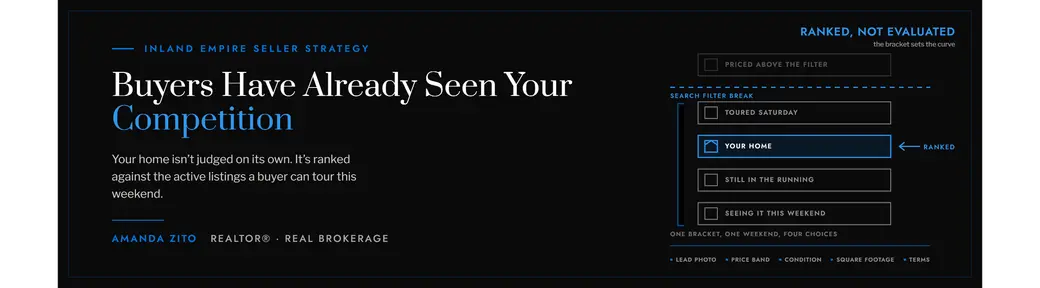
Do buyers compare your home to other listings before they see it? Yes. Most Inland Empire buyers have already scrolled dozens of listings and toured several homes before yours. Your home isn't judged on its own — it's ranked against the active competition in your price range.
The buyer walking through your living room is not starting fresh
By the time someone stands in your kitchen in Corona, Redlands, or Rancho Cucamonga, they have already sorted your home into a mental ranking. They saw four homes last Saturday. Two of them are still in the running. Yours is being measured against those two — right now, in real time, while they're opening your pantry door.
That's a different game than most sellers think they're playing. Sellers price against what they paid, what they owe, what the neighbor got in 2022, and what they need to buy the next house. Buyers price against what else they can go see this weekend.
Both are reasonable. Only one of them decides what your home sells for.
Your price isn't a number to a buyer. It's a rank.
Buyers shop in brackets. They set a search filter — say, $600,000 to $650,000, three bedrooms, two baths, Riverside County — and the portal hands them a list. Every home on that list is your competition, whether you think it's comparable or not.
Two things follow from that:
You get compared to homes you'd never choose to be compared to. A tired three-bedroom with a converted garage and no yard is in your bracket if it's priced there. So is a newer build with paid-off solar. Buyers don't grade on your effort or your upgrades in isolation. They grade on the curve the current inventory sets.
Price above a filter break and you don't get compared at all. List at $655,000 when the search filters cluster at $650,000 and a portion of your buyer pool never sees the home. You're not losing the comparison. You're not in it.
The first showing is the scroll
Before anyone books a tour, your photos have already competed against every other listing thumbnail in the feed. That comparison takes about two seconds and it's brutal in a way in-person showings never are.
If your first photo is a dim front elevation with a car in the driveway and the listing next to yours leads with a bright, wide, well-composed shot, you lost that round before the buyer knew your address. The homes getting showings in the Inland Empire right now are almost always the homes that won the thumbnail.
Same logic applies to the details buyers filter and skim for locally: square footage, single-story versus two-story, garage spaces, RV parking, pool, ADU or casita potential, solar and whether it's owned or leased. Buyers use those fields to build the short list before a human ever gets involved.
Condition gets graded against what's for sale, not what's normal
Sellers often ask whether a repair is "worth it." The honest answer is that it depends entirely on what else the buyer is touring.
If the three closest competitors have fresh interior paint and new flooring, your original carpet doesn't read as "lived in." It reads as a project — and buyers price projects at retail contractor cost plus a penalty for the hassle. If those same three competitors are dated and yours is clean and neutral, you can hold price with far less work.
This is why walking your own competition matters more than any list of general advice. You can't know what you're up against from a spreadsheet.
Go tour your competition. Actually go.
Before you finalize a list price, go see the four or five active listings a buyer in your bracket would tour. Not sold comps — sold comps tell you what the market did. Active listings tell you what the buyer is choosing between this weekend.
Walk them and answer three questions honestly:
- If I were the buyer with this budget, which house do I pick?
- What specifically makes me pick it?
- What would my home need — in price, condition, or terms — to win that head-to-head?
Most sellers come back from that tour with a completely different view of their price. Some find out they're underpriced.
Buyer feedback is comparative, and it's the most useful data you'll get
"They liked the one on the next street better" isn't rejection. It's a scoreboard.
When the feedback keeps naming the same competitor, you have a targeted problem with a targeted fix — usually price, layout, condition, or one specific feature. When feedback is scattered and vague, the issue is more often exposure or price bracket.
Either way, the market is telling you where you rank. The sellers who listen in week two sell. The sellers who wait for a buyer who "gets it" tend to end up as the reference point that helps a neighbor's home look like a better deal.
That's the quiet cost of sitting on the market too long in San Bernardino County or Riverside County: you stop being a contender and start being the comparison.
Frequently asked questions
How many homes does a typical buyer see before making an offer? It varies widely, but most buyers view a number of homes in person and many more online before writing an offer. The practical takeaway is that your home is almost never the first one they've seen, so it's evaluated relative to the others in its price range.
Should I price high to leave negotiating room? Leaving room sounds safe but usually moves you into a higher bracket where your home compares poorly against larger, newer, or more updated listings. It's generally stronger to price inside the bracket where your home ranks well and let the comparison work in your favor.
How do I know which listings are actually my competition? Your competition is the set of active listings a buyer would see using the same search filters that surface your home — similar price band, bed and bath count, and general area. An agent can pull that exact list from the MLS and tour it with you before you set a price.
Thinking about selling in the Inland Empire?
If you want to know exactly which homes your house will be compared to — and what it would take to win that comparison — call or text me and we'll go look at them together before you decide on a price.
Amanda Zito, REALTOR® Real Brokerage CA DRE #01740063 | TX TREC #840088 SoldByZito.com
Market data references: National Association of REALTORS® Research and Statistics, Redfin Data Center, Realtor.com Research
Categories
Recent Posts











“Your goals come first. My job is to help you make the right move.”