

Can You Sell a House With a Mortgage in Hudson Bend, TX? What Actually Happens to Your Loan at Closing
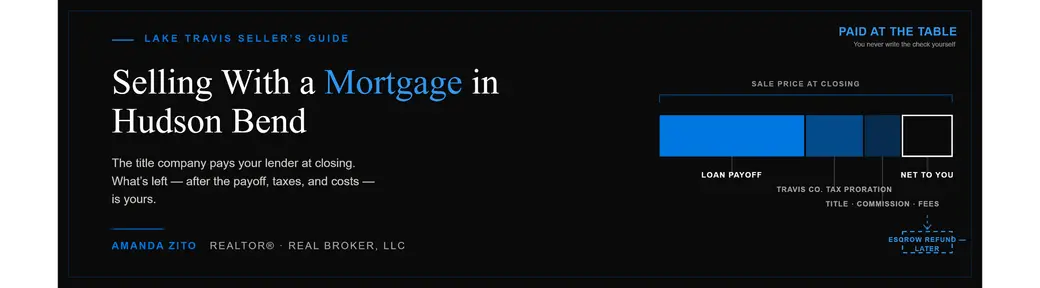
Can you sell a house in Hudson Bend, Texas if you still owe on your mortgage? Yes. Your loan is paid off from the sale proceeds at closing by the title company, and whatever remains after the payoff, taxes, and closing costs goes to you. You never write a check to your lender yourself.
The question behind the question
Almost nobody actually wonders whether selling with a mortgage is allowed. What people are really asking is some version of: how much of this is mine when it's over?
That's a fair thing to be unsure about. Your mortgage statement shows one number. Your payoff will be a different, slightly larger number. Your escrow account is a third number that doesn't show up on the closing statement at all. And in Travis County, property taxes are large enough that the proration line alone can move your proceeds by five figures depending on when you close.
So let's skip the yes and go straight to the mechanics — specifically the parts that surprise Hudson Bend sellers.
How the payoff actually works
You don't pay off your loan. The title company does, out of the sale proceeds, on the day of closing.
Here's the sequence:
- Once you're under contract, the title company orders a payoff statement from your lender.
- That statement shows your principal balance, accrued interest, any recording or reconveyance fees, and a good-through date — usually 10 to 30 days out.
- At closing, the buyer's funds come in. The title company wires the payoff to your lender first.
- Your lender releases the lien, and the release gets recorded in the Travis County real property records.
- What's left after the payoff and your other closing costs is wired to you.
The whole thing happens without you touching it. Your job is to keep making your regular mortgage payment until the loan is actually paid off, because a payment missed while you're "about to close" still hits your credit.
Your payoff is not your statement balance
This is the number-one source of "wait, why is that higher?" at the closing table.
Your monthly statement shows the balance as of the statement date. Your payoff includes:
- Per diem interest — daily interest from your last payment through the actual funding date
- Recording and release fees for clearing the lien
- Occasionally a wire or payoff processing fee
On a typical Hudson Bend price point, the difference between statement balance and payoff is usually a few hundred to a couple thousand dollars. It's not a mistake. It's just interest doing what interest does.
One more timing note: if closing slips past the good-through date, the title company orders an updated payoff. That's routine, but it's a good reason not to let a closing drift.
Your escrow account is separate money
If your lender collects taxes and insurance monthly, you have an escrow account with a balance in it. That balance is not applied to your payoff and it does not appear on your closing statement.
After the loan is paid off, your servicer closes the escrow account and refunds the balance directly to you. Federal rule gives them 20 business days from full payoff to return it (12 CFR 1024.34), so most sellers see it within about a month of closing. In Travis County, where annual property taxes on a lake-area home are substantial, that refund can be meaningful. Plenty of sellers forget it's coming and are pleasantly surprised later.
Make sure your servicer has a forwarding address before you move.
The Travis County property tax proration (this one matters)
Texas property taxes are billed in arrears. Taxing units start mailing bills in October, and payment isn't due until January 31 of the following year. That means when you sell mid-year, you haven't yet paid for the months you've already owned the home.
So at closing, you credit the buyer for your share of the year's taxes — January 1 through your closing date. The buyer takes it from there and pays the full bill in January.
Two things follow from that:
- The later in the year you close, the larger your tax proration. A December closing carries roughly eleven months of Travis County taxes as a debit against your proceeds.
- Your escrow balance and your tax proration are unrelated. You still owe the proration even though you've been paying into escrow all year — that's exactly why the escrow refund comes back to you afterward.
If you carry a homestead exemption, or an over-65 or disability tax ceiling, that affects the assessed value the proration is calculated from. You can look up your property's current assessment and exemptions through the Travis Central Appraisal District.
What's different about Hudson Bend specifically
Hudson Bend sits in unincorporated Travis County, off Hudson Bend Road between Lake Travis and RM 620, with Austin 78734 mailing addresses. A few local characteristics affect the timeline more than they would in a subdivision inside city limits — and because per diem interest accrues daily, timeline is money.
Septic systems and private wells. Many homes in and around Hudson Bend are on OSSF septic rather than city sewer, and some are on a private well or served by a water district. Buyers and lenders often want inspections, pumping records, or a permit transfer through Travis County. None of that changes your payoff, but a two-week delay does.
Investor and second-home financing. Hudson Bend has a high share of second homes and rental properties. If yours was financed with a DSCR, portfolio, or other non-conforming investor loan rather than a standard conventional mortgage, read your note for a prepayment penalty before you assume you don't have one.
Waterfront and slope factors. Lakefront and steep-lot properties can trigger additional survey work or a T-47 affidavit on an existing survey. Build the time into your closing date rather than discovering it during option period.
When you have more than one lien
The payoff clears the liens on title — all of them, not just the first mortgage. Anything recorded against the property has to be released before the buyer can take clear title.
Common ones around the Lake Travis area:
- A HELOC or second mortgage, which must be paid off and formally closed — an open line with a zero balance still leaves a lien
- A Texas home equity loan under Section 50(a)(6) of the state constitution, which has its own payoff and release requirements
- Contractor's liens from a remodel, dock, or retaining wall
- Solar panel loans or leases, which frequently carry a UCC filing against the property and need to be paid off or formally assumed by the buyer
- HOA or POA assessments, plus transfer and resale certificate fees
Bring these up early. A solar lien or an unreleased second discovered during the title commitment review is the kind of thing that pushes a closing date, and pushed closing dates cost you per diem interest.
What if you owe more than the home is worth?
You still have options, but they change the transaction.
If your payoff plus closing costs exceeds your sale price, you either bring the difference to closing in cash, or you negotiate a short sale — where your lender agrees to accept less than the full balance. Short sales require lender approval, take considerably longer, and affect your credit.
Realistically, most Hudson Bend owners who bought more than a couple of years ago are not in this position. If you're unsure, the honest first step is a payoff quote from your servicer and a real net sheet — not a Zestimate.
The one case where a mortgage is an asset, not an obstacle
If you have a VA or FHA loan at a low fixed rate, that loan may be assumable. A qualified buyer can take over your existing loan and rate rather than getting a new one at today's rates. In a market where financing costs shape what buyers can afford, an assumable loan is a genuine marketing advantage.
Two caveats worth knowing:
- Servicer assumption processing is slow. Plan for a longer contract-to-close timeline.
- VA entitlement. If a non-veteran buyer assumes your VA loan, your entitlement stays tied up in that property, which can limit your ability to use a VA loan on your next home. Restoration generally requires a substitution of entitlement by a veteran buyer.
Texas has promulgated contract addenda covering release of seller liability and restoration of VA entitlement, so this gets handled inside the contract — but only if someone raises it. Note that a normal sale paying the loan off in full restores your entitlement automatically. It's assumptions where veterans get stuck.
If you're a veteran selling in the Lake Travis area, this is worth a conversation before you list. It changes both how the home is marketed and how your next purchase is financed. Start with the VA home loan program page, then confirm specifics with your servicer.
One thing not to do
If an investor offers to "take over your payments" and leave the loan in your name, understand exactly what's being proposed. Nearly every mortgage contains a due-on-sale clause allowing the lender to call the full balance when the property transfers. In a subject-to arrangement, the loan stays in your name, your credit carries the risk, and you have no control over whether payments actually get made. Have a real estate attorney review anything structured that way before you sign it.
What this means for you
Selling with a mortgage is normal. The variables worth controlling are:
- Order your payoff early so there are no surprises about the actual number
- Know your closing month, because Travis County tax proration scales with it
- Identify every lien — solar, HELOC, home equity loan, contractor — before the title commitment does it for you
- Keep paying your mortgage until it's actually paid off
- Update your address with your servicer so the escrow refund finds you
FAQ
Do I need my lender's permission to sell my house in Texas? No. You don't need approval to sell — your mortgage simply gets paid off from the proceeds at closing. Lender approval only comes into play for a short sale, where the lender is being asked to accept less than the full balance.
Will I have to pay a prepayment penalty? Almost certainly not. Prepayment penalties are prohibited on VA and FHA loans and are rare on conventional owner-occupied loans. They occasionally appear on investor, non-QM, or hard money loans. Check the terms on your note, or ask your servicer when you request the payoff.
How much will I actually walk away with? Start with your sale price, subtract your loan payoff, commissions, title and escrow fees, the Travis County tax proration through closing, and any negotiated repairs or seller concessions. Your escrow refund arrives separately afterward. A seller net sheet run at a few different price points is the most reliable way to see the range before you list.
Does Texas charge a transfer tax when I sell? No. Texas has no state real estate transfer tax, which keeps closing costs lower here than in states like California. Your largest seller-side line items are commission, the owner's title policy, and the Travis County tax proration.
How long does the lien release take? The payoff is wired the day of closing, and the release is typically recorded with Travis County within 30 to 60 days. You'll usually get confirmation from your servicer once it's done.
Thinking about selling in Hudson Bend?
Before you list, it's worth seeing the real numbers — payoff, tax proration, and net proceeds — for your specific property and a realistic closing date. That takes one conversation, and it's the difference between guessing at your equity and knowing it.
Call or text me at 949-484-9486 and we'll run your numbers.
Amanda Zito, REALTOR® Real Broker, LLC TX TREC #840088 | CA DRE #01740063 soldbyzito.com
This article is general information, not legal, tax, or financial advice. Confirm your specific loan terms with your servicer.
Categories
Recent Posts











“Your goals come first. My job is to help you make the right move.”