

Deferred Maintenance and Your Inland Empire Home Sale
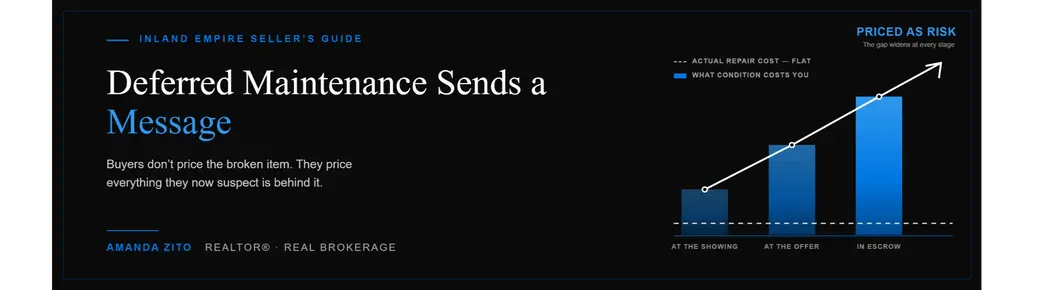
Does deferred maintenance actually affect what your home sells for in the Inland Empire? Yes — and usually by more than the repairs would have cost. Buyers in Riverside and San Bernardino County don't price the broken item. They price everything they now suspect is behind it.
A seller in Fontana once walked me through her house and pointed out the list herself: garage door that sticks, a water stain on the ceiling from a leak fixed years ago, dry rot on one fascia board, a slider that takes two hands. Maybe $800 of work, she figured. She was probably right about the number.
But that's not the number buyers were doing math on.
A buyer walking that same hallway isn't adding up repairs. They're building a theory about the house — and about the person who owned it. Every unfinished item is a data point, and buyers extrapolate from the ones they can see to the ones they can't.
Buyers don't price repairs. They price risk.
Here's the part most sellers miss: a buyer has almost no information about your home. They get 30 minutes, a phone flashlight, and a set of photos. So they use the visible condition of the house as a sample — a shortcut for judging the things they can't inspect on a Saturday afternoon.
Peeling paint on the south-facing trim isn't a $400 problem to them. It's evidence about the roof. A furnace with a 2007 date sticker isn't a line item. It's a question about the electrical panel, the ducting, and the water heater.
The message the buyer receives is simple: if the easy things weren't handled, the expensive things probably weren't either.
That's the leap that costs you money. And it happens whether or not it's fair.
The visible list is never the whole list — to a buyer
Sellers know their home's history. You know the ceiling stain is from a supply line that got replaced in 2019. You know the slider sticks because of the track, not the frame.
A buyer knows none of that. They know what they saw.
So they do what any reasonable person does with incomplete information: they assume the worst-case version and protect themselves with price. Not out of hostility — out of self-defense. A buyer who guesses low on condition and is wrong loses money. A buyer who guesses high and is wrong loses the house. The incentive only runs one direction.
What Inland Empire buyers notice first
Condition reads differently depending on the market, because the climate does different things to houses. In Riverside County and San Bernardino County, buyers are trained by the environment to look at a specific short list:
- Roof and fascia. Sun exposure here is brutal on wood trim and composition shingles. Visible dry rot or curling shingles raises the biggest single question in the buyer's mind.
- HVAC age. In a market where summer runs triple digits for weeks, an aging system isn't a comfort issue — it's a "when do I write a $12,000 check" issue.
- Exterior paint and stucco cracks. Chalking paint or unpatched hairline cracks reads as years without attention.
- Landscape and irrigation. Dead front yard, broken sprinkler heads, or an unfinished side yard tells buyers the house was in maintenance-deferred mode.
- Water heater and its strapping. California seismic strapping is a fast, visible tell about whether basics were kept current.
- Pool equipment. In Rancho Cucamonga, Eastvale, and Corona, pools are common enough that buyers know what a tired pump looks like.
- Garage door and openers. Cheap to fix, and one of the first things a buyer physically touches.
None of these individually decides a sale. Together, they set the frame the buyer uses to evaluate everything else — including your price.
Deferred maintenance costs you three separate times
This is why the repair estimate and the real cost never match.
At the showing. Some buyers simply don't write. You'll never know they were interested, because condition moved you out of the running before an offer was ever drafted. This is the invisible cost, and it's the largest one.
At the offer. Buyers who do write build a condition discount into their number — and that discount is almost always larger than the actual repair bids, because they're pricing uncertainty, not scope. They also tend to bring softer terms: longer contingency periods, more inspections, more caution baked in.
In escrow. After the inspection report lands, you renegotiate — from a much weaker position. Now the buyer has a written list from a third party, your home has been off the market for two weeks, and everyone knows a relisted home invites questions. Items you could have handled quietly before listing get resolved as credits, at buyer-friendly pricing.
The same repair costs the least in the first stage and the most in the last.
What's worth fixing before you list — and what isn't
You don't need a renovation. You need to remove the reasons a buyer would guess low.
Usually worth doing:
- Anything visible, cheap, and quick — sticking doors, torn screens, dead bulbs, running toilets, broken sprinkler heads
- Anything that reads as a safety or system concern — exposed wiring, unstrapped water heater, GFCI outlets, smoke and CO detectors
- Touch-up paint and fascia repair on sun-damaged trim
- A deep clean and clear landscape edges
Usually not worth doing before listing:
- Full kitchen or bath remodels
- Replacing a functioning HVAC or roof purely to improve the listing
- Flooring throughout when the existing floor is clean and intact
- Anything you'd be guessing at, taste-wise
The goal isn't a perfect house. It's a house that doesn't invite the buyer to imagine problems.
If you're not fixing it, control the story instead
Some sellers can't or shouldn't do the work — estate sales, tenant-occupied homes, tight timelines, limited cash. That's a legitimate position, and it can still sell well. What kills those sales is silence.
Three moves make an as-is home competitive in the Inland Empire:
- Get a pre-listing inspection. You find out what buyers will find out, on your schedule instead of theirs.
- Bring contractor bids to the table. A written $4,800 roof quote replaces the buyer's imagined $20,000 number. Specificity beats speculation every time.
- Price and disclose it plainly. California's Transfer Disclosure Statement requires disclosure of known material facts anyway. Volunteering it up front converts a negotiating weapon into a stated term of sale.
A buyer who knows what they're buying will pay for it. A buyer who's guessing will discount for it.
For broader context on how condition and improvements track with value, the National Association of REALTORS® publishes remodeling and resale research, and Redfin and Realtor.com both track current Inland Empire market conditions.
Frequently asked questions
Should I fix everything before selling my Inland Empire home? No. Focus on visible, low-cost items and anything that reads as a safety or system issue. Large remodels rarely return their cost, and buyers don't reward finishes the way they punish neglect.
Will buyers just ask for credits anyway if I make repairs? Some will ask. But a home with no obvious deferred items gives them far less to build a request around, and gives you a much stronger position to hold your price when they do.
Is it better to sell as-is or make repairs first? It depends on your cash, timeline, and how much of the work is cosmetic versus structural. As-is works well when it's paired with a pre-listing inspection, real contractor bids, and a price that reflects the condition honestly.
Thinking about selling in the Inland Empire?
Before you spend a dollar on repairs, it's worth knowing which items will actually move your number and which ones won't. I'll walk your home with you and give you a straight answer — including the things I'd tell you to skip.
Call or text me at 949-484-9486 to talk through your home and your timeline.
Amanda Zito, REALTOR® Real Brokerage CA DRE #01740063 | TX TREC #840088 soldbyzito.com
Categories
Recent Posts











“Your goals come first. My job is to help you make the right move.”