

How Much Equity Do You Need to Sell Your Home in Austin? Expert Advice for Homeowners
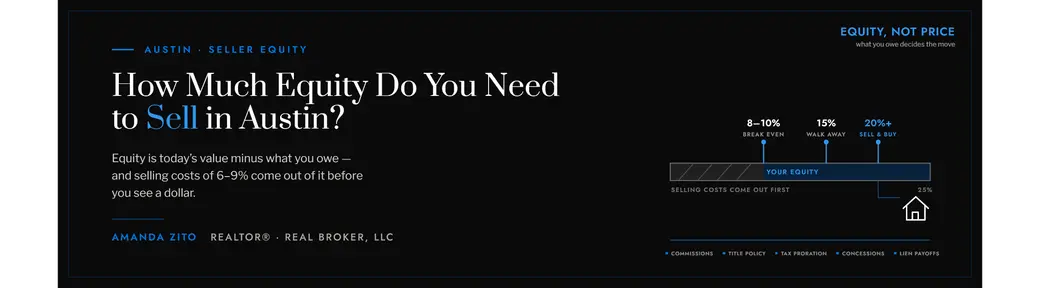
How much equity do you need to sell your home in Austin? In most cases, you need about 8–10% equity to sell without bringing cash to closing, and closer to 15–20% if you want to walk away with a meaningful check or buy your next home right away.
The number that matters isn't what you paid
Most Austin homeowners answer the equity question with the wrong math. They subtract what they paid from what they think the home is worth today, and stop there.
Equity is your home's current market value minus what you still owe — your first mortgage, plus any second lien, HELOC balance, or solar loan attached to the property. Your purchase price has nothing to do with it. Neither does your tax appraisal from Travis County.
And here's the part that catches people: having equity and having enough equity are two different questions. Selling costs money. If your equity doesn't cover those costs, you'll be writing a check at the title company instead of receiving one.
Why this question is sharper in Austin than most of the country
Austin is one of a handful of U.S. markets where the equity question is a real question rather than a formality.
As of August 2026, the Austin-area median sold price sits around $416,000 — roughly 24% below the market's May 2022 peak, with homes averaging about 68 days on market and more than half of active listings having taken a price reduction. Metro-wide, the picture is steadier than that peak-to-now figure suggests: Unlock MLS data put the July 2026 Austin metro median at $435,000, up about 1% year over year, with the City of Austin median at $577,000.
The homeowners feeling the squeeze are the ones who bought at or near the top. ICE Mortgage Technology data for the second quarter of 2026 ranked Austin fourth in the nation for negative equity at 6.6%, and found that roughly 85% of underwater mortgages nationally were originated in 2022 or later. The national trend points the same direction: ATTOM reported that the share of equity-rich homes fell to 41.1% in Q2 2026, its lowest point in nearly five years.
If you bought in northwest Austin, Lakeway, or the Lake Travis area in 2018 or earlier, you almost certainly have plenty of room. If you bought in 2021 or 2022 with a low down payment, you need to run the numbers before you do anything else.
What it actually costs to sell in Austin
Here's where the equity requirement comes from. Plan for total selling costs in the range of 6% to 9% of your sale price in Central Texas. That typically includes:
- Real estate commissions — the largest line item, and fully negotiable. Since the 2024 industry changes, what you pay the listing side and what (if anything) you offer a buyer's agent are separate decisions.
- Title policy and closing fees — in most Texas transactions the seller customarily pays for the owner's title policy, though it's negotiable.
- Prorated property taxes — Texas taxes are paid in arrears, so at closing you owe your share of the year up to the sale date. With Travis County tax rates, this line is bigger than sellers from other states expect.
- Buyer concessions and repairs — with roughly 5 to 6 months of inventory area-wide, concessions are common. The current Austin-area sold-to-list price ratio is about 97%, meaning most homes are closing below asking.
- Payoff details — any HELOC, solar lien, or prepayment item has to clear at closing.
Texas has no state transfer tax, which helps. But on a $500,000 sale, 7% is $35,000 — money that comes out of your equity before you see a dollar.
The three equity thresholds
Think of it in tiers rather than one magic number.
Tier 1: Break even (roughly 8–10%)
This is the floor. Enough equity to cover closing costs and walk away owing nothing. You don't leave with cash, but you leave clean. If you're relocating for work or need out of a payment, this is the bar to clear.
Tier 2: Walk away with real money (roughly 15%)
Now the sale produces a check. Enough for moving costs, a rental deposit, or a cash cushion while you figure out your next step.
Tier 3: Sell and buy again (roughly 20%+)
If you're moving up, downsizing, or buying elsewhere in the Austin area, your equity has to cover the cost of selling and your next down payment plus reserves. This is where most sellers overestimate their position — they forget that Tier 1 costs come out first.
A quick example: a home worth $500,000 with a $420,000 loan balance has $80,000 in equity, or 16%. After roughly $35,000 in selling costs, that's about $45,000 in the seller's pocket — solid for a 10% down payment on a similar home, thin for 20%.
What if the numbers don't work?
Not enough equity isn't the end of the conversation, and it doesn't automatically mean staying put. Your options depend on why you're moving and how fast.
- Wait and pay down. Every payment builds equity, and time in a stabilizing market helps. If your move is optional, this is often the honest answer.
- Rent it out. Central Texas rents can cover a note on a low-rate loan. This turns a forced sale into a hold, though you take on landlord responsibilities and the tax picture changes.
- Price to sell, not to test. In a market where over half of active listings have cut price, a listing that sits accrues carrying costs that eat the equity you were trying to protect.
- Bring cash to closing. Sometimes the cleanest answer, especially if the move is time-sensitive.
- Talk to your lender early. If you're underwater and facing a hardship, your servicer has options worth understanding before you list.
How to find your actual number
Metro medians won't tell you where you stand. Values in Lakeway, Bee Cave, Hudson Bend, and Steiner Ranch have behaved differently from downtown Austin condos or Pflugerville tract homes. Your ZIP, your street, your condition, and your floor plan drive your number.
Three steps:
- Pull your current payoff amount from your servicer — not your last statement balance, an actual payoff quote including per-diem interest.
- Get a real valuation based on recent closed sales within a tight radius of your home. Not a Zestimate, and not your tax appraisal.
- Run a net sheet — a line-by-line estimate of what you'd actually clear at closing.
That third step is the one that changes decisions. Most sellers who think they can't move discover they can, and some who assume they're fine find out the timing needs work.
Frequently asked questions
Can I sell my Austin home if I owe more than it's worth? Yes, but you'll need to cover the shortfall plus closing costs in cash, or work with your lender on a short sale. Since roughly 85% of underwater mortgages nationally were taken out in 2022 or later, this affects recent buyers far more than long-term owners.
Does my Travis County tax appraisal tell me what my home is worth? No. Appraisal district values are set for tax purposes on a mass-appraisal basis and often differ significantly from market value in either direction. Only recent comparable sales tell you what a buyer will actually pay.
How much equity do I need to buy my next home before selling? More than a standard sale requires, because you're carrying two payments during the overlap. Bridge financing, a HELOC on your current home, or a sale contingency can bridge the gap, but each has real tradeoffs worth mapping out before you make an offer.
Know your number before you make a decision
If you're weighing a move anywhere in the Austin area, start with the math. I'll put together a current valuation and a full seller net sheet for your property so you can see exactly what a sale would look like — no pressure, no obligation.
Call or text me at 949-484-9486 to talk it through.
Amanda Zito, REALTOR® Real Broker, LLC CA DRE #01740063 | TX TREC #840088 SoldByZito.com
Categories
Recent Posts











“Your goals come first. My job is to help you make the right move.”