

How the Annual Cap Works at Real: A Plain-English Guide for Agents
The version nobody explains clearly
If you've looked into Real Broker, LLC, you've probably heard three numbers thrown around: 85/15, $12,000, and "then you keep everything." What you may not have gotten is a straight explanation of how those numbers actually connect — and what the fine print does to your take-home pay after you cap.
That's the part that matters when you're comparing brokerages. A cap isn't a gimmick; it's a ceiling on what you'll ever owe the brokerage in a given year. Understand exactly where that ceiling sits and what sits above it, and you can forecast your income with real confidence.
Here's the whole thing, start to finish, the way I'd explain it to an agent sitting across from me in California or Texas who's deciding whether Real is the right move.
Start here: the 85/15 split
Every agent at Real is on the same 85/15 commission split. On each closing, you keep 85% of your commission and the brokerage keeps 15%.
An example makes it concrete. On a $10,000 commission check, you take home $8,500 and Real receives $1,500. That $1,500 isn't gone into a black hole — it counts toward your cap. Every dollar the brokerage collects from your split is a dollar closer to you keeping everything.
There are no tiers to climb, no "prove yourself" split that improves over time, and no negotiated side deals for top producers. Every agent in every state pays the same split and the same cap.
What "capping" actually means
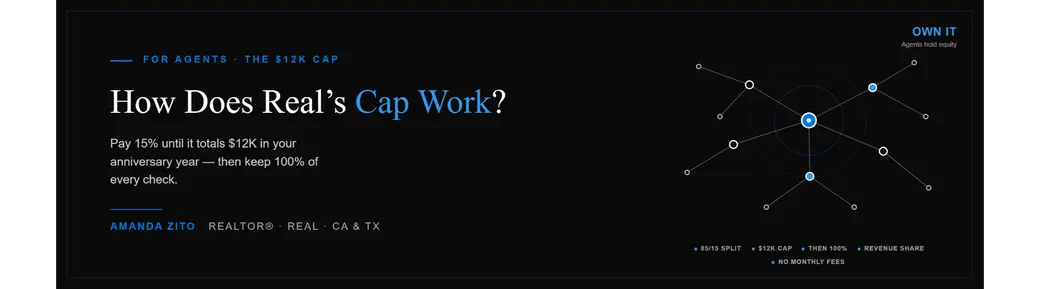
Your cap is the maximum you'll ever pay Real in commission splits in a single year: $12,000.
Because the brokerage takes 15% per deal, you reach the cap once your paid splits add up to $12,000. In practical terms, that happens at roughly $80,000 in gross commission income (GCI) — 15% of $80,000 is $12,000. The moment your cumulative splits cross that line, the 15% stops and you move to a 100% split for the remainder of your year.
For a producing agent in a mid-priced market, capping often happens in the first half of the year. That means you can spend the back half keeping every dollar of your split.
The detail that trips people up: it's an anniversary year, not a calendar year
This is the single most misunderstood piece, so read it twice: your cap year runs on your anniversary date, not January to December.
If you join Real in April, your cap resets every April. Your production toward the cap starts fresh on that anniversary, no matter what the calendar says. So when someone asks "does the cap reset on January 1st?" — no. It resets twelve months from the day you activated your license with Real.
What happens after you cap (the honest version)
You'll hear "keep 100% after you cap," and that's true for your split — Real stops taking its 15%. But there's a post-cap transaction fee you should know about so nothing surprises you later.
Once you've capped, each sale carries a post-cap transaction fee of $285 (or 15% of the commission, whichever is less), and lease transactions carry a $125 fee. Notice the "whichever is less" — on smaller commissions, you'll never pay more than you would have under the split. On a big commission, $285 is a fraction of what 15% would have cost you.
Agents who reach Elite status pay a reduced post-cap fee, and the specifics there are worth confirming directly since Real periodically updates Elite terms. The headline stays true: after you cap, the vast majority of every check is yours.
The fees that live alongside the cap
The cap covers your split — it doesn't cover every fee. Here are the others, laid out plainly so you can budget:
- One-time sign-up fee: $249. Paid once when you activate your license. Never again.
- Annual brokerage fee: $750. Collected as $250 out of each of your first three transactions in your anniversary year — not billed as a lump sum, and not a monthly charge.
- BEOP processing fee: $30 per transaction. This applies on every deal, before and after cap, and covers broker review, errors-and-omissions insurance, and processing.
What you won't find: monthly desk fees, franchise royalties, or hidden charges that quietly eat your margin. That absence is a big part of why the model pencils out favorably.
Solo agents vs. team members
The cap depends on how you're set up:
- Solo agents and team leaders cap at $12,000 (roughly $80,000 in GCI).
- Capped team members cap at $6,000 (roughly $40,000 in GCI), then move to 100%.
If you lead a team, that lower team-member cap is a genuine recruiting advantage — a team member keeps an extra $6,000 a year compared to capping at a solo rate, and that's a number you can put in front of talent you're trying to bring on.
Why a low, flat cap changes your math
Plenty of franchise brokerages run a 70/30 split, which means giving up 30% of every check until you hit a cap that can sit anywhere from $18,000 to $30,000 — and some structures pull even more once royalties are layered on. The rough first few months after a reset, when you're handing over a third of every commission, are exactly what a lower split is designed to soften.
At an 85/15 split, you feel less of a hit on each deal and you spread your cap over more of the year. And if you're a newer, part-time, or referral-based agent who doesn't reach the cap, you're never on the hook for the unpaid balance — you simply keep more of every commission because your split was favorable to begin with. The cap resets, and you start fresh.
What capping unlocks
Reaching your cap isn't just the end of paying splits — it's a trigger for additional ways to earn at Real, including stock awards tied to capping, the option to take a share of your commissions in discounted stock, and revenue share from agents you bring into the company. Those are separate topics worth their own conversation, but they're the reason a lot of agents view the cap as a starting line rather than a finish line.
Frequently asked questions
Does the cap reset every January? No. Your cap runs on your anniversary year and resets twelve months from the date you activated your license with Real — not on the calendar year.
How much do I need to sell to cap at Real? Because Real takes 15% per deal, you hit the $12,000 cap at approximately $80,000 in gross commission income. Capped team members reach their $6,000 cap at roughly $40,000 in GCI.
Do I really keep 100% after I cap? On your split, yes — Real stops taking its 15%. You'll still pay a post-cap transaction fee of $285 per sale (or 15%, whichever is less) and the $30 per-transaction processing fee, so the vast majority of each check is yours, but it's not literally 100% to the penny.
Let's run your numbers
The cap only means something when you apply it to your actual production. If you tell me your typical deal count and average commission, I can show you exactly when you'd cap, what you'd pay Real for the year, and what your take-home would look like compared to where you are now.
I'm Amanda Zito, a licensed agent with Real serving California and Texas, and I help agents make this move the right way — including sponsoring agents onto the platform. If you're weighing whether Real fits your business, book a private call with me and we'll walk through your numbers together, no pressure.
Categories
Recent Posts











“Your goals come first. My job is to help you make the right move.”