

Real Brokerage Commission Split Explained (2026)
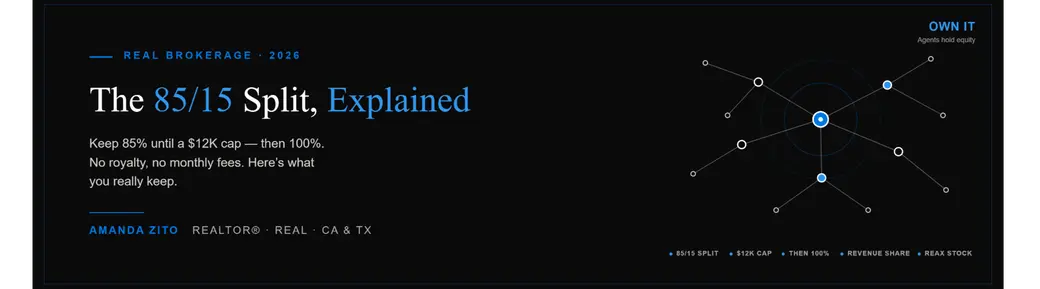
How does the Real Brokerage commission split work? Real Brokerage runs an 85/15 split with a $12,000 annual cap for solo agents. You keep 85% of every commission until you've paid Real $12,000 in your anniversary year — then you move to 100% for the rest of that year.
Agents don't leave a brokerage over a logo. They leave when the math finally makes sense. If you've been looking at Real and trying to figure out what you'd actually take home, this is the honest breakdown — the split, the cap, every fee, and the two wealth-building pieces most agents don't fully understand until they're inside the model.
I made the move to Real myself, and I run my business across California and Texas on this exact structure. So this isn't a recruiting pitch dressed up as education. It's the same math I ran on a napkin before I signed, laid out so you can run it on your own numbers.
Let's get into it.
The 85/15 split and the $12,000 cap
Real Brokerage operates on a flat 85/15 commission split. You keep 85 cents of every dollar of gross commission income (GCI); Real keeps 15 cents. That's it — no tiers based on experience, no different splits for buyer-side versus listing-side, no franchise math layered on top.
That 15% isn't forever. It stops the moment you hit your cap:
| Agent type | Annual cap (U.S.) |
|---|---|
| Solo agent / team leader | $12,000 |
| Team member | $6,000 |
| Mega-team member | $4,000 |
Once you've paid Real $12,000 in splits during your anniversary year, you're done. Every commission after that is 100% yours (minus a small per-transaction fee — more on that below). At an 85/15 split, you reach the $12,000 cap at roughly $80,000 in GCI. For a lot of producing agents, that lands in the first half of the year, which means the back half is spent keeping essentially everything.
Two details I appreciated coming from the traditional world:
- The cap is identical everywhere. A $250,000 sale and a $2 million sale count the same dollars toward your cap. And because Real isn't a franchise, no local owner gets to set a different cap. Your numbers are your numbers whether you're in Redlands or Lakeway.
- It runs on your anniversary year, not the calendar year — so your clock starts the day you join, not every January 1.
The fees — the real ones, not the scary ones
Every brokerage has fees. The question is whether they're predictable. At Real, they mostly are. Here's what actually comes out:
- One-time start-up fee: ~$249 when you join.
- Annual brokerage fee: ~$750 per year, collected as ~$250 on each of your first three closings. No surprise invoice, no monthly desk fee.
- Post-cap transaction fee: ~$285 per deal after you've capped. This is the number people miss. While you're still paying your 15% split, there is no transaction fee — you pay the split or the fee, never both.
- Small per-transaction fees (a modest broker review/E&O-style fee per deal) that run in the tens of dollars.
There are no monthly fees and no franchise royalty. That last point matters more than it sounds. Many national brands skim a 5–6% royalty off the top before your split is even calculated. Real doesn't have one.
And here's the part that softens the post-cap fee: if you hit Elite Agent status (capping plus a defined level of post-cap production), that $285 transaction fee drops to roughly $129, and you earn a stock award on top. So your highest-volume months get cheaper, not more expensive.
How Real compares
You can't evaluate a split in a vacuum. Here's the rough landscape in 2026:
| Model | Split | Cap | Notable extra |
|---|---|---|---|
| Real Brokerage | 85/15 | $12,000 | No royalty; post-cap fee drops at Elite |
| eXp Realty | 80/20 | ~$16,000 | Post-cap transaction fees |
| Traditional / franchise | ~70/30 | $18,000–$30,000+ | Often a 5–6% royalty on top |
| Keller Williams | 64/30/6 | ~$18,000–$25,000 | 6% royalty to KWRI |
The headline: Real gives you a higher base split and a lower cap than most of the field, which is exactly the combination that helps newer and part-time agents (who may never cap) and high producers (who cap early and coast). It's rare for one structure to serve both ends of the spectrum.
The part that isn't on your commission check: revenue share
This is where Real stops being "just a good split" and starts being a wealth play.
Real runs a five-tier revenue share program, and the single most important thing to understand is where the money comes from: it's paid out of Real's 15%, never out of your 85% and never out of the sponsored agent's pocket. When you help another agent join Real and they produce, you earn a share of the revenue Real collects from them.
Real pays roughly 60% of its revenue back to agents through this program — among the most generous in the industry. The tiers pay up to about $4,000 per year for a Tier 1 agent, scaling down through the deeper tiers. There's also a co-sponsor option that lets an incoming agent name up to two sponsors and split the revenue share 50/50 — built to reward actual mentorship, not just who made the introduction.
One important string: to collect revenue share, you have to stay a producing agent yourself (a modest rolling production minimum). Real is a production-based company — the program rewards people who are still in the business, not people who signed up years ago and disappeared. And because revenue share is willable, agents increasingly treat it as a succession and legacy plan, not just side income.
The stock piece
Real is publicly traded (ticker REAX), and agents can build an actual ownership stake in the company they work for. You can direct a portion of your commissions into company stock — typically at a discount and with a company match — and you earn stock awards for milestones like capping and reaching Elite Agent.
The specifics of the stock program (match percentages, discounts, award sizes) get adjusted periodically, so confirm the current terms before you count on a number. But the concept is the durable part: you're converting a slice of production into equity in a growing company instead of watching 30% of your check disappear into a franchise you'll never own a piece of.
FAQ
What is the Real Brokerage commission split for a new agent? It's the same as everyone else's: 85/15 with a $12,000 cap. Real doesn't tier splits by experience, so a first-year agent and a top producer are on the identical plan from day one.
Are there monthly fees at Real Brokerage? No. There are no monthly desk or franchise fees. You'll see a one-time start-up fee (~$249), an annual brokerage fee (~$750, taken from your first three closings), and a post-cap transaction fee only after you've capped.
Do I pay both the split and a transaction fee? No — it's one or the other. While you're paying your 15% split you owe no transaction fee. The ~$285 per-deal fee only applies after you've capped, and it drops to ~$129 once you reach Elite Agent status.
Where does revenue share money come from? From Real's 15% company share — never from your commission and never from the sponsored agent's earnings. It's a share of the revenue Real already collects, paid back out to agents.
Curious how the numbers would look for you?
The best way to evaluate any brokerage isn't a chart — it's running your production through the model. If you sold what you sold last year on Real's structure, what would you have kept? What would capping early have freed you up to do? What would the revenue share and stock have added on top?
I'm happy to walk through that math with you, no pressure and no script — just an honest conversation with someone who runs her business on this plan every day across California and Texas. If you've been quietly curious about Real, that's reason enough to reach out.
Amanda Zito REALTOR® | Real Broker, LLC — serving California & Texas
Fee and program figures reflect Real's published U.S. structure as of 2026 and can be updated over time; confirm current terms before making a decision.
Categories
Recent Posts











“Your goals come first. My job is to help you make the right move.”