

Should You Sell Your Lakeway Home As-Is or Make Repairs First? A Practical Seller's Guide
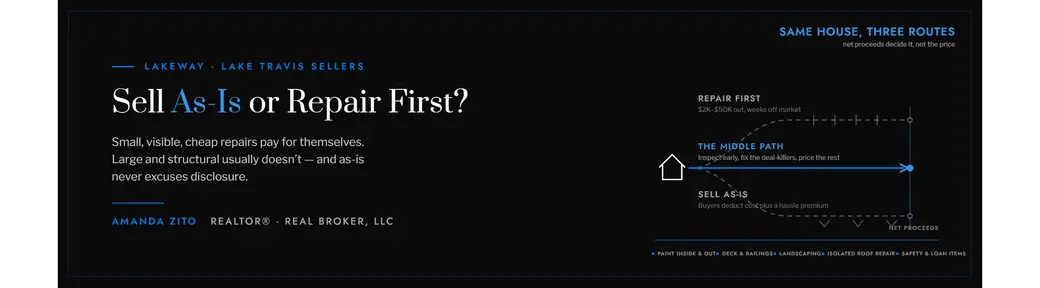
Should you sell your Lakeway home as-is or make repairs first? Sell as-is when the repairs are large, unknown, or time-sensitive. Repair first when the work is cosmetic, inexpensive, and visible — those are the items Lakeway buyers actually pay more for.
The question most sellers are really asking
When a homeowner in Lakeway asks me whether to sell as-is, they're usually not asking about paint colors. They're asking a financial question: will I keep more money if I spend money first?
Sometimes yes. Often no. And the answer has less to do with how the house looks than with who can buy it. Every repair decision either widens or narrows your buyer pool, and in the 78734 ZIP code — where you're competing against newer construction in the surrounding Lake Travis area — the size of that pool drives your price more than any single upgrade does.
Here's how to think it through before you call a contractor.
What "as-is" actually means in Texas
This is where sellers get tripped up. In Texas, selling as-is limits your obligation to repair. It does not limit your obligation to disclose.
Under Section 5.008 of the Texas Property Code, most sellers of a single-family home must provide a written Seller's Disclosure Notice covering known conditions — foundation, roof, plumbing, electrical, HVAC, flooding history, and more. Selling as-is doesn't exempt you from that form, and it doesn't protect you from a claim if you knew about a defect and stayed quiet. The Texas REALTORS® guidance on seller's disclosure is clear that the notice is a risk-reduction document, not a formality.
An as-is sale also doesn't stop a buyer from inspecting. Under a standard Texas contract, a buyer with an option period can inspect, find what you disclosed plus whatever else the inspector turns up, and terminate. So the practical meaning of as-is is narrower than most sellers assume: I'm not fixing anything, and I've priced the home accordingly.
That second half is the part people forget. As-is only works when the price reflects it.
The math buyers actually run
Buyers don't deduct the cost of a repair. They deduct the cost of a repair plus a premium for the hassle, the risk, and the fact that they're spending cash after closing when their savings are thin.
A $12,000 roof rarely costs you $12,000 in price. It costs you $12,000 plus the buyers who scrolled past your listing photos, plus the ones whose lender flagged it, plus the negotiating leverage it hands to whoever does write an offer.
That's the argument for fixing things. But the counterargument is just as real: sellers routinely spend $40,000 on a renovation that returns $25,000. The National Association of Realtors' 2025 Remodeling Impact Report found wide gaps between what projects cost and what they recover — a new steel entry door recovered around 100% of its cost, while larger interior remodels recovered far less. The same report noted the projects agents most often recommend before listing are painting the whole home, painting a single room, and replacing old roofing. Not kitchens. Not bathroom gut jobs.
The pattern is consistent: small, visible, cheap wins. Large, structural, expensive usually doesn't.
When selling as-is is the right call in Lakeway
Selling as-is makes sense when one or more of these is true:
- The scope is unknown. Foundation movement, chronic drainage issues, or a septic or aerobic system that hasn't been serviced in years. Once you open it up, you own the answer — and you have to disclose it either way.
- You don't have the cash. Borrowing against a home you're about to sell, or floating repairs on a credit card, adds cost and stress to a transaction that already has both.
- The timeline is short. Job relocation, a probate sale, a divorce, or a purchase contract already in motion on your next home.
- You inherited it or rented it out. You may not know the home's history well enough to manage repairs confidently, and partial fixes can create disclosure complications.
- The home's value is mostly in the land or the view. In parts of Lakeway and the surrounding Lake Travis area, a lot with elevation, a view corridor, or waterfront access carries value that a kitchen update won't meaningfully change. Some of those buyers plan to remodel no matter what you do.
In these cases, the winning strategy isn't cosmetic. It's accurate pricing, complete disclosure, and clean documentation — bids, inspection reports, service records — so a buyer can price the risk instead of imagining the worst.
When making repairs first pays off
Repair first when the work meets all three of these tests: it's visible, it's bounded, and it's cheap relative to the price bracket.
Practically, in Lakeway that usually means:
- Interior and exterior paint, especially where sun exposure has faded or chalked the trim
- Deck and railing repair — a common issue on Travis County homes with hillside elevation and heavy sun
- Landscaping cleanup, irrigation repair, and drought-tolerant replanting where the yard has thinned out
- Deep cleaning, carpet replacement, and light fixture updates
- Minor plumbing and electrical items an inspector will flag anyway
- Roof repair where the issue is isolated and documented
There's also a category that isn't about return on investment at all — it's about financing eligibility. Active roof leaks, non-functioning HVAC, exposed wiring, missing handrails, and significant wood rot can cause problems with FHA and VA appraisals. If those conditions exist in your home, choosing as-is may quietly restrict you to cash and conventional buyers. In a market where many Lakeway buyers are financing, that's a real narrowing of your pool.
As-is vs. repair first: a side-by-side look
| Sell as-is | Repair first | |
|---|---|---|
| Upfront cost | Minimal | $2,000–$50,000+ depending on scope |
| Time to market | Days | Weeks to months |
| Buyer pool | Narrower; more cash and investor interest | Wider; includes financed and relocation buyers |
| Negotiating position | Weaker on price, stronger on certainty | Stronger on price, more exposure on inspection |
| Main risk | Underpricing the deduction buyers apply | Overspending on work you don't recover |
Neither column is the "right" one. Which one wins depends on your equity, your timeline, and your home's condition relative to its direct competition.
The middle path most sellers should consider
There's a third option that gets overlooked, and it's the one I recommend most often: get a pre-listing inspection, fix only the deal-killers, and price the rest.
That approach does three things at once. You find out what a buyer's inspector will find before you're under contract, so nothing blindsides you during the option period. You address the small set of items that block financing or scare buyers. And you go to market with a defensible price and a stack of documentation instead of a vague as-is label.
It also changes the tone of negotiation. A seller who says "here's the inspection, here's what we fixed, here's what we didn't and here's why the price reflects it" is in a fundamentally stronger position than a seller reacting to a buyer's report on day five.
Frequently asked questions
Do I still have to complete a seller's disclosure if I sell my Lakeway home as-is? Yes, in nearly all cases. Texas Property Code Section 5.008 requires most sellers of a single-family residence to provide a written Seller's Disclosure Notice, and selling as-is does not remove that duty. As-is limits your obligation to repair, not to disclose what you know.
Will I get less money selling as-is in the Lake Travis area? Usually you'll accept a lower price, but that doesn't automatically mean lower net proceeds. Once you subtract repair costs, carrying costs, and the extra weeks off market, some as-is sellers net close to — or occasionally more than — what they would have after renovating.
What repairs should I never skip before listing in Lakeway? Anything that affects safety, water intrusion, or loan approval. Active roof leaks, non-working HVAC, exposed electrical, significant wood rot, and missing handrails are the items most likely to cost you buyers, appraisal problems, or both.
Let's run your numbers before you spend anything
The right answer for your home depends on your equity, your timeline, and what's actually selling around you in Lakeway and the greater Lake Travis area. Before you write a check to a contractor, it's worth seeing the two scenarios side by side — as-is versus repaired, with real estimated net proceeds for each.
Call or text me at 949-484-9486 and we'll walk your home together, identify what's worth doing and what isn't, and build a plan around the outcome you need.
Amanda Zito REALTOR® | Real Broker, LLC Serving the Lake Travis area, Texas and Southern California CA DRE #01740063 | TX TREC #840088 SoldByZito.com | 949-484-9486
Categories
Recent Posts











“Your goals come first. My job is to help you make the right move.”