

What "Move-In Ready" Actually Means
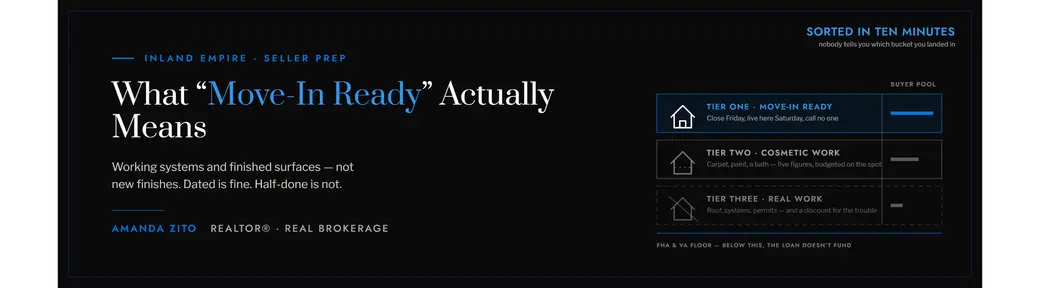
What does "move-in ready" actually mean when selling a home? Move-in ready means a buyer can close, move in, and live normally without spending money or scheduling contractors first. It is about working systems and finished surfaces — not new finishes, upgrades, or remodels.
Almost every seller I meet in the Inland Empire believes their home is move-in ready. Most of them are describing something different than the buyer walking through it.
The seller usually means: nothing is broken, and we've lived here comfortably for years. The buyer means something narrower and much more literal: I can sign, get the keys, and not write another check for six months.
Those two definitions are close enough to sound the same in a listing appointment and far enough apart to cost you the first two weeks on market. So it's worth defining the term the way the market defines it — because the market is the one setting your price.
The three condition tiers buyers sort homes into
Buyers touring homes across Riverside County and San Bernardino County aren't grading on a hundred-point scale. After three or four showings, they're sorting everything into three buckets, usually within the first ten minutes of walking in.
Tier one — move-in ready. Nothing has to happen before they move in. They might paint a bedroom eventually. Nothing is on a timeline.
Tier two — cosmetic work. The home functions, but they'll be replacing carpet, painting, or updating a bathroom within the first year. They're mentally budgeting somewhere in the five-figure range and doing that math while standing in your kitchen.
Tier three — real work. Roof, HVAC, electrical, plumbing, foundation, permits, or an addition that was never signed off on. This buyer pool is a fraction of the size, and the people in it expect a discount for the trouble.
The gap between tier one and tier two is where most sellers lose money without ever knowing it happened. Nobody tells you they moved you into bucket two. They just offer less, or they don't come back.
What move-in ready actually requires
Here's the working standard. If all of this is true, you're in tier one.
- Systems function. HVAC heats and cools, the water heater works, the electrical panel is adequate and safe, plumbing drains without a trick to it, and the roof doesn't leak.
- Nothing is visibly deferred. No dry rot on the fascia, no cracked stucco anyone would call structural, no exposed wiring, no missing outlet covers, no doors that need a shoulder.
- Surfaces are finished and intact. Flooring is whole, walls are painted, counters aren't damaged, and every room reads as complete. Dated is fine. Half-done is not.
- It's clean at a level buyers notice. Odor-free, sanitary, no active pest issue. This one is unglamorous and it disqualifies more homes than any other item on the list.
- Every improvement is permitted. A converted garage or an addition without a permit moves you to tier three instantly, regardless of how well it was built.
- Appliances and fixtures included in the sale actually work. All of them.
Notice what's not on that list: new quartz, a remodeled primary bath, luxury vinyl plank, a redone kitchen. None of it is required to be move-in ready.
What move-in ready does not mean
It does not mean updated. A Rancho Cucamonga home with original 1998 tile and oak cabinets can be fully move-in ready. It's dated, and a buyer will price the dating into what they offer — but it's still tier one, and it will move faster than a partially renovated home two streets over.
It does not mean new. It doesn't mean the finishes match current design trends. It doesn't mean everything is under warranty.
And most importantly: it does not mean you get a premium for it. This is the part sellers dislike hearing. Move-in ready is not a feature you charge extra for in today's Inland Empire market. It's the baseline that keeps you in the running with the rest of your price band. Homes that fall below it get discounted. Homes that meet it get considered.
Why partially finished is worse than dated
There's a specific trap I see constantly in Riverside, Corona, Ontario, and out in the High Desert: the seller started a project.
The bathroom is half retiled. Two rooms have new flooring and the hallway doesn't. The kitchen has new cabinets and the original counters. From the seller's side, this looks like progress — value already added. From the buyer's side, it looks like an unknown. They can't tell what was done well, what was done cheaply, or what's hiding behind the part that isn't finished.
A consistently dated home is legible. A half-updated home is a question mark, and buyers price question marks conservatively. If you're going to start work before listing, finish it. If you can't finish it, it's often better not to start.
The financing floor: condition becomes yes or no
Here's where "move-in ready" stops being a marketing phrase and becomes a hard requirement.
If your buyer uses FHA or VA financing — and a meaningful share of Inland Empire buyers do — condition is not a negotiation. The appraiser is checking the property against published minimum standards for safety, soundness, and sanitation. HUD publishes its requirements in the Single Family Housing Policy Handbook 4000.1, available through HUD's handbook library. The VA maintains its own Minimum Property Requirements and updated several of them in 2026 to reduce appraisal delays.
If the home fails those standards, repairs get made before closing or the loan doesn't fund. There's no version where the buyer accepts it and moves on. That's a real risk in a market where a large portion of buyers are using low-down-payment financing — and, as a REALTOR® working with military families, it's a conversation I have on nearly every transaction near the bases.
Roofing, heating, exposed wiring, and pest or wood-rot damage are the usual failure points. Sellers who address those before listing keep their buyer pool intact. Sellers who don't often discover the problem two weeks into escrow, with far less leverage.
How to figure out which tier you're actually in
Do this before you set a price, not after your first weekend of showings.
Walk your home with a stranger's eyes, starting at the curb. Then ask the only question that matters: could someone close on Friday and live here normally on Saturday, without calling anyone?
If yes — you're tier one, and you price at market for your band.
If it's mostly yes but there are three or four items on a list somewhere in your head — that list is what a buyer will find, usually with an inspector. Handle it or expect it to come back as a request for credits.
If the answer involves explaining anything — you're tier two or three. That's not a crisis. It just means your pricing and your marketing need to reflect it honestly, and your target buyer is different than you assumed. Pricing a home as if it's in a tier it isn't is the single most expensive assumption a seller can make.
FAQ
Does a home have to be updated to be move-in ready? No. Updated and move-in ready are separate things. A home with original but well-maintained finishes qualifies as move-in ready, while a partially remodeled home with unfinished work does not. Buyers care more about whether things function than whether they're current.
Do buyers pay more for a move-in ready home in the Inland Empire? Not exactly. Move-in ready condition mostly protects you from being discounted rather than earning you a premium. It keeps your home competitive with others in your price range in cities like Riverside, Corona, Rancho Cucamonga, Redlands, Murrieta, and Temecula, where buyers have several options to compare.
Should I make repairs before listing or offer a credit instead? It depends on the repair. Anything that affects financing, safety, or the roof and major systems is usually better handled before listing, because it protects your buyer pool. Cosmetic items are often more efficient to negotiate. Which approach makes sense for your home depends on your price band, timeline, and equity position.
Let's figure out where your home actually stands
If you're preparing to sell in the Inland Empire and you're not sure which tier your home falls into, that's exactly what a pre-listing walkthrough is for. I'll give you a straight assessment of condition, what's worth addressing, what isn't, and how it should shape your pricing — before you're on market and reacting.
Call or text me at 949-484-9486 and we'll set up a time.
Amanda Zito, REALTOR® Real Brokerage CA DRE #01740063 | TX TREC #840088 soldbyzito.com
Categories
Recent Posts











“Your goals come first. My job is to help you make the right move.”