

Your House Doesn't Need To Be the Best To Sell
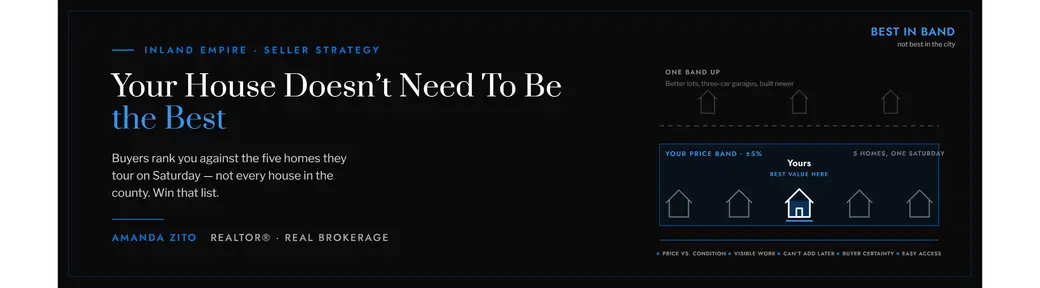
Does your home have to be the nicest one on the market to sell? No. In the Inland Empire, homes sell when they're the strongest option inside their price band — not when they're the best house in the city. Buyers compare a short list, then pick the best value on that list.
Most sellers walk their own house looking for everything wrong with it. The dated hall bath. The kitchen they meant to redo in 2019. The neighbor's house that sold last spring with the quartz counters and the new floors.
That's not how a buyer sees it.
A buyer in Riverside, Fontana, or Rancho Cucamonga isn't ranking your house against every home in San Bernardino County. They're ranking it against the five or six homes their agent booked for Saturday — all in the same price range, all in roughly the same area. They only need one of them to feel like the smartest choice.
That's a much smaller contest than the one running in your head. And it's winnable without a renovation.
Buyers Shop in Price Bands, Not in Perfection
Buyers start with a payment, work backward to a price range, and filter. Everything they see lives inside that window.
So the question isn't "is my house nice?" The question is: of the homes a buyer can afford this weekend, is mine the one that makes the most sense?
That comparison usually comes down to four things:
- Price relative to condition. Not condition alone — the ratio.
- How much work is visible on day one. Buyers estimate repair costs badly and always high.
- What they can't easily add later. Lot size, layout, garage space, single-story, location.
- How certain they feel. Unknowns cost you money at the offer stage.
Notice what's missing: being the nicest. A home in average condition priced correctly beats an upgraded home priced like it's flawless, almost every time.
The Mistake: Upgrading Yourself Into a Harder Fight
Here's the part that costs Inland Empire sellers real money.
You spend $40,000 on a kitchen and new floors. You add that to your price. Now you're not competing with the homes you were competing with last month — you're competing one tier up, against homes that were built better, sit on better lots, or have the three-car garage you don't have.
You went from being the best option in your old band to a middle option in a tougher one. Same house. Worse position.
Moving up a price band is a competitive decision, not just a pricing one. Before you spend, look at what's actually listed at your new number and ask whether you'd win that group.
Sometimes the answer is yes and the work is worth doing. Often it isn't.
What Actually Moves the Needle Here
In the Inland Empire, the features buyers pay attention to tend to be the ones that are expensive or impossible to add later:
- Owned solar (leased is a different conversation — be ready to explain the terms)
- RV parking or side-yard access
- A permitted ADU or usable casita space
- Three-car garage
- Single-story layout
- A pool, in the right neighborhood and price range
You either have these or you don't. That's the point — that's the ceiling you're working with, and it's fine. Your job isn't to manufacture a better house. It's to make the house you have read as the clearest choice at its number.
The things that reliably do that are unglamorous:
- Clean, bright, current photography
- Easy showing access — a lockbox and a yes to short-notice requests
- Visible small repairs handled (running toilets, torn screens, sticking doors, burned-out bulbs)
- Landscaping cleaned up at the curb
- Paperwork ready: permits, solar agreement, HOA documents, roof and HVAC ages
None of that is a remodel. All of it removes reasons for a buyer to hesitate — and hesitation is what turns into a lower offer or no offer.
Reduce the Unknowns, Not the Imperfections
Buyers don't punish flaws they can see and price. They punish flaws they can't measure.
An old roof with a documented age and a couple of contractor quotes is a known quantity. An old roof with a shrug next to it becomes a $25,000 fear during negotiation.
If something in your home is going to come up in inspection, it's cheaper to disclose it early than to defend it later. Sellers who front-load information usually negotiate from a stronger place, because the buyer's imagination never gets to fill in the blank.
How To Find Your Real Competition
This takes about twenty minutes with your agent:
- Pull every active listing in your area within about 5% above and below your target price.
- Cut it to the ones a buyer would genuinely tour on the same day as yours.
- Line them up on the things buyers weigh — beds, baths, square footage, lot, garage, single-story, pool, condition.
- Ask one question: if a buyer saw all of these, why would they pick mine?
If you can answer that in a sentence, you're priced right. If the only honest answer is "they wouldn't," you don't have a marketing problem — you have a position problem, and price is the fastest lever you have.
For broader context on what buyers nationally say drives their decisions, the National Association of REALTORS® research library is worth a look, and the Redfin Data Center tracks local supply and price trends. Rate movement — which quietly resets everyone's price band — is tracked weekly by Freddie Mac.
The Takeaway
You're not trying to win an award. You're trying to be the obvious answer to one buyer's very specific question: of the homes I can afford, which one do I want?
That's a competition you can win with an average kitchen.
FAQ
Do I need to renovate before selling my Inland Empire home? Usually not. Full renovations often move you into a higher price band where you compete with stronger homes. Targeted cleanup, repairs, and photography typically return more than a remodel does.
Will buyers automatically pick the updated house over mine? Not if yours is priced to reflect its condition. Buyers weigh price against work required. An honestly priced home in original condition regularly beats an overpriced updated one.
What if my house is the smallest or oldest in the comparison? Then price and presentation carry more of the load, and clarity matters more. Document what you know about the home, make it easy to see, and position it as the value option in its range rather than competing on features it doesn't have.
Thinking about selling and not sure where your home actually stands against the competition?
Call or text me and we'll pull your real comparison set and talk through what's worth doing — and what isn't — before you spend a dollar.
Amanda Zito, REALTOR® Real Brokerage CA DRE #01740063 | TX TREC #840088 SoldByZito.com
Categories
Recent Posts











“Your goals come first. My job is to help you make the right move.”