

10 Signs You've Outgrown Your Current Brokerage
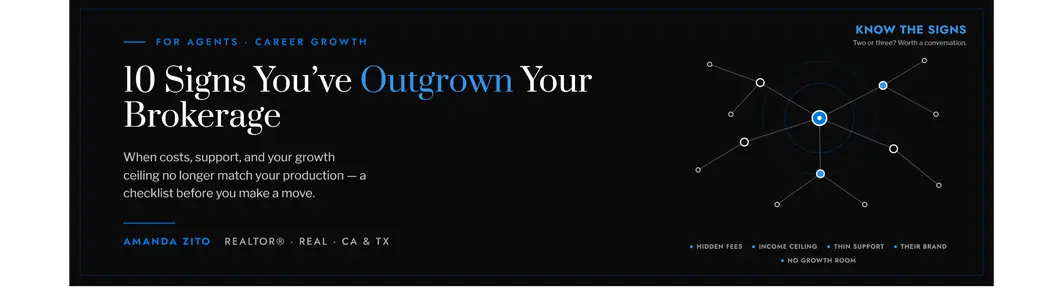
How do you know when it's time to change brokerages? You've likely outgrown your brokerage when your costs, support, and growth ceiling no longer match your production — when you're paying for value you stopped receiving, or you can't build the business you want inside the model you're in.
Most agents don't leave a brokerage over one dramatic moment. They leave after a slow accumulation of small frustrations: another month of fees for tools they never open, another closing where the split stung more than it used to, another year of building a business that doesn't fully belong to them.
The tricky part is that outgrowing a brokerage rarely feels like a crisis. It feels like a quiet plateau. You're still producing, still closing, still busy — but the environment around you has stopped adding much to what you do on your own.
Below are ten signs I hear most often from agents who eventually make a move. If two or three land, it's probably worth a conversation. If seven or eight land, you already know the answer.
1. You're paying for a lot of things you don't actually use
Desk fees, franchise fees, technology fees, marketing fees, transaction fees. Add them up for the last twelve months and compare that number against what you genuinely used.
Plenty of agents discover they're funding a full-service infrastructure while running a business that's essentially self-sufficient. That's not a scandal — it's just a mismatch between what you're buying and what you need.
2. Your cap or split no longer matches your production
There are two versions of this problem, and they're opposites.
If you cap in the first quarter every year, you're subsidizing the office for the other nine months. If you never come close to capping, you're paying a high split without the support that's supposed to justify it. Either way, the math is working better for someone else than it is for you.
Run a simple exercise: take your last twelve months of gross commission income and calculate what you would have kept under two or three different models. Numbers settle arguments that feelings can't.
3. Your income has a ceiling you can't raise
If the only way to make more money at your brokerage is to sell more houses, you have one lever. That's a hard way to build long-term wealth, especially in a market where transaction volume swings.
Agents who feel stuck often aren't unhappy with their production — they're unhappy that production is the only thing that pays. Equity, revenue share, and other ownership components exist specifically to solve that. Whether or not you want those things, you should at least know whether your current brokerage offers them.
4. You've stopped learning anything in the office
Early in your career, the office was where you learned everything: how to write a clean offer, how to handle an inspection negotiation, how to talk to a nervous seller.
At some point, that flips. You start answering more questions than you ask. If your training calendar hasn't taught you something new in a year, you're not being supported anymore — you're being retained.
5. Support has become a ticket you file instead of a person you call
Every brokerage says it has great support. The real test is response time when something goes wrong on a Friday afternoon with a Monday closing.
If broker support means submitting a form and waiting, or if the person who answers doesn't know your transaction, you're carrying operational risk that your split is supposed to cover.
6. You're building someone else's brand instead of your own
Look at your last ten pieces of marketing. Whose name is bigger — yours, or the brokerage's?
There's nothing wrong with a strong brokerage brand. But if your database, your reviews, your content, and your reputation are all filed under a company logo, you've spent years building equity in an asset you don't own. Clients should hire you first and your brokerage second.
7. Your tech stack is a patchwork you're paying for twice
Many agents pay their brokerage for a CRM they don't use, then pay again for the one they do use. Same story with websites, transaction management, and lead tools.
Audit it. If you're double-paying in two or three categories, the "included" technology isn't included — it's just bundled.
8. You're mentoring everyone and getting nothing for it
New agents find you. You take their calls, review their contracts, talk them off ledges. It's genuinely rewarding work, and in most traditional models, it's also unpaid.
If you're already functioning as a team lead or trainer without the title, the compensation, or any ownership in the outcome, that's a sign your contribution has outgrown your role.
9. You want to expand and your brokerage can't follow you
This one is personal for me. I'm licensed in California and Texas, and I work with clients moving between the two — usually selling one home while buying another 1,400 miles away.
If you're growing into a second market, a second state, or a team structure, and your brokerage's footprint or model can't accommodate it, you'll be managing around a limitation instead of building through it.
10. You've already been quietly researching
You've watched the videos. You've read the comparison posts. You've had the coffee conversation with the agent who left last year and asked how it's going.
Agents who are happy where they are don't do this. The research itself is the signal.
What to Do Before You Decide Anything
Outgrowing a brokerage doesn't automatically mean leaving is right. Sometimes the answer is a conversation with your broker about a different split, a different role, or a different level of involvement. Ask before you assume.
If you do want to explore a move, do it methodically:
- Run the numbers on your actual production, not your best year and not your worst.
- List what you'd genuinely miss. If the answer is "the people," that's real — but people can stay in your life after a change of employing broker.
- Read your independent contractor agreement, especially anything about pending transactions, referral obligations, and post-termination compensation.
- Understand the mechanics of transferring your license through the California DRE or the Texas Real Estate Commission, and what your local association and MLS require.
- Talk to two or three agents who made the same move eighteen months ago — long enough to be past the honeymoon.
The National Association of REALTORS® publishes member profile research each year showing how long agents typically stay with a firm. The short version: changing brokerages is normal, not disloyal. Most agents do it more than once.
Frequently Asked Questions
How often do real estate agents change brokerages? Changing firms is common across a career, and it usually happens when an agent's production, goals, or business model shifts. Agents most often move in the first few years while finding a fit, and again later once their business has matured past what their original brokerage offers.
Will I lose my clients if I switch brokerages? Your relationships are yours; your active listings are technically your broker's. Past clients and your personal database generally follow you, while pending transactions and current listings are governed by your independent contractor agreement and state license law. Read those terms before you give notice.
Is it better to switch brokerages at the start of the year? January is popular because caps and anniversary dates reset, but the right timing depends on your pipeline more than the calendar. Many agents wait until pending transactions close so nothing is disrupted mid-escrow.
Let's Talk — Confidentially
If several of these signs sounded familiar, you don't need a pitch. You need a straight conversation with someone who's actually run the numbers.
I'm happy to walk through your production, your current costs, and what a move would realistically look like — including the reasons it might not make sense for you right now. No pressure, and nothing gets repeated.
Amanda Zito, REALTOR® Real Brokerage | Licensed in California (DRE #01740063) and Texas (TREC #840088) Call or text: 949-484-9486 Email: soldbyzito@gmail.com
Categories
Recent Posts











“Your goals come first. My job is to help you make the right move.”