

Are Home Prices Dropping in the Inland Empire?
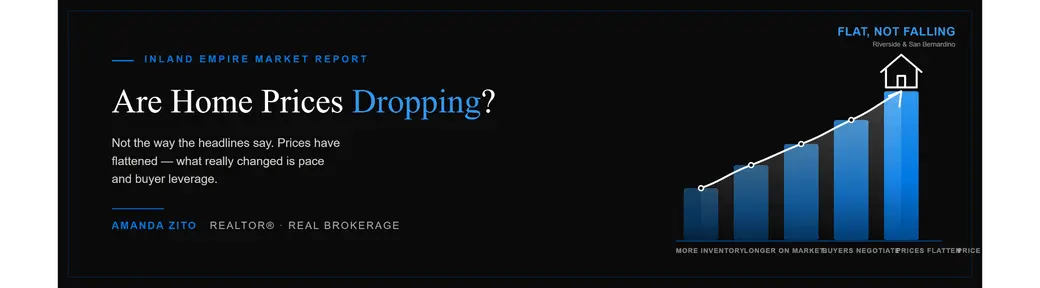
Are home prices dropping in the Inland Empire? Not in the dramatic way the headlines suggest. Prices across Riverside and San Bernardino counties have largely flattened after years of fast appreciation — what's really changed is how long homes take to sell and how much room buyers have to negotiate.
Introduction
If you've searched this question recently, you've probably found two completely opposite answers on the first page. One article says values are sliding. The next says the Inland Empire is still one of the most competitive markets in Southern California. Both are pulling from real data. They're just measuring different things.
Here's the part that actually matters to you: there is no single Inland Empire market. There's Corona. There's Eastvale. There's Redlands, Rancho Cucamonga, Ontario, Murrieta, Temecula, and the High Desert — and in any given month, some of those are softening while others are holding firm or still climbing. A regional median can drop while your street doesn't budge.
So let's separate the headline from your house. Below, I'll walk through what "prices are dropping" usually means when you see it in a news story, what's genuinely shifting in Riverside and San Bernardino counties right now, and how to figure out where your specific home actually stands.
Where the "Prices Are Dropping" Headlines Come From
Most market stories are built on one number: the median sale price. That's the midpoint of everything that closed in a county last month — half sold for more, half sold for less.
It's a useful number for tracking a region over time. It is a terrible number for pricing your home.
The median measures what sold, not what homes are worth
If a lot of entry-level homes in the High Desert close in a given month and fewer larger homes in South Corona do, the median falls — even if every single one of those homes sold for exactly what it was worth. The mix changed, not the values.
This is why a county-level median can tick down a percent or two while a well-prepared, correctly priced home in Eastvale still draws multiple offers. Two different realities, one statistic. The California Association of Realtors publishes county-level market data monthly, and it's worth reading with that caveat in mind.
Small percentage moves are normal, not a signal
A one or two percent shift month to month is noise in a market this size. When you see that framed as a decline, remember what a real correction looks like — double-digit drops, sustained over quarters, driven by forced selling. That's a fundamentally different picture from a market catching its breath.
What's Actually Changing in the Inland Empire
The more honest answer isn't about price at all. It's about pace and leverage.
There are more homes to choose from
Inventory across the Inland Empire has rebuilt significantly from the extreme lows of a few years ago. More sellers competing for the same pool of buyers means listings can't rely on scarcity to do the work anymore.
Homes are taking longer to sell
The window between "just listed" and "in escrow" has stretched. A home that would have gone pending in a weekend a few years ago may now sit for several weeks — and that's not a sign of a broken market, it's a sign of a normal one. You can track how days-on-market and inventory are trending in the Riverside–San Bernardino–Ontario metro through Redfin's market data or the FRED listing data sourced from Realtor.com.
Buyers are negotiating again
Repair requests, credits, rate buydowns, closing cost help — these are back on the table in most Inland Empire submarkets. Sellers who priced against last year's peak are the ones making the biggest concessions, usually after a price reduction they could have avoided.
That combination is what people are feeling when they say the market is dropping. It feels softer because it is softer. That's different from values falling.
Why Your ZIP Code Answers This Differently
Within Riverside and San Bernardino counties, the spread between submarkets is wide.
- Price tier matters most. Entry-level and mid-tier homes generally still see the deepest buyer pool. Higher price points tend to move slower and negotiate harder.
- Newer master-planned communities in areas like Eastvale, Menifee, and parts of Murrieta compete directly with builder incentives — and builders can buy down a rate in ways an individual seller can't.
- Established neighborhoods in Redlands, Riverside, and Rancho Cucamonga often hold value differently because supply is naturally limited.
- Commuter distance still shapes demand across the region, particularly further out toward the High Desert and southwest Riverside County.
If your neighbor's home sat for 90 days and yours is a different size, condition, or price tier, their experience tells you very little about yours.
What This Means If You're Thinking About Selling
You have not missed your window. But you can't price off a Zestimate, a neighbor's rumor, or what your home was worth at the peak.
The sellers struggling right now are almost always the ones who started high "just to test it." In a market with real inventory, an overpriced listing doesn't get offers — it gets skipped, goes stale, and eventually sells for less than it would have if it had been priced correctly on day one. Your first two weeks on the market are the most valuable ones you get.
Price it to today's comps, present it well, and most Inland Empire homes still sell in a reasonable timeframe.
What This Means If You're Waiting to Buy
The trade-off is real and worth naming. Waiting may or may not get you a lower price — but it does mean paying today's rent while you find out, and it means competing with everyone else who's waiting on the sidelines the moment conditions shift.
What you have right now that buyers two years ago didn't: options, inspection leverage, and time to think. That's genuinely valuable.
Is This the Start of a Crash?
The conditions that produced 2008 aren't the conditions we have. Lending standards are dramatically tighter, most Inland Empire homeowners hold meaningful equity, and a large share are sitting on low fixed-rate mortgages they have no reason to walk away from. Distressed inventory — the fuel of a true crash — isn't there.
A market that stops appreciating rapidly is not a market in collapse. It's a market returning to something closer to normal, which is what most buyers have been asking for.
Frequently Asked Questions
Will Inland Empire home prices go down in 2026?
Most forecasts point toward relatively flat conditions rather than significant declines, with mortgage rates and inventory levels as the main variables. Regional forecasts from the California Association of Realtors are updated regularly and are a better source than any single headline.
Is now a bad time to sell my house in Riverside County?
Not inherently — but pricing strategy matters far more now than it did two or three years ago. Homes priced to current comps and prepared properly are still selling; homes priced to peak-market memory are the ones sitting.
How do I know what my Inland Empire home is actually worth today?
An automated estimate can't see your upgrades, your lot, your condition, or your specific street. A comparative market analysis using recent closed sales in your immediate area is the only reliable way to know where you stand.
Find Out What Your Home Is Actually Worth
Regional averages can't tell you what your home would sell for. Your neighborhood, your price tier, and your home's condition will.
I'll put together a no-obligation home valuation based on current comparable sales in your specific area — no pressure, no commitment to list, just a straight answer about where you stand.
Amanda Zito REALTOR® | Inland Empire Listing Specialist Real Brokerage Serving Riverside and San Bernardino Counties — Corona, Eastvale, Ontario, Rancho Cucamonga, Redlands, Murrieta, and Temecula
Categories
Recent Posts











“Your goals come first. My job is to help you make the right move.”