

Are Short-Term Rentals Allowed in Hudson Bend?
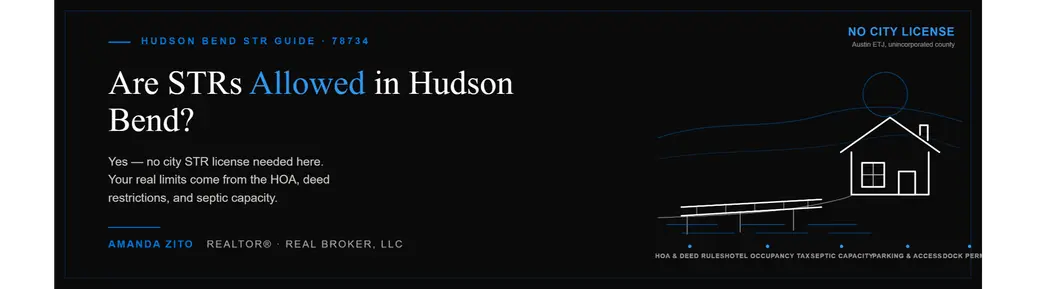
Are short-term rentals allowed in Hudson Bend, Texas? Yes. Hudson Bend is in unincorporated Travis County within the City of Austin's extraterritorial jurisdiction, so no city STR license is required. Your real limits come from HOA rules, deed restrictions, and septic capacity.
Why This Question Comes Up So Often on Lake Travis
Most buyers looking at Hudson Bend have already read something about Austin's short-term rental rules — the license fees, the caps, the enforcement push, the platform delisting deadlines. It sounds complicated because inside Austin city limits, it is.
Then they find out Hudson Bend has an Austin mailing address, an Austin ZIP code, and Austin-area MLS listings, and they assume all of that applies. It doesn't. Hudson Bend is unincorporated — there's no city hall, no city council, and no municipal STR ordinance sitting over the neighborhood.
That distinction is worth real money if you're buying a lake property with rental income in mind. But "no city license required" is not the same as "no rules at all," and the buyers who get burned in this market are almost always the ones who stopped researching after the first answer. Here's the full picture.
Hudson Bend Is Unincorporated Travis County — and That's the Key
Hudson Bend is a census-designated place in western Travis County, sitting on the peninsula between Lake Travis and Lakeway. It has never been annexed by the City of Austin. It falls inside Austin's extraterritorial jurisdiction (ETJ), which is the ring of land outside city limits where a city holds limited authority — mostly over subdivision platting and some development standards, not over land use like rentals.
The City of Austin is explicit about this in its own short-term rental guidance: properties located in the ETJ do not need a City of Austin STR license and are not subject to the city's local hotel occupancy tax. That's the same reason Austin's occupancy caps, license types, and zoning rules stop at the city line.
So the two jurisdictions that could regulate you here are Travis County and the State of Texas. Neither currently requires a short-term rental permit for unincorporated areas.
What Travis County Requires — and Doesn't
Texas gives counties much narrower authority than cities. Counties generally can't zone, which is why unincorporated Travis County has no STR permitting program, no license application, no annual renewal, and no occupancy formula tied to bedroom count.
There have been bills filed in Austin over the years that would grant certain counties authority to register short-term rentals in unincorporated areas, and the topic resurfaces most sessions. None of that has produced a Travis County registration requirement to date — but if you're buying for rental income, it's worth knowing the ground could shift. Build your numbers on a property that pencils as a long-term rental or a second home too, not one that only works at nightly rates.
The Rule That Actually Stops People: HOAs and Deed Restrictions
This is where Hudson Bend buyers get caught, and it has nothing to do with government.
Hudson Bend is a patchwork of subdivisions platted across several decades. Some have active homeowners associations with recorded restrictions that prohibit or limit short-term rentals. Some have deed restrictions with rental language even without an active HOA enforcing them. Others have neither and are completely open.
Two houses on the same street can land on opposite sides of that line. A private restriction is enforceable in a way a county ordinance isn't even present to be — and no city or county office will warn you about it during your option period. You have to look.
Before you write an offer on a Hudson Bend property you intend to rent nightly:
- Request the full set of recorded CC&Rs for that specific subdivision, not a summary
- Read for rental terms, minimum lease periods, and any commercial-use language
- Check whether restrictions have been amended — older documents get updated
- Ask the title company to pull recorded restrictions in the commitment
- If there's an HOA, ask directly and get the answer in writing
Have a Texas real estate attorney review anything ambiguous. The cost of that review is trivial next to a property you can't legally operate.
Taxes Still Apply, Even Without a License
No license does not mean no tax. Texas imposes a state hotel occupancy tax of 6% on lodging rented for less than 30 consecutive days, and that applies to short-term rentals anywhere in the state, including unincorporated Travis County.
Airbnb and Vrbo collect and remit the state portion on bookings made through their platforms, but you're still the responsible party — you'll want a Texas hotel occupancy tax permit through the Comptroller's eSystems, and you'll need to handle any direct bookings yourself. Travis County also administers venue project taxes on lodging; confirm your specific obligation with the Travis County Tax Office rather than assuming the platform covers everything.
None of this is difficult. It's just easy to overlook when you've been told the area is unregulated.
The Practical Constraints Nobody Mentions
Regulation isn't the only thing that limits a Hudson Bend rental. The peninsula has physical realities that cap what a property can realistically host:
Septic capacity. Many Hudson Bend homes are on on-site sewage facilities rated for a specific bedroom count. Packing twelve guests into a three-bedroom on an older system is how you end up with a failed drain field and a five-figure repair. Pull the OSSF permit records during due diligence.
Water service. Much of the area is served by Hudson Bend Municipal Utility District rather than a city utility. Understand the service, the rates, and any restrictions before you count on high-turnover use.
Parking and access. Hudson Bend roads are narrow, winding, and in places have no shoulder. Guest parking is one of the fastest ways to generate neighbor conflict here, and neighbor conflict is what eventually produces regulation.
Docks and shoreline. If waterfront access is part of your rental pitch, dock permitting on Lake Travis runs through the Lower Colorado River Authority. Confirm the dock is permitted and transferable before you market it.
Lake levels. Lake Travis is a fluctuating reservoir. "Waterfront" in a full-lake year and "waterfront" in a drought year can look very different to a guest who booked based on photos.
How to Verify Before You Buy
Work this order and you'll know exactly where you stand:
- Confirm the property is in unincorporated Travis County and not inside a city's limits — Lakeway, Bee Cave, and Austin proper all have their own rules, and the boundaries near Hudson Bend are not intuitive
- Pull recorded deed restrictions and CC&Rs for the subdivision
- Confirm HOA status and any rental policy in writing
- Review OSSF/septic records for permitted capacity
- Register for a state hotel occupancy tax permit and confirm local obligations
- Check dock permit status if waterfront
Frequently Asked Questions
Do I need an Austin STR license for a Hudson Bend property? No. Properties in Austin's extraterritorial jurisdiction, which includes Hudson Bend, are not required to obtain a City of Austin short-term rental license and are not subject to the city's hotel occupancy tax. Austin's license requirement applies within its full-purpose and limited-purpose jurisdictions.
Can an HOA legally stop me from running an Airbnb in Hudson Bend? Yes, if the recorded restrictions for your subdivision prohibit or limit short-term rentals. Private deed restrictions are enforceable regardless of whether the county regulates STRs, which is why reviewing them before closing matters more here than the government question does.
Is Lakeway different from Hudson Bend for short-term rentals? Yes. Lakeway is an incorporated city with its own short-term rental ordinance and permitting process. Hudson Bend is unincorporated. Two properties a few minutes apart can operate under completely different rules, so verify the jurisdiction of the specific address.
Thinking About a Rental Property in Hudson Bend?
The jurisdiction question is the easy part. The part that decides whether a Hudson Bend property actually works as a rental is the specific subdivision, the specific restrictions, and the specific septic and dock situation — and that's an address-by-address answer.
If you're evaluating a property on Lake Travis and want a straight read on what you'd actually be able to do with it, call or text me. I'll walk the details with you before you're under contract, not after.
Amanda Zito REALTOR® | Lake Travis & Austin Area Real Broker, LLC | TREC #840088
This article is general information, not legal or tax advice. Regulations change. Verify current requirements with Travis County, the Texas Comptroller, and a Texas real estate attorney before making a purchase decision.
Categories
Recent Posts









“Your goals come first. My job is to help you make the right move.”