

Best Pricing Strategy for Inland Empire Home Sellers
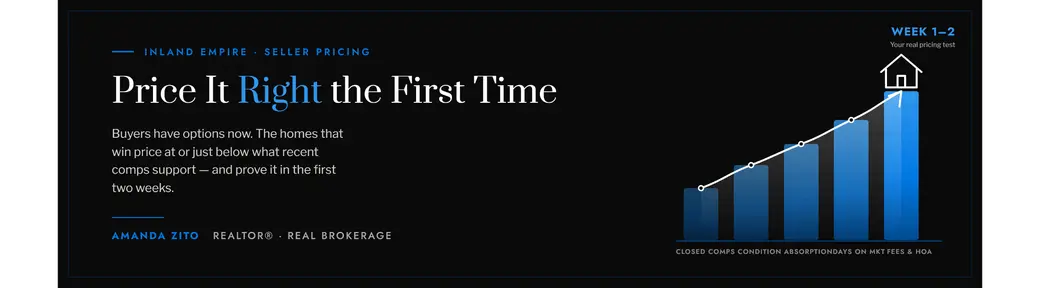
What's the best pricing strategy in today's Inland Empire market? Price at or slightly below what recent comparable sales support. In today's Inland Empire market, buyers have options, and homes priced to compete win attention in the first two weeks — when it matters most.
The market rewards accuracy, not optimism
There was a stretch not long ago when pricing strategy barely mattered in Riverside and San Bernardino counties. You could list high, sit back, and let a line of buyers negotiate you up. Pricing was almost a formality.
That's not the market you're selling into now. Buyers across the Inland Empire have more inventory to choose from, more time to make a decision, and a mortgage payment that forces them to be selective. They're comparing your home to every other home in the same price band — and they're comparing carefully.
Here's what that means practically: your list price is no longer a starting point for negotiation. It's a filter. It decides which buyers ever see your home in their search results, and it decides whether the ones who do bother to schedule a showing. Get it right and you create momentum. Get it wrong and you spend the next 90 days chasing the market down.
The three pricing strategies (and when each one works)
Every list price falls into one of three buckets. The right one depends on your property, your timeline, and how much competition you have.
1. Aspirational pricing (above market)
You list above what recent comparable sales in your neighborhood support, betting that a buyer will fall for your home specifically.
This works in a narrow set of cases — a truly rare property, a view lot, an oversized parcel in Redlands or a custom build in Temecula wine country where there are no clean comparables. If your home is genuinely one of one, the market has to discover the price.
For a standard three-bedroom in Eastvale, Corona, or Ontario, where there are twelve similar homes competing with yours? Aspirational pricing is how listings go stale. Buyers don't stretch. They move on to the house that's priced correctly.
2. Market pricing (at value)
You price in line with what comparable homes have actually closed for in the last 60 to 90 days, adjusted for your condition, upgrades, and location within the neighborhood.
This is the right call for most Inland Empire sellers. It positions you competitively without leaving money on the table, and it holds up when the buyer's appraiser reviews the file. Appraisals matter more in a flatter market — a contract price your comps can't support becomes a renegotiation you didn't plan for.
3. Competitive pricing (slightly below market)
You price modestly under the comps to generate volume — more showings, more traffic, and ideally multiple parties bidding against each other.
This is a strategy, not a concession. It works well when you need speed, when you're carrying two payments, or when inventory in your ZIP code is heavy and you want to be the obvious value. The risk is that it requires real conviction. If you price aggressively and then reject the offers it produces, you've given up the advantage for nothing.
What should actually set your number
A pricing conversation that starts with what you need to net is starting in the wrong place. Buyers don't price your home — the market does. Here's what a defensible Inland Empire list price is built on:
- Closed comparable sales, not active listings. Actives tell you what sellers hope for. Solds tell you what buyers paid. Anyone can list at any price; only closings prove value.
- Condition and updates, honestly assessed. An updated kitchen and newer HVAC move your number. Original 1990s finishes move it the other direction, whether or not the home shows well.
- Absorption rate in your price band. How many months of inventory sit in your segment? A $500K home in Riverside and a $1.2M home in Rancho Cucamonga can be in the same city and completely different markets.
- Days on market for recent sales nearby. If comparable homes are taking 45 to 60 days, that's your reality — not the two-week timeline you remember from a few years back.
- Solar leases, Mello-Roos, and HOA dues. In newer Inland Empire communities, these directly affect what a buyer can qualify for and what they'll pay. They belong in the pricing conversation from day one.
You can cross-check the broader picture yourself using Redfin's Riverside County market data or the California Association of REALTORS® county sales and price reports — but county-level medians won't tell you what your street is doing. That takes a real comparative market analysis.
The first two weeks are your pricing test
Your listing gets the most attention it will ever get in the first 10 to 14 days. That's when it hits every saved search, every alert, every agent's new-listing email in Riverside and San Bernardino counties.
That window is also your most honest feedback. Read it like data:
- Strong showing traffic and offers: you priced it right.
- Strong traffic, no offers: the price got them through the door, but something inside — condition, layout, deferred maintenance — isn't matching the number.
- Little to no traffic: it's the price. Not the photos, not the season, not the interest rate. The price.
The mistake I see most often is waiting 60 days to interpret a signal that was clear at day 14.
When and how to adjust
If the market tells you the price is wrong, adjust decisively. Small, repeated reductions — $5,000 here, $5,000 there — do more harm than good. Each one resets nothing, and the accumulating price-change history tells buyers you'll keep going.
One meaningful reduction that moves you into the next search bracket does more than three timid ones. Getting from $625,000 to $599,000 puts you in front of an entirely different pool of buyers. Getting from $625,000 to $619,000 puts you in front of nobody new.
And a listing that sits collects a reputation. Buyers and their agents notice cumulative days on market, and it invites lower offers regardless of what the home is worth. Pricing correctly at launch is almost always cheaper than correcting later.
Frequently asked questions
Should I price high to leave room for negotiation in the Inland Empire? Generally, no. Padding your price mostly costs you visibility in buyer searches, and in today's market most negotiation happens after inspections rather than off the list price. You're more likely to lose your best two weeks than to gain leverage.
How long should my Inland Empire home take to sell? It varies by city and price band across Riverside and San Bernardino counties, and it's shifted from the frenzy years. Recent closed sales in your specific neighborhood and price range are a far better guide than a countywide average.
What if my home doesn't appraise at the contract price? The lender's appraisal has to support the loan, so a gap means renegotiating, the buyer covering the difference in cash, or the deal falling apart. Pricing against solid comparable sales from the beginning is the best protection against that outcome.
Let's price your home the right way the first time
If you're planning to sell in Riverside, Corona, Eastvale, Ontario, Rancho Cucamonga, Murrieta, Temecula, or Redlands, the right list price comes from your neighborhood's actual numbers — not a countywide median or an online estimate.
Schedule a private consultation and I'll walk you through the closed comps for your street, the current competition in your price band, and a pricing strategy built around your timeline.
Amanda Zito | REALTOR®, Inland Empire | Real Brokerage Serving Riverside and San Bernardino counties
Categories
Recent Posts











“Your goals come first. My job is to help you make the right move.”