

What Are Seller Concessions in Texas, and Should Austin Home Sellers Offer Them?
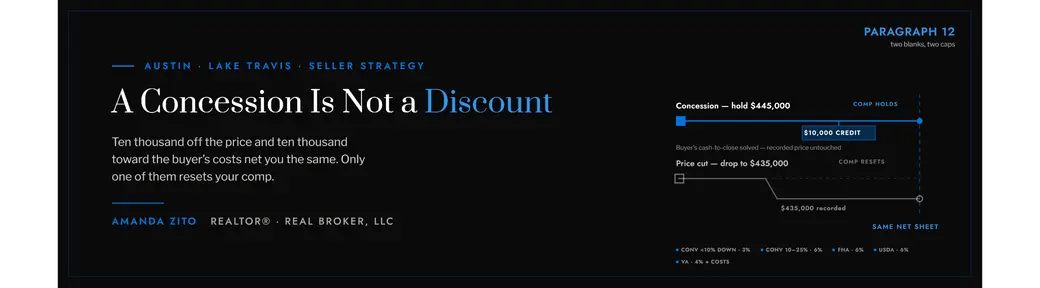
What is a seller concession in Texas? A seller concession is money the seller agrees to pay toward the buyer's costs — closing costs, prepaids, or a rate buydown — written into the contract instead of taken off the sales price.
Most Austin sellers hear "concession" and translate it to "discount." That's the wrong frame, and it costs people money.
A price reduction and a concession of the same dollar amount hit your net sheet identically. They do not hit the buyer identically, and they do not hit your listing identically. One quietly solves the buyer's cash problem. The other resets your comp and tells every future buyer what your home is worth.
This post covers what concessions are under Texas contracts, where they live in the paperwork, what the loan programs actually allow, and when offering one makes sense in the Austin market right now.
What Counts as a Seller Concession in Texas
A concession is anything of value the seller contributes to reduce what the buyer has to bring to closing. In Central Texas transactions, the common ones are:
- Buyer closing costs — lender fees, title fees, half the escrow fee, recording
- Prepaids — the first year of homeowner's insurance, property tax escrow deposits, prepaid interest
- Rate buydown — discount points that permanently lower the rate, or a temporary 2-1 buydown that lowers the payment for the first two years
- Repair allowance — a credit in place of doing the work yourself
- Residential service contract — a home warranty, capped at a dollar amount the seller agrees to pay
- Owner's title policy — in Texas this is negotiable in the contract, and buyer-side agents in Austin increasingly ask for it
Lowering the list price is not a concession. Neither is a side agreement. If the seller is paying it, the lender has to see it, and it has to appear on the closing disclosure.
Where Concessions Live in the Texas Contract
This is where Texas differs from California, and it's the part most sellers never see until they're reading an offer.
Paragraph 12 — Settlement and Other Expenses. This is where seller-paid buyer expenses get capped. The current TREC One to Four Family Residential Contract (Resale) separates a seller contribution toward the buyer's broker fee from a separate cap on other buyer expenses. Two different blanks, two different dollar amounts. If a buyer's agent fills in both and you only read one, you agreed to more than you think.
Paragraph 6A — Owner's Title Policy. The parties select who pays. Texas custom in much of the state has been seller-paid, but custom is not the contract. Read the box.
Paragraph 6C — Survey. Either you deliver an existing survey with a T-47 declaration, or someone pays for a new one. In older Travis and Hays County neighborhoods where the existing survey has aged out or improvements were added, this quietly becomes a several-hundred-dollar concession.
The option period. Repair credits are almost always negotiated here, after the inspection, using an Amendment. This is why holding some room back matters — the option period is the second negotiation, and you want dry powder when it arrives.
Texas has no state real estate transfer tax, so the concession conversation here is about lender costs and title, not transfer stamps. That's a meaningful difference for sellers relocating from California.
Loan Program Caps: How Much a Buyer Can Actually Accept
A buyer cannot take more concession than their loan program allows. Anything above the cap is wasted — it gets stripped at underwriting or forces a re-trade days before closing.
| Loan type | Maximum seller contribution |
|---|---|
| Conventional, less than 10% down | 3% of price or appraised value, whichever is less |
| Conventional, 10–25% down | 6% |
| Conventional, 25%+ down | 9% |
| Conventional, investment property | 2% |
| FHA | 6% of the lesser of price or appraised value |
| USDA | 6% |
| VA | 4% in concessions, plus reasonable and customary closing costs on top |
Two things sellers should take from that table.
First, the buyer with the smallest down payment — the one most likely to ask for help — has the tightest cap. On a $435,000 Austin home with 5% down, a conventional buyer can accept about $13,000. Not more.
Second, VA is the outlier, and Austin has a large military and veteran buyer pool between Fort Cavazos, Randolph, and the relocation traffic. A VA buyer can absorb far more seller help than a conventional buyer at the same price. If your buyer pool skews VA, a concession is a more efficient tool than a price cut.
Concession vs. Price Reduction: Run the Math
Say you're at $445,000 and stalled. You can drop to $435,000, or you can hold price and offer $10,000 toward the buyer's costs.
The $10,000 price cut lowers the buyer's payment by roughly $50–60 a month. It does not help them get to the closing table. It resets your comp permanently, and it becomes the number every appraiser and every neighbor uses next year.
The $10,000 concession covers most of that buyer's cash to close, or funds a 2-1 buydown that cuts their payment by several hundred dollars a month in year one. It closes the affordability gap where the buyer actually feels it. Your recorded sale price stays at $445,000.
Your net is the same either way. The buyer's experience is not.
The exception: price cuts work when they move you across a search filter. Going from $455,000 to $449,000 puts you in front of everyone shopping under $450,000. No concession does that, because buyers do not search by concession.
Should Austin Sellers Offer Concessions Right Now?
Usually not upfront. Almost always in reserve.
The Austin metro had 4.7 months of inventory in July 2026 with a median sale price of $435,000, up about 1% year over year, according to Unlock MLS. That is a balanced market — not the distressed one the headlines suggest. Nationally, sellers gave concessions in roughly 46% of sales in spring 2026, per Redfin, but Austin has historically run well below the national share.
Advertising "seller will contribute $15,000" in the MLS remarks before you have an offer does two things: it caps your outcome, and it signals you're motivated. Buyers who were going to pay full price now ask for the credit too.
Offer a concession when:
- You've had solid showing traffic and no offers, and feedback points to payment or cash-to-close, not condition or price
- An offer comes in low and you'd rather protect the comp than cut price
- Inspection turned up real items and you'd rather credit than manage contractors
- Your buyer is VA or FHA and short on cash, not on qualification
- You're competing against similar homes and need a differentiator that doesn't touch your list price
Hold back when:
- You're in your first two weeks on market with strong activity
- Showings are low — that's a price or photo problem, and no concession fixes it
- You haven't confirmed the buyer's loan type and cap
- Your buyer is putting 25% down and has plenty of cash; the concession is just margin to them
What This Means for You
Concessions are a closing tool, not a marketing tool. Keep them off the listing and in your back pocket, know your buyer's cap before you counter, and make sure whatever you agree to is written into the right paragraph of the contract with a number you chose.
If showings are strong and offers aren't coming, a concession is often the fix. If showings are weak, it never is.
Frequently Asked Questions
Do seller concessions lower my sale price in Texas? No. The recorded sale price stays where you agreed. A concession appears on the closing disclosure as a seller-paid credit, so your net drops but the comp holds. That distinction matters when your neighbors sell next year.
Can a seller concession hurt the appraisal? It can. Appraisers are required to consider sales concessions when comparing properties, and unusually large credits may be adjusted for. Keep the concession within normal ranges for the price point and it typically doesn't affect value.
Who pays the owner's title policy in Austin? It's negotiable and selected in Paragraph 6A of the TREC contract. Seller-paid has been the more common custom in Central Texas, but buyers ask for changes to this regularly in a balanced market. Don't assume — read the box on every offer.
Thinking about selling in Austin or the Lake Travis area?
Before you agree to a concession — or turn one down — it's worth running the numbers on your specific home, price point, and likely buyer pool. Call or text me and we'll go through it.
Amanda Zito, REALTOR® Real Broker, LLC CA DRE #01740063 | TX TREC #840088 SoldByZito.com | 949-484-9486
Categories
Recent Posts










“Your goals come first. My job is to help you make the right move.”