

Home Inspection Isn't Pass/Fail: Inland Empire Sellers
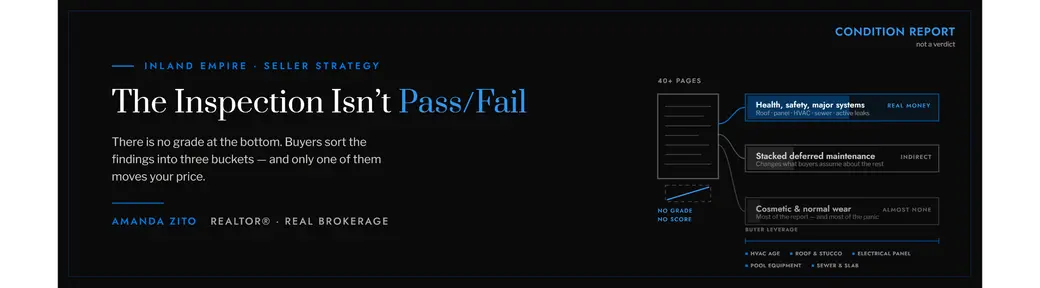
Can a house fail a home inspection? No. There is no pass, no fail, and no score. A home inspection is a condition report, and every home in Riverside and San Bernardino County produces one with findings on it. What matters is which findings a buyer can act on.
The report lands in your inbox on a Thursday. Forty-something pages. Red icons down the margin. Words like deficiency, recommend evaluation by a licensed contractor, safety hazard.
Most sellers read three pages, feel their stomach drop, and conclude the same thing: we failed.
You didn't. You can't. There's no line at the bottom where the inspector writes a grade. What you're holding is a list of observations about a house that human beings have been living in — and if your Rancho Cucamonga or Fontana home had produced a clean report, I'd want to know which inspector wrote it.
The problem isn't the report. It's that sellers read it as a verdict and start negotiating from shame instead of from information.
The length of the report tells you nothing
Inspectors document. That's the job. A missing outlet cover and a compromised roof deck both get an entry, both get a photo, and to an untrained eye both look about equally alarming in the margin.
A thorough inspector on a well-maintained 1990s Corona tract home will still generate dozens of line items. A rushed inspector on a house with real problems might generate fewer. Page count measures the inspector, not the house.
So stop counting items. Start sorting them.
Buyers sort findings into three buckets — only one has real leverage
Every buyer, consciously or not, runs the report through the same filter:
| Bucket | What's in it | Effect on your price |
|---|---|---|
| Health, safety, and major systems | Roof, electrical panel, foundation movement, sewer line, HVAC at end of life, active leaks | Real. This is where money moves. |
| Stacked deferred maintenance | Many small unfinished items in a pattern | Real, but indirect — it changes what buyers assume about the rest of the house |
| Cosmetic and normal wear | Sticking windows, hairline stucco cracks, worn caulk, missing covers | Almost none, unless the buyer is fishing |
Most of the report lives in bucket three. Most seller panic also lives in bucket three.
Your job before you respond is to move each item into the right bucket honestly — including the ones you'd rather file under "cosmetic" that actually belong in bucket one.
What tends to surface in Inland Empire inspections
The housing stock and the climate here produce recurring themes. In Riverside and San Bernardino County homes, the items I see drive real negotiation most often are:
- HVAC age and condition. Systems here run hard from May through October. An aging unit is a bucket-one item to a buyer facing a Hemet or Victorville summer.
- Roof and stucco. Sun exposure, not rain, does most of the damage. Buyers ask about remaining life, not appearance.
- Electrical panels. Older tract homes across the region sometimes carry panel types that insurers and buyers now treat as a problem.
- Pool and spa equipment. Common in this market, expensive to correct, and frequently past service life.
- Sewer laterals and slab movement. Not on a standard inspection at all — buyers order these separately, and the findings land later in escrow.
- Water heater strapping and other seismic items. Small fixes, but they read as safety findings, which gives them outsized weight.
Notice how many of those are systems a buyer can't see during a showing. That's exactly why the report matters to them: it's their first real look behind the drywall.
The request for repairs is a negotiation, not a sentence
In California, an inspection report doesn't obligate you to do anything. It gives the buyer information, and their contingency gives them the right to ask, walk, or proceed.
When the request comes, you have three moves:
Do the repair. Cleanest for the buyer, riskiest for you. You're now the general contractor on a deadline, the buyer gets to re-inspect the work, and anything the contractor uncovers becomes a new conversation.
Offer a credit instead. Usually the stronger seller position. The number is fixed, the scope can't creep, the buyer chooses their own contractor, and nobody re-inspects your work at day 14. Credits do have limits depending on the buyer's loan, so confirm the structure before you offer one.
Decline, in whole or part. A real option, especially when the request wanders into cosmetic territory or when your home is priced with the condition already built in. Declining is a leverage question: how replaceable is this buyer, and how honest are you being with yourself about the answer?
Where sellers actually lose money: surprise, not condition
Here's the uncomfortable part. The finding usually isn't what costs you. The timing is.
A known condition, disclosed upfront and reflected in your list price, gets absorbed. Buyers evaluate it with a calculator before they've committed anything.
The identical condition, discovered on day 12 of escrow, gets evaluated by a buyer who is now anxious, already spent money on inspections, and wondering what else you didn't mention. That buyer doesn't ask what the repair costs. They ask what the repair costs plus what else is hiding. And they ask it from a position where you have one buyer and a listing that will look re-listed if this falls apart.
Same house. Same defect. Very different number.
Should you get a pre-listing inspection?
It's the right call for some sellers and a genuine trade-off for all of them, so here's the honest version.
What you gain: time to get bids instead of accepting the buyer's contractor estimate, the ability to price the home with the condition already accounted for, and the removal of the mid-escrow ambush.
What you take on: in California, once you know about a material condition, you have to disclose it. A pre-listing inspection converts unknowns into disclosures. That's not a reason to skip it — undisclosed problems have a way of surfacing anyway, and they surface at the worst possible moment — but anyone who sells you a pre-inspection as a free upside is skipping half the equation.
The sellers it helps most: older homes, homes with visible deferred maintenance, and anyone selling as-is who needs the price to be defensible.
"As-is" doesn't mean what most sellers think
Listing as-is signals you don't intend to make repairs. It does not eliminate your disclosure obligations, and it does not remove the buyer's right to investigate and cancel during their contingency period.
As-is is a pricing and expectation strategy. It sets the frame before offers come in, which is where it does its actual work. It is not a shield, and treating it as one is how sellers end up surprised twice.
What this means for you
Read the report all the way through before you react to any of it. Sort each item into a bucket. Get real numbers on anything in bucket one, from someone who does the work, before you respond to a single request. Then negotiate from what the finding costs — not from how the report made you feel on Thursday afternoon.
The buyer isn't grading you. They're pricing risk. Give them less of it to price.
Frequently Asked Questions
Can a home fail an inspection in California? No. Inspectors report conditions; they don't issue a pass or fail. Some findings may affect a buyer's loan or insurance, but that's a lender or carrier decision — not an inspection result.
Do I have to fix everything on the inspection report? No. A California seller isn't required to make repairs. The buyer can request them, and you can repair, offer a credit, or decline. Disclosure of known material facts is a separate obligation and does apply.
Is a pre-listing inspection worth it for an Inland Empire home? Often, particularly for older homes in Riverside or San Bernardino County or homes being sold as-is. The upside is control over timing and cost estimates. The trade-off is that anything you learn becomes something you must disclose.
Thinking about selling in the Inland Empire?
If you're weighing a pre-listing inspection, sitting on a report you're not sure how to read, or trying to decide whether to fix, credit, or hold firm — let's go through it together before you respond to anyone.
Call or text 949-484-9486 and we'll look at your specific report and your specific market.
Amanda Zito, REALTOR® Real Brokerage CA DRE #01740063 | TX TREC #840088 soldbyzito.com
Further reading on home inspections and market conditions: InterNACHI Standards of Practice, National Association of REALTORS® Research & Statistics, Redfin Data Center.
Categories
Recent Posts











“Your goals come first. My job is to help you make the right move.”