

The Seller Walk-Through Test | Inland Empire Sellers
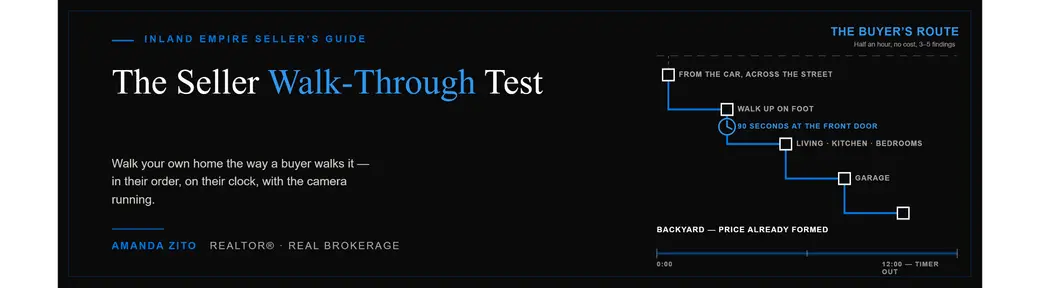
How can I tell what buyers will notice about my house before I list it? Walk your own home the way a buyer walks it — from the curb, in order, on a clock, with your phone camera running. Most Inland Empire sellers have never done this, and it's the cheapest pre-list diagnostic there is.
You have walked through your front door thousands of times. That is exactly the problem.
A buyer walks through it once. They spend somewhere between ten and twenty minutes inside, they're talking to their agent the whole time, and they form a price opinion before they get to the backyard. You cannot un-know your house, but you can borrow the buyer's route, the buyer's clock, and the buyer's questions — and see what shows up.
This is the walk-through test. It takes about half an hour. It costs nothing. And it usually finds three to five things you would have paid for later in the form of a price reduction or a repair request.
Why You Can't See Your Own House
Familiarity does two things to a seller.
First, it edits. You stopped seeing the scuffed baseboard in the hallway sometime around year two. Your brain files it under "normal" and stops rendering it. A buyer's brain renders it immediately, because everything is new information to them.
Second, it explains. You know why the guest bathroom door sticks — the house settled, it's been like that since 2015, it's nothing. The buyer doesn't get that explanation. They get a door that sticks, and they quietly wonder what else moved.
That gap between what you see and what a buyer sees is where negotiating leverage goes to die. The test closes it.
How to Run the Test
Do this on a weekday, at roughly the time buyers actually tour your Riverside County or San Bernardino County neighborhood — late afternoon on a weekday, or midday Saturday. Light matters. So does street noise.
Step 1: Start in the car, across the street
Park where a buyer would park. Sit for thirty seconds before you get out. What do you see, in order? The house, or the neighbor's trailer? The roofline, or the three different colors of stucco patch?
Take a photo from the driver's seat. That framing is close to what your listing's exterior photo will look like, and close to what a buyer will compare against the four other homes they're seeing that afternoon.
Step 2: Walk up, don't drive up
Buyers arrive on foot from the street. You arrive by garage. You have possibly never approached your own front door the way every single buyer will.
Walk it. Notice the walkway, the porch light, the address numbers, the front door itself.
Step 3: Stand at the front door for ninety seconds
This is the most underrated moment of any showing. The buyer's agent is working the lockbox, fumbling with the app, and the buyer is standing there with nothing to do but stare at your entry.
Stand there. Ninety seconds. Look at what they'll be looking at — the door hardware, the cobwebs in the corner of the porch ceiling, the paint on the trim, the mat.
Step 4: Walk your standard tour route, in order
Buyers move through a home in a predictable pattern: entry, main living space, kitchen, then bedrooms, then primary suite, then garage, then backyard. Follow that order even if it's unnatural for you.
Set a twelve-minute timer. Do not stop to fix anything. Do not straighten a rug. Walk it, film it on your phone, and let the clock run out.
Step 5: Watch the video with the sound on
This is where the test does its work. On video, in your own house, you will notice:
- The floors. Every squeak, every transition strip, every soft spot.
- The light. A room that reads "cozy" in person often reads "dark" on camera — and every buyer photographs your home the same way.
- The sound. The HVAC kicking on. The neighbor's dog. The freeway hum you stopped hearing years ago.
- The scale. A sectional that swallows the living room makes a Rancho Cucamonga family room look small. Buyers don't mentally remove your furniture. They should, but they don't.
The Three Questions at Every Stop
At each room, ask these in order:
- What do I notice first? If the first thing is a feature, good. If the first thing is a repair, that room is costing you money.
- What would I ask about if this weren't mine? Water stain on the ceiling. Newer patch on the drywall. A window that doesn't match the others. Write the question down — because a buyer will ask it, and you want the answer ready before they do.
- What would I assume this costs to fix? Buyers are terrible estimators, and they always guess high. A $200 fix reads as a $2,000 unknown. That gap is the point.
That third question is the whole reason small, visible, unfinished items are so expensive. A buyer can't tell the difference between a cosmetic issue and a symptom, so they price for the symptom.
What to Do With Your List
You'll end up with somewhere between five and twenty items. Sort each one into three buckets:
Fix it. Cheap, visible, and it removes a question. Burned-out bulbs, sticking doors, torn screens, cracked switch plates, a dead patch of landscaping. This bucket is almost always worth doing, because you're not buying an upgrade — you're buying the absence of doubt.
Disclose it. Real, known, and either expensive or not worth repairing. In California, you're disclosing it anyway. The strategic move is disclosing it early and in writing, with any receipts or contractor bids attached, so it lands as transparency instead of as a discovery during inspection.
Price it. Structural, systems-level, or dated in a way that no weekend fixes. The roof, the panel, the original kitchen. You don't have to renovate. You do have to be honest about where your home sits against the other homes a buyer is seeing in your price band that same weekend.
The mistake is letting an item drift between buckets — half-fixing something, or fixing it in a way that's visibly unfinished. That's worse than leaving it alone.
The Honest Limitation of This Test
You are still the worst possible person to walk your own home. You will grade generously, and you will explain things away in your head that you'd never explain away in someone else's house.
So run it twice. Once yourself, once with someone who has never been inside — a friend from another neighborhood, a family member, anyone willing to be blunt. Give them the same three questions and ask them not to be polite about it.
Then have your listing agent do it. A good one is running this exact test in their head the first time they see your home in Riverside, Corona, Redlands, or anywhere across the Inland Empire. Ask them to say it out loud.
FAQ
How far before listing should I do the walk-through test? Three to four weeks out. That gives you time to complete the "fix it" list without rushing, gather bids for anything larger, and still hit your target list date.
Should I do this if I'm selling as-is? Yes — arguably more so. Selling as-is doesn't remove disclosure obligations in California, and it doesn't stop buyers from pricing in unknowns. Knowing your list means you can decide what to disclose up front rather than discovering it during the inspection period.
What if the test turns up something major? That's the test working. Finding it now means you can get a bid, decide whether to repair or credit, and price accordingly. Finding it during escrow means you're negotiating from behind, usually with a buyer who now doubts everything else you said.
Ready to Walk It With Someone Who Sees What Buyers See?
If you're thinking about selling in the Inland Empire, I'll walk your home with you and tell you exactly what I'd expect buyers to react to — what's worth fixing, what's worth disclosing, and what's simply worth pricing for.
Call or text 949-484-9486 to set up a walk-through.
Amanda Zito, REALTOR® Real Brokerage CA DRE #01740063 | TX TREC #840088 soldbyzito.com
Further reading on buyer behavior and local market conditions: National Association of REALTORS® Research & Statistics, Redfin Data Center, Realtor.com Research.
Categories
Recent Posts









“Your goals come first. My job is to help you make the right move.”