

Buy Before You Sell in the Inland Empire (58 characters)
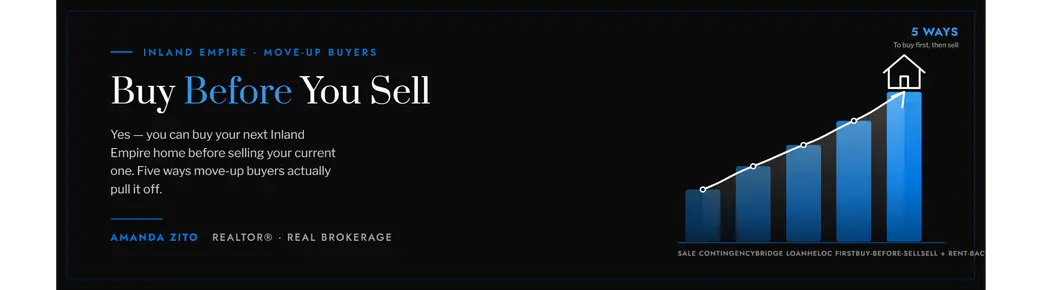
Can you buy a home in the Inland Empire before selling your current one? Yes. Most move-up buyers in Riverside and San Bernardino counties do it one of five ways: a home sale contingency, a bridge loan, a HELOC pulled before listing, a buy-before-you-sell program, or selling first with a rent-back.
The real question isn't "can I" — it's "how"
Almost every move-up seller I work with in the Inland Empire asks this in the first ten minutes. You've outgrown the house in Eastvale, or you're ready to trade the Corona commute for something in Redlands, and you're staring down the same problem: your down payment is locked in the walls of the house you're living in.
The fear underneath the question is usually one of two things. Either you're afraid of owning two homes and two mortgage payments at once, or you're afraid of selling, having nowhere to go, and moving twice with a storage unit in between.
Both are solvable. But they're solved differently, and the right path depends on your equity, your debt-to-income ratio, and how much uncertainty you can live with. Here's how each option actually works.
Option 1: Buy with a home sale contingency
This is the most common approach, and the most misunderstood. A home sale contingency means your purchase is conditional on your current home selling first. If yours doesn't sell, you walk away from the new one without losing your deposit.
The upside: You're protected. You never carry two mortgages.
The catch: Your offer is weaker. In a competitive Riverside County price range with multiple offers on the table, a contingent offer usually loses to a clean one. Sellers don't want their timeline tied to a house they've never seen in a market they aren't tracking.
Where this works best: on homes that have been sitting, in slower price bands, or when the seller has their own timing problem and your flexibility is actually an asset. That's a conversation your agent should be having directly with the listing agent before you write.
Option 2: A bridge loan
A bridge loan is short-term financing secured against your current home's equity, used to fund the down payment on the next one. You close on the new house, move, then sell the old one and pay the bridge loan off.
The upside: You make a non-contingent offer. You move once. You prep and show your old house empty, which almost always sells better.
The catch: Bridge loans carry higher rates and fees than a standard mortgage, and you have to qualify carrying both payments. Lenders also want to see real equity in the departing property — this isn't a tool for someone who bought in Ontario two years ago with 5% down.
The Consumer Financial Protection Bureau has plain-English explanations of how home equity borrowing works if you want to read up before you talk to a lender.
Option 3: Pull a HELOC before you list
A home equity line of credit on your current house can fund the down payment on the next one. Functionally similar to a bridge loan, usually cheaper.
The critical detail: you have to set it up before you list. Most lenders will not open or fund a HELOC on a property that's actively on the market or in escrow. I've watched this window close on Rancho Cucamonga sellers who waited two weeks too long.
If buying first is even a possibility for you, talk to a lender about a HELOC months before you plan to move — not the week you decide.
Option 4: Buy-before-you-sell programs
A category of companies and lender programs will either buy your next home in cash on your behalf and sell it back to you after your current home closes, or guarantee a backstop purchase of your existing home if it doesn't sell in a set window.
The upside: You get to make a cash offer, which is the strongest position in any Inland Empire negotiation.
The catch: These programs charge for the convenience, and the fee structures vary enormously. Some are reasonable. Some quietly cost you more than a bridge loan and a price reduction combined. Read the full fee schedule and the backstop price — that's the number that matters, not the marketing.
I don't have a financial relationship with any of these companies, so I'll walk through the math with you on whichever ones you're considering.
Option 5: Sell first, negotiate a rent-back
The reverse approach: sell your Murrieta or Temecula home, then negotiate a rent-back (also called a seller leaseback) that lets you stay in the house for 30 to 60 days after closing while you buy and move into the next one.
The upside: You know your exact proceeds. You're a non-contingent buyer with cash in hand — the strongest possible position. No double payments, no bridge loan fees.
The catch: You're on a clock, and the clock is somebody else's. If you don't find the right house in that window, you're renting short-term or moving twice. Rent-backs longer than 60 days can also create loan complications for your buyer, which limits how much runway you can negotiate.
In practice, this is the option I recommend most often to sellers with a lot of equity and a specific, narrow target — someone who knows they want a particular Redlands pocket and will recognize the right house when it hits.
How to decide: four questions
- How much equity do you actually have? Not the Zestimate minus the loan balance — your net proceeds after commission, escrow, county transfer fees, and repairs. If that number is thin, buying first is off the table regardless of how you feel about it.
- Can you qualify carrying both payments? Your lender will tell you in a day. This single answer eliminates half the options for most people.
- How specific is your target? If you'll take any four-bedroom in a ten-mile radius, selling first is low-risk. If you want one particular street in Riverside, you may need to be ready to buy the moment it lists.
- What actually keeps you up at night? Two mortgage payments, or having nowhere to live? Be honest. The best strategy on paper is the wrong one if you can't sleep through it.
What Inland Empire market conditions mean for your timing
Strategy follows the market, and the Inland Empire isn't one market. Timelines and negotiating leverage in Corona look different than in the High Desert, and entry-level price bands behave differently than move-up ones in the same city.
Before you commit to buying first or selling first, get current days-on-market and absorption data for your specific price band and ZIP — not a countywide average. Freddie Mac publishes weekly mortgage rate data and the National Association of Realtors tracks national inventory, but the number that decides your strategy is hyperlocal: how long homes like yours are actually taking to sell right now.
That's the analysis I run before recommending an approach to anyone.
Frequently asked questions
Do I need to sell my current home before I can get pre-approved for the next one? No. A lender can pre-approve you carrying both mortgages if your income and debt-to-income ratio support it. If they don't, the lender can pre-approve you contingent on the sale of your current home, which tells you exactly which strategy is available to you.
Will a home sale contingency kill my offer in the Inland Empire? It weakens it, but it doesn't always kill it — especially on properties that have been on the market a while or where the seller has their own timing constraints. The stronger your other terms are, the more a seller can absorb the contingency.
What happens if I buy first and my current home doesn't sell? You carry both payments until it does, which is why lenders stress-test this before approving a bridge loan or a non-contingent purchase. The bigger risk is usually pricing, not demand — a correctly priced Inland Empire home sells. Build your plan around a realistic list price, not an optimistic one.
Let's map out your specific numbers
There's no universal right answer here — there's only the right answer for your equity, your loan qualification, and your tolerance for uncertainty. Most of my move-up clients figure out which of these five paths fits in a single conversation.
If you're thinking about a move anywhere in the Inland Empire — Riverside, Corona, Eastvale, Ontario, Rancho Cucamonga, Redlands, Murrieta, or Temecula — schedule a private consultation and we'll run your actual net proceeds, talk through financing options, and build a timeline that works.
Amanda Zito Inland Empire Real Estate Agent | Real Brokerage Serving Riverside and San Bernardino Counties
Categories
Recent Posts










“Your goals come first. My job is to help you make the right move.”