

Can You Keep Your Clients When You Change Brokerages?
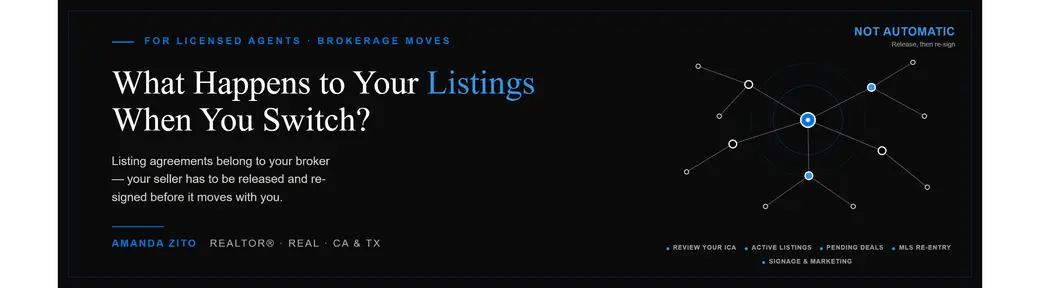
Can you keep your clients when you change brokerages? Yes. The relationships you've built follow you. What doesn't automatically follow are your signed agreements and any brokerage-provided leads — those belong to the brokerage. Your sphere, your past clients, and your reputation are yours.
The fear that keeps agents stuck
Most agents who are unhappy at their brokerage don't stay because of the split. They stay because of a quiet, nagging question: if I leave, do I lose everyone I've worked with?
It's a reasonable fear. You've spent years earning trust, showing up to closings, remembering birthdays, and answering the phone at 8 p.m. on a Sunday. The idea that a logo change could undo that is genuinely unsettling.
Here's the reality after 20 years in this business and a brokerage change of my own: clients hire people, not companies. Almost nobody chose you because of the sign in the yard. They chose you because you returned their call, told them the truth about their price, and made a stressful transaction feel manageable. That doesn't live at your brokerage. It lives with you.
That said, "your relationships travel with you" is not the same as "you can do whatever you want on your way out the door." There's a right way to handle a brokerage change, and it starts with knowing the difference between a relationship and a contract.
Relationships are yours. Contracts are not.
This is the single most important distinction to understand before you switch.
In every state, including California and Texas, listing agreements and buyer representation agreements are legally between the client and the brokerage — not between the client and you. You are the licensed agent performing the work under your broker's supervision. The National Association of REALTORS® and your state licensing authority both structure it this way, and it's not something your brokerage invented to trap you.
So when you leave:
- The agreement stays with the brokerage you signed it under.
- The relationship goes wherever you go.
Practically speaking, that means a past client who loved working with you is free to call you at your new brokerage tomorrow. A client with an active signed agreement has a decision to make, and that decision typically involves your former broker. Those are two very different conversations, and confusing them is how agents get themselves into trouble.
What actually comes with you
Your past clients and your sphere
Nobody owns a relationship. Your former clients, your neighbors, your kid's soccer parents, the couple you helped buy in 2019 — none of them are contractually bound to a brokerage. They can work with you again wherever you hang your license.
Your database
Contacts you sourced yourself — your sphere, your open house sign-ins, your personal marketing leads, your referrals — are generally yours to keep. Contacts that came from a brokerage-provided lead program, a company website, or a team lead source are usually a different story, and that difference is spelled out in your paperwork.
Your brand and your reputation
Your personal brand, your content, your reviews on third-party platforms, your social following, your local reputation — all of it is portable. If you've built a business on being a trusted local expert rather than on borrowed brand equity, you're in a strong position to move.
Your referral partners
Lenders, inspectors, contractors, escrow officers, and out-of-area agents who refer you business are working with you. Those relationships almost always survive a brokerage change intact.
What usually stays behind
Be honest with yourself about this column, because it's where the surprises happen:
- Brokerage-provided leads and their contact records — including anything living inside a company-owned CRM
- Your brokerage email address and any phone number issued by the company
- Company-hosted websites, IDX feeds, and landing pages built on their platform
- Marketing assets using brokerage branding, which you'll need to retire
- Team-generated leads, if you're on a team with its own agreement — team agreements are frequently stricter than the brokerage agreement itself
Read your independent contractor agreement before you announce
Before you tell a single person you're leaving, pull out your ICA and any team agreement and look specifically for:
- Non-solicitation language. Some agreements restrict you from actively soliciting brokerage clients or fellow agents for a set period. Note the difference between soliciting someone and announcing a move — but know that where that line sits varies by agreement and by state.
- Lead payback or referral fee clauses. If you took company leads, you may owe a referral fee on those closings even after you leave.
- Notice requirements. How much notice, and in what form.
- Pending-transaction terms. How in-progress deals are handled and paid.
- Database and CRM ownership language. This is the clause most agents have never read.
Two housekeeping items worth handling early: export your own contacts from any personal CRM while you still have access, and confirm your license transfer process with the California DRE or Texas TREC so there's no gap in your ability to work.
None of this is legal advice — it's a checklist. If your agreement is ambiguous or your situation is complicated, spend the money on an hour with a real estate attorney. It's cheap compared to the alternative.
How to tell your clients
Keep it short, forward-looking, and free of drama. The message that works is some version of:
"I've moved my license to Real. Nothing changes about how I work with you — same phone number, same email, same person. The move gives me better tools and better support, which means I can do a better job for you."
Three rules: don't disparage your former brokerage, don't over-explain, and don't make your clients feel like they've been dropped into the middle of a business dispute. Most people will react with a shrug and a "congrats." That's the goal.
Why the transition is cleaner at Real
Part of what makes a move stressful is the operational drag — new office, new systems, new email, rebuilding your marketing from scratch while trying to keep deals moving.
Real was built cloud-based from day one, which removes most of that friction. There's no office to relocate to and no franchise template to conform your brand to. Your business is your business; the brokerage is infrastructure underneath it. The company has grown to more than 35,000 agents across the U.S. and Canada and now ranks among the top five U.S. brokerages by transaction sides and volume in the 2026 RealTrends Verified rankings.
Two things matter most for agents worried about client continuity. First, the platform is national — if you're licensed in more than one state, as I am in California and Texas, you're not stitching together two different brokerages to serve clients relocating between them. Second, Real doesn't ask you to bury your personal brand under a corporate one, so the identity your clients already recognize stays intact through the move.
FAQ
Do I have to tell my clients I'm changing brokerages? For clients with an active agreement, yes — they're entitled to know who is representing them and under which brokerage. For past clients, it's a courtesy and a smart marketing touchpoint, not a legal requirement.
Can my old brokerage stop my past clients from working with me? No. Past clients with no active agreement are free to hire whoever they want. What your brokerage can enforce is the specific language in your ICA about soliciting clients and recruiting agents, which is why reading it first matters.
How long does it take to transfer my license? It varies by state and by how quickly your current broker releases you. In both California and Texas, the transfer itself is generally a matter of days once the paperwork is submitted, though board and MLS transfers can add a little time.
Thinking about a move?
If you're weighing a brokerage change and want a straight answer about what it would actually look like for your business — your clients, your pipeline, your income — call or text me. No pressure and no pitch deck; just a real conversation with someone who has made the move and helps agents do the same in both California and Texas.
Amanda Zito REALTOR® | Real Brokerage — Inland Empire & High Desert, CA (DRE #01740063) Real Broker, LLC — Lake Travis, TX (TREC #840088)
Categories
Recent Posts











“Your goals come first. My job is to help you make the right move.”