

Do Homes in Hudson Bend Hold Their Value?
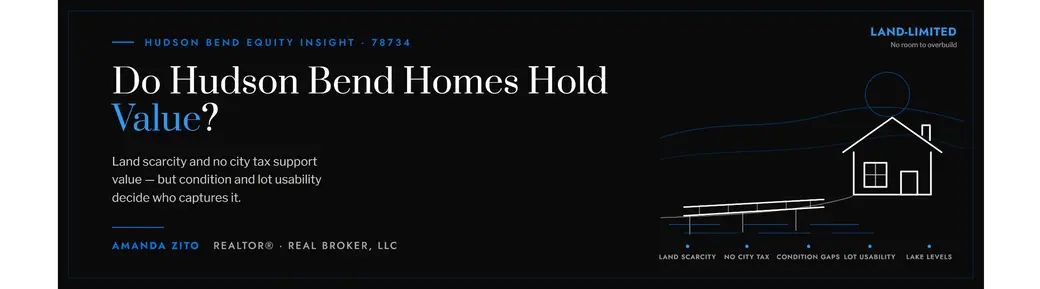
Meta title: Do Homes in Hudson Bend Hold Their Value?
Meta description:
Do homes in Hudson Bend, TX hold their value? Generally, yes. Hudson Bend sits on a land-limited peninsula on Lake Travis in unincorporated Travis County, and that scarcity — plus no city property tax — has historically supported long-term value. Condition and lot usability matter more here than in most Austin-area markets.
Why This Question Comes Up So Often Out Here
If you own in Hudson Bend, you've probably heard some version of this at a neighbor's barbecue: lake markets are volatile, values swing with the water level, and the whole area is one drought away from a correction.
There's a kernel of truth in it, which is why it sticks. But it's also a blunt instrument. Value retention in the 78734 ZIP code isn't one number applied evenly across the peninsula. Two homes a quarter mile apart — same square footage, same year built — can behave completely differently over a ten-year hold, and the reasons are usually predictable.
If you're sizing up your equity right now, whether you're planning to sell this year or just want to know where you stand, here's what actually drives the answer.
What Protects Value in Hudson Bend
Land supply is genuinely limited
Hudson Bend is a peninsula. It's bounded by water on three sides, with Mansfield Dam at one end and RR 620 as the spine feeding everything in and out. There is no meaningful path to large-scale new subdivision development the way there is in Bee Cave, Dripping Springs, or the Highway 71 corridor.
That constraint is the single strongest thing working in your favor as an owner. When a market can't add much inventory, existing homes absorb demand instead of competing with a hundred new builds down the road.
No city property tax
Hudson Bend is unincorporated. You're paying Travis County, Lake Travis ISD, and your water district — but not a municipal rate on top of it. Compared with an incorporated neighbor like Lakeway, that difference shows up in a buyer's monthly payment, and buyers absolutely do the math.
Lower carrying cost widens your buyer pool. A wider buyer pool is what holds value when the market softens. You can check how your own parcel is assessed through the Travis Central Appraisal District.
Lake access as a durable amenity
Marina access, boat storage, and proximity to the water are amenities that can't be replicated inland. Even non-waterfront homes in Hudson Bend benefit from being ten minutes from a slip. That's a structural advantage over comparable homes in landlocked parts of Travis County, and it doesn't erode over time the way a trendy finish package does.
Proximity to Austin employment
You're roughly 30 to 45 minutes from downtown Austin depending on traffic, and much closer to the tech corridor along 620 and 183. Hudson Bend functions as a legitimate commuter market, not purely a second-home market. Homes with year-round resident demand hold value more consistently than pure vacation markets, because the buyer pool doesn't disappear in the off season.
What Puts Hudson Bend Equity at Risk
This is the part most owners underweight.
Condition gaps are punished harder here
Hudson Bend has an unusually wide spread of housing stock — 1970s and 1980s lake cottages sitting near new construction on the same street. In a subdivision where everything was built in 2015, a dated kitchen costs you a modest adjustment. Here, an unrenovated home is competing directly against a fully renovated one in the same price band, and buyers make that comparison in a single afternoon of showings.
Deferred maintenance doesn't just cost you the repair estimate. It costs you the negotiating position.
Lot usability varies enormously
Steep grade, limited flat yard, difficult driveway access, and tree-heavy topography are common across the peninsula. Two homes with identical interiors can appraise and sell differently based entirely on whether the lot is usable. If your lot is flat, fenced, and functional, that is a real and durable value driver — and if it isn't, you need a pricing strategy that accounts for it rather than hoping buyers overlook it.
Septic, well, and water district variables
Parts of Hudson Bend are on septic; parts are on district service. Well versus WCID water matters too. These affect financing, inspection outcomes, and how smoothly a transaction closes. Systems that are documented, permitted, and recently serviced protect your value. Undocumented ones create buyer hesitation, and hesitation is what produces price reductions.
Lake level perception
Lake Travis is a managed reservoir — levels fluctuate by design, not just by drought. The Lower Colorado River Authority manages that system. Long-term owners understand the cycle; out-of-area buyers often don't, and a low-water year can affect what waterfront and water-view homes command in the short term. If your value is heavily tied to the view or to a dock, timing matters more for you than for an interior-lot owner.
Upper price tiers move differently
Higher-priced homes across the Lake Travis area generally sit on the market longer and draw from a thinner buyer pool. That's not a Hudson Bend problem specifically — it's true in most luxury segments — but it means the "does it hold value" answer depends partly on which price band you're in. Appreciation and liquidity are not the same thing.
So What Does This Mean for Your Equity?
If you've owned in Hudson Bend for five years or more, you're very likely sitting on meaningful equity — driven by land scarcity, the tax structure, and sustained demand for lake-adjacent living near Austin.
But your equity is not automatic. It's a function of your specific lot, your home's condition relative to current inventory, and how your systems and documentation hold up under inspection. Those are the three things I look at first when an owner asks me what their home is actually worth today.
The homes that hold value best out here are the ones where the owner made a handful of deliberate decisions before listing — not the ones that simply waited for the market to do the work.
Frequently Asked Questions
Is Hudson Bend a good long-term investment?
For most owners, yes. The limited land supply on the peninsula, the absence of a city property tax, and steady demand from both Austin commuters and lake buyers have historically supported values in the 78734 area. Condition and lot quality determine how much of that upside you actually capture.
Does a low lake level hurt my home's value?
It can affect waterfront and water-view homes in the short term, particularly with out-of-area buyers who aren't familiar with how the reservoir is managed. Interior-lot homes in Hudson Bend are far less sensitive to it. If your value is tied to a view or a dock, listing timing deserves real thought.
Should I renovate before selling in Hudson Bend?
Not always, and not everything. Because the housing stock varies so widely here, targeted updates in the right areas often return more than a full renovation. The right answer depends on what your direct competition looks like at your price point — which is worth reviewing before you spend a dollar.
Thinking About Your Next Move?
If you want a clear read on what your Hudson Bend home is worth today — and what would move that number before you list — call or text me. I'll walk your property, look at your real competition, and give you a straight answer.
Amanda Zito REALTOR® | Lake Travis & Hudson Bend, TX Real Broker, LLC TREC #840088 | CA DRE #01740063
Categories
Recent Posts











“Your goals come first. My job is to help you make the right move.”