

Hidden Costs of Buying Near Lake Travis
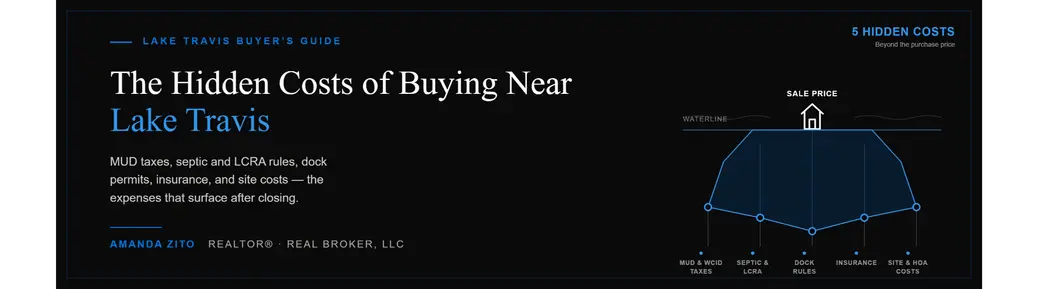
What are the hidden costs of buying a home near Lake Travis? The costs buyers miss most near Lake Travis are MUD and WCID taxes layered on top of county taxes, septic (OSSF) inspection and replacement, dock rules and maintenance, higher insurance premiums, and Hill Country site work like retaining walls and erosion control.
Most buyers who tour Lake Travis fall for the same thing: the water, the hills, and the feeling that they've found something that doesn't exist in a subdivision. That part is real. What surprises people is the second budget — the one that shows up after the sales price, and that nobody mentions on the showing.
None of these costs should scare you off. Plenty of my clients look at the full picture and buy anyway, happily. But there's a real difference between choosing a lake property with your eyes open and finding out in month three that your septic system needs to be replaced. This is the list I walk buyers through before they write an offer anywhere in the Lake Travis area — Lakeway, Hudson Bend, Spicewood, Bee Cave, Lago Vista, Jonestown, Briarcliff, and the unincorporated pockets of western Travis County.
Your Property Tax Bill Has More Layers Than You Think
Texas has no state income tax, which is the headline every relocating buyer hears. The trade-off is that local services are funded almost entirely through property taxes — and around Lake Travis, those taxes come from more entities than just the county.
Depending on the address, your bill can include the county, the school district, a city, a Municipal Utility District (MUD), a Water Control and Improvement District (WCID), an Emergency Services District (ESD), and community college and healthcare districts. Two homes a mile apart can carry meaningfully different effective rates purely because of which districts they sit in.
MUD and WCID rates in particular are tied to district debt, which means a newer development can carry a higher rate that steps down over time as bonds are paid off. You can look up the exact taxing entities and adopted rates for any parcel through the Travis County tax rate tables and the Travis Central Appraisal District.
What to do: Before you fall in love with a property, pull its actual tax breakdown by entity — not the estimate on the listing portal, which is often based on the prior owner's exemptions.
Septic Systems and the LCRA
Large parts of the Lake Travis area are not on municipal sewer. Homes run on an on-site sewage facility (OSSF) — a septic system — and near this lake, that comes with a regulator most out-of-state buyers have never heard of.
Since 1971, the Lower Colorado River Authority has regulated the installation and operation of on-site sewage facilities within a 2,000-foot zone around Lake Travis and a wider zone around the upper Highland Lakes. If the home is in that zone, LCRA is the permitting authority — not just the county.
Here's the part that catches buyers: when a property changes hands, a system inspection is required before LCRA can issue the new owner approval for continued use, and the new owner needs that approval to legally operate the system. If the system fails, is undersized for the bedroom count, or was never permitted correctly, that becomes a live negotiation item — and replacement on a rocky Hill Country lot is a five-figure project, not a weekend repair.
Ongoing, budget for pumping every few years and, on aerobic systems, a maintenance contract and periodic inspections. You can check whether a specific address falls in LCRA's jurisdiction using the LCRA water quality map, and review the program details on the LCRA On-Site Sewage Facilities page.
Water, Propane, and Utilities That Aren't Automatic
Water service around the lake comes from a patchwork of WCIDs, MUDs, and private water systems, with rate structures that vary widely — and some properties are on wells, which means pump maintenance, filtration, and testing on your dime.
Natural gas lines don't reach much of the area. Many homes run on propane, which means a tank (owned or leased), delivery scheduling, and a fuel cost that moves with the market rather than a fixed utility rate. Trash service is often a private contract instead of a municipal service, especially in unincorporated Travis County.
The Dock Question
If you're buying waterfront, the dock is its own line item — in cost, in rules, and sometimes in whether you can have one at all.
LCRA does not require a permit, registration, or fees for residential docks of 1,500 square feet or less, but residential docks on Lake Travis must meet the Safety Standards for Residential Docks on the Highland Lakes covering flotation, lighting, access, anchoring, and maximum distance from shore. Larger structures and marinas do require permits. Local jurisdictions and property owners associations can layer their own requirements on top — within WCID 17's jurisdiction, for example, docks require a district license.
Three things to verify before closing on a waterfront home:
- Does the existing dock have the right approvals, and can they transfer? Ask for permit numbers, approval letters, and inspection records.
- Do you have rights to the submerged land? Owning shoreline doesn't automatically mean you own what's under the water.
- Is the shoreline actually dock-capable? Shallow coves, narrow water frontage, and rocky terrain can make a dock impractical regardless of what's allowed.
Then there's the ongoing cost. Lake Travis is a flood-control and water-supply reservoir, so levels swing — sometimes dramatically. Floating docks need to be repositioned, cables and anchors need attention, and flood events create real repair bills. If you're keeping a boat, add slip fees or storage, maintenance, and fuel. Start with the LCRA docks and marinas guidance.
Insurance Costs More Out Here
Premiums on Hill Country properties tend to run higher than equivalent homes in central Austin, for reasons that stack: brush and wildfire exposure, distance from fire stations and hydrants, replacement costs on custom construction, and — for some parcels — floodplain proximity. Waterfront owners often need separate coverage for the dock and watercraft.
Get a real quote during your option period, on the specific address. An insurance estimate pulled from a general calculator can be off by thousands on a lake property.
Hill Country Lots Carry Site Costs
The terrain that makes these properties beautiful also makes them expensive to maintain. Steep driveways and long private drives need resurfacing. Retaining walls need inspection and eventually repair. Erosion control, drainage, and tree work — including oak wilt management — are recurring, not one-time. Homes with waterfront access often have stairs or a tram down to the water, and those are mechanical systems with real service costs.
If the property is on a private road, ask who maintains it and what the annual assessment runs. That answer is sometimes "the neighbors, informally," which is worth knowing before you own it.
HOA Dues, POA Fees, and Lake Access
Community fees near Lake Travis range from modest annual POA dues to full club memberships with mandatory initiation costs. Some communities include boat ramp or waterfront park access; others charge separately for it. Short-term rental rules also vary by city and by covenant — a city that permits STRs doesn't override an HOA that prohibits them.
Read the governing documents during your option period, not after.
How to Budget Realistically
A simple rule I give buyers: take your expected monthly payment and add a Lake Travis line for taxes at the actual district-stacked rate, insurance at the real quoted premium, septic and water maintenance, HOA or POA dues, and a dock or site reserve if the property has one. It's usually a bigger number than the portal estimate — and it's the number you actually need to be comfortable with.
Frequently Asked Questions
Do all homes near Lake Travis have septic systems? No — some areas are on municipal sewer, but a large share of properties in and around Hudson Bend, Spicewood, and unincorporated western Travis County are on septic. If the home is within LCRA's regulated zone around the lake, the system requires LCRA approval for continued use when ownership changes.
Are property taxes higher near Lake Travis than in Austin? It depends entirely on the address. Effective rates vary based on which taxing entities apply — a home in a MUD or WCID with outstanding bond debt can carry a higher combined rate than a comparable home elsewhere in Travis County. Always check the parcel-specific breakdown rather than a county average.
Can I build a dock on any waterfront lot on Lake Travis? Not necessarily. Shoreline conditions, submerged land rights, LCRA safety standards, local jurisdiction rules, and HOA restrictions all factor in, and the most restrictive rule governs. Verify dock feasibility before you're under contract, not after.
Let's Look at the Real Numbers on Your Property
If you're considering a purchase near Lake Travis, I'll pull the actual tax breakdown, septic history, and community requirements for any property you're serious about — before you write the offer. That's the part that keeps closings from turning into surprises.
Call or text me at 949-484-9486, or email soldbyzito@gmail.com.
Amanda Zito, REALTOR® The Zito Group | Real Broker, LLC Serving the Lake Travis area
Categories
Recent Posts











“Your goals come first. My job is to help you make the right move.”