

HOA vs. No HOA Homes in Hudson Bend: What Relocating Buyers Should Know
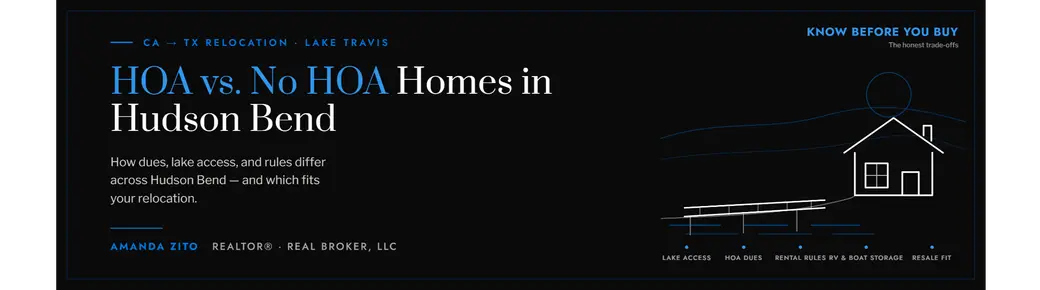
Do homes in Hudson Bend have an HOA? Some do, some don't. Hudson Bend sits in unincorporated Travis County, so many older subdivisions in 78734 have no HOA or only light deed restrictions, while newer and gated communities near Lake Travis carry mandatory dues.
If you're moving to the Lake Travis area from out of state — and especially if you're coming from California — this is one of the first questions that catches people off guard. You tour two houses a mile apart, similar size, similar price. One has $1,800 a year in dues, a gate, a community boat ramp, and a design review committee. The other has none of that, and the neighbor has a boat, an RV, and a shipping container in the side yard.
Both are Hudson Bend. Neither is wrong. But they lead to very different day-to-day lives, and the difference is bigger here than in most Texas suburbs. Here's how to think it through before you write an offer.
First, Understand What Hudson Bend Actually Is
Hudson Bend is an unincorporated community on the south shore of Lake Travis in western Travis County, wrapped around by Lakeway, Bee Cave, and the Lake Travis corridor west of Austin. Unincorporated matters. There's no city hall, no municipal zoning ordinance, and no city code enforcement officer coming out about the boat parked on the grass.
That's the key insight most relocating buyers miss: in Hudson Bend, the HOA is often the only rule-maker there is. In a city like Cedar Park or Round Rock, municipal zoning already sets a baseline — what can be built, what can be run out of a home, how a lot can be used. Out here, if a subdivision doesn't have an HOA and enforceable deed restrictions, the baseline is Travis County regulations, and those are far lighter than a city code.
That cuts both ways, which is exactly why the choice deserves real thought.
What an HOA Actually Does Here
Hudson Bend HOAs and property owners' associations (POAs) generally handle some mix of the following:
- Amenities. Community boat ramps, private lake access parks, day docks, pools, and courts. This is the big one in 78734.
- Private road maintenance. Many lakeside streets are privately maintained, and the association funds resurfacing and drainage.
- Architectural control. Approval for exterior changes, additions, fencing, paint, and outbuildings.
- Use restrictions. Rules on short-term rentals, RV and boat storage, livestock, home businesses, and rental minimums.
- Common area upkeep. Entry landscaping, gates, lighting, wildfire fuel management on greenbelts.
Texas HOAs operating in residential subdivisions are governed largely by Chapter 209 of the Texas Property Code, which sets rules for how associations enforce restrictions, levy fines, and handle assessments. Texas gives associations meaningful teeth — including, in some circumstances, the ability to foreclose on unpaid assessments — so "it's just a small HOA" is not a reason to skip reading the documents.
What You Give Up and Gain Without an HOA
No-HOA homes in Hudson Bend tend to be the older lake-cabin-era properties and the larger acreage lots off the main arterials. Buyers gravitate to them for real reasons.
What you gain:
- No monthly or annual dues, and no special assessments
- Freedom to park boats, trailers, and RVs on your own property
- Freedom to build a shop, a casita, or a detached garage without committee approval
- Typically more flexibility on rental use, subject to county and state rules
- No risk of dues escalating after you buy
What you give up:
- Your neighbor has the same freedoms you do
- No community boat ramp or private lake park — you're using public access or paying for a marina slip
- Road maintenance may fall to an informal owner group, or to nobody
- No architectural consistency, which some buyers read as character and others read as a resale drag
- Fewer guardrails if a nearby property turns into a full-time party rental
That last point is worth sitting with. In a lake community, the difference between a quiet street and a loud one is often a single property owner's decision — and without an association, your recourse is limited.
The Side-by-Side
| HOA / POA Home | No-HOA Home | |
|---|---|---|
| Ongoing cost | Annual or monthly dues, plus possible special assessments | No dues |
| Lake access | Often a private ramp, park, or day dock | Public ramps, marinas, or waterfront ownership |
| What you can build | Architectural review required | County permitting and deed restrictions only |
| Boat / RV storage | Frequently restricted or prohibited | Usually unrestricted |
| Short-term rentals | Commonly restricted or banned | More often allowed, but verify |
| Roads | Often privately maintained by the association | County-maintained or informally maintained |
| Neighbor behavior | Enforceable standards | Limited recourse |
| Resale audience | Buyers who want structure and amenities | Buyers who want land, storage, and flexibility |
Lake Access Is the Real Dividing Line
For most relocating buyers, this is where the decision actually lands. A non-waterfront home inside a Hudson Bend subdivision with a deeded community ramp and lake park is a fundamentally different lifestyle than a non-waterfront home with no association at all. The first one gets you on Lake Travis in fifteen minutes with your own boat. The second one means public ramps, marina wait lists, and seasonal crowds.
If boating is a core reason you're moving to Lake Travis, the dues attached to lake access are often the best value in the deal. If you're here for the hill country setting, the drive to Austin, and the space — and you're fine renting a boat a few weekends a year — that same fee buys you something you'll rarely use.
Also worth knowing: Lake Travis is a reservoir managed by the Lower Colorado River Authority, and its levels fluctuate significantly with drought and rainfall. Shoreline structures and docks fall under LCRA permitting. That affects waterfront and access-lot buyers regardless of which side of the HOA question you land on.
Short-Term Rentals: Ask Early, Not Late
If part of your relocation math involves renting the house out — during ACL and F1 weekends, or while you're back in California — do not assume. Short-term rental rules in the Lake Travis area come from multiple layers at once: state law, Travis County, and the subdivision's own recorded restrictions.
A no-HOA property is generally more permissive, but "no HOA" doesn't always mean "no deed restrictions." Many Hudson Bend subdivisions recorded restrictive covenants decades ago that still run with the land even though no active association exists to enforce them. Those covenants can still be enforced by neighboring owners.
Get the recorded restrictions pulled and read during your option period. Every time.
Utilities and Infrastructure: Where No-HOA Really Shows Up
Relocating buyers often focus on dues and miss the infrastructure question, which has a much larger dollar impact.
Much of Hudson Bend is on septic — on-site sewage facilities regulated at the county level and under TCEQ standards — rather than centralized wastewater. Water service in parts of the area comes through a water control and improvement district rather than a city utility. Fire protection comes from an emergency services district. None of that is tied to whether the neighborhood has an HOA, but it changes your carrying costs and your inspection checklist in ways a suburban buyer isn't used to.
Add wildfire exposure to the list. Homes in the hill country west of Austin often carry higher insurance premiums than comparable homes in central Austin. Get a quote before you're under contract, not after.
Which One Fits Your Relocation?
An HOA property likely fits if you: want private lake access without owning waterfront, value predictable neighborhood standards, are buying as a second or seasonal home, or want private roads and gates maintained without organizing your neighbors.
A no-HOA property likely fits if you: are bringing an RV, boat, trailer, or work vehicles; plan to build a shop or guest quarters; want acreage and privacy over amenities; or are optimizing for lowest carrying cost.
For most out-of-state buyers I work with in Travis County, it comes down to one honest question: are you moving here to be on the lake, or to be near it? The answer usually resolves the HOA question by itself.
How to Verify Before You Offer
- Pull the recorded deed restrictions for the subdivision — not just the HOA's marketing summary.
- If there's an association, request the resale certificate, current dues, bylaws, financials, and reserve status.
- Ask directly whether any special assessment is pending or under discussion.
- Confirm short-term rental rules at both the subdivision and county level in writing.
- Verify road maintenance responsibility — county, association, or private agreement.
- Confirm water source, septic status and last inspection, and get an insurance quote early.
- Check the property's assessed value and exemption history through the Travis Central Appraisal District.
Property taxes in Texas run considerably higher than what California buyers are used to, and the homestead exemption timing on a relocation purchase is worth planning deliberately. That conversation belongs in your first meeting, not your last.
FAQ
Are most homes in Hudson Bend in an HOA? It's genuinely mixed. Newer and gated developments in 78734 typically have mandatory associations, while many older lakeside subdivisions have either no association or dormant deed restrictions with no active enforcement body. You have to check subdivision by subdivision.
How much are HOA dues in Hudson Bend? There's a wide range, driven mainly by amenities. Associations with private boat ramps, lake parks, and privately maintained roads sit at the higher end; associations that only maintain an entrance sit near the bottom. Always confirm current dues and any pending assessments through the resale certificate rather than a listing sheet.
Does having an HOA help or hurt resale in the Lake Travis area? Both, depending on the buyer. Lake access and consistent standards attract buyers who want a turnkey lake lifestyle. Storage flexibility and acreage attract buyers with boats, RVs, and hobbies. The stronger predictor of resale is whether the property's restrictions match what that specific buyer pool wants.
Thinking About a Move to Hudson Bend?
If you're relocating to the Lake Travis area and trying to figure out which neighborhoods actually fit how you want to live, I'm happy to walk through it with you — including which subdivisions have active associations, what their restrictions look like, and how that changes your budget.
I've made the California-to-Texas move myself and help clients coordinate selling one home while buying another. Call or text me and we'll map it out.
Amanda Zito REALTOR® | Licensed in Texas (TREC #840088) and California (DRE #01740063) Real Broker, LLC — serving Hudson Bend, Lakeway, Bee Cave, and the Lake Travis area 📞 [phone number]
Categories
Recent Posts










“Your goals come first. My job is to help you make the right move.”