

How Do You Choose the Right Listing Price for a Hudson Bend Home? Proven Pricing Strategies
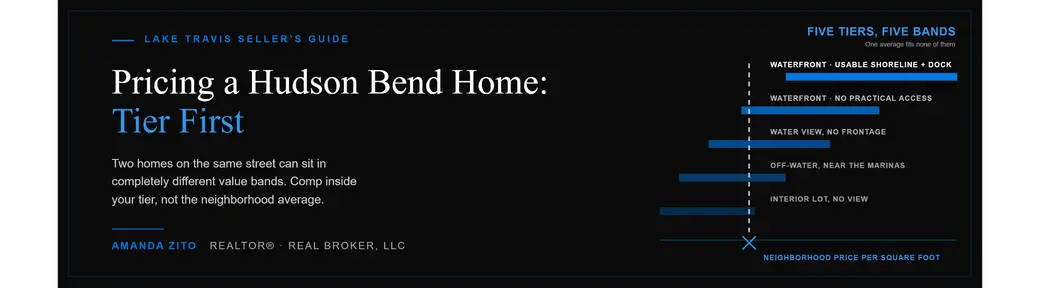
How do you choose the right listing price for a Hudson Bend home? You price it against the three or four homes that share its waterfront status, access, and utility setup — not against a neighborhood price-per-square-foot average. In Hudson Bend, two homes on the same street can be worth very different numbers.
Most sellers here start in the same place: they pull up recent sales in 78734, divide by square footage, multiply by their own square footage, and land on a number.
That number is almost always wrong in Hudson Bend. Sometimes by a little. Sometimes by six figures in either direction.
The reason isn't complicated. Hudson Bend is an unincorporated community in Travis County where roughly 40% of the census area is water. Homes were built across five decades, on lots with wildly different slope and shoreline, on different utility setups, under different deed restrictions. There's no tract-home baseline to average against. So the average tells you almost nothing about your specific house.
Here's how to price it properly instead.
Why Hudson Bend Doesn't Price Like a Suburban Neighborhood
In a master-planned community, a price-per-square-foot range works reasonably well. The homes were built by the same builders in the same years on similar lots with the same utilities and the same HOA. Variables are few, so averages mean something.
Hudson Bend is the opposite. Within a mile of Hudson Bend Road you can find a 1970s weekend cabin, a 2020s custom build, a steep lot with no lake access, and a gentle-slope waterfront property with a dock — and the same square footage across several of them.
When variables are that wide, an average stops describing anything. It just averages away the things buyers are actually paying for.
Step One: Define Which Hudson Bend Home You Actually Own
Before you look at a single comp, place your home in one of these tiers. Each tier has its own buyer pool and its own pricing logic.
| Tier | What defines it | What buyers pay for |
|---|---|---|
| Waterfront with usable shoreline | Gentle slope, dock or dock-permittable | Water access and the dock itself |
| Waterfront without practical access | Steep, rocky, or shallow cove frontage | The view and the ownership, not the use |
| Water view, no frontage | Elevation and sightlines | The view — which can be lost to tree growth or new construction |
| Off-water, near the marinas | Short drive to boat storage and the lake | Location and lifestyle at a lower entry price |
| Interior, no view | Standard residential lot | Home condition, layout, lot, and Lake Travis ISD zoning |
If your comps come from a different tier than your home, your price is built on sand. This is the single most common pricing error I see here, and it happens in both directions — sellers who price a view home like waterfront, and sellers who leave real money behind because their agent lumped them in with interior comps.
Step Two: Price the Factors That Don't Show Up in Photos
Waterfront status sets the band. These factors move you inside it — and they matter far more in Hudson Bend than cosmetics do.
Septic and the transfer inspection. Most homes here are on an on-site sewage facility rather than city sewer. The LCRA regulates septic systems within a 2,000-foot zone around Lake Travis, and for systems under its jurisdiction, an inspection is required at transfer of ownership before the new owner can get approval for continued use. Buyers and their agents know this. A documented, recently serviced system supports your price. An undocumented one invites a price negotiation later, which is why it's worth resolving before you list rather than during option period.
Water service. Much of the area is served by Travis County WCID No. 17, whose main office sits just off RR 620 near Hudson Bend Road. Some properties are on a private well. That distinction changes the buyer pool and belongs in your pricing conversation, not your disclosure packet alone.
Access and driveway. Steep, narrow, or shared driveways narrow your buyer pool. Nobody lists this as a feature or a flaw, but it consistently shows up in what buyers are willing to pay.
Dock condition and permitting. A dock in good shape with clean paperwork is a priced asset. A dock needing repair is a deduction buyers will calculate — usually higher than the actual repair cost.
Deed restrictions and rental use. Restrictions vary property to property in Hudson Bend, and some homes here attract second-home and short-term-rental buyers while others can't be used that way. That difference has real dollar value, and it needs to be verified for your specific property rather than assumed from a neighbor's situation.
Step Three: Choose a Pricing Strategy on Purpose
Three approaches work in this market. Pick one deliberately.
1. Price at the top of a defensible band
Identify the three or four true tier-matched comps, establish the range they support, and list at the top of it. You capture maximum value while keeping the number appraisable. This is the default strategy for a well-maintained home with clean comps, and it's the one I recommend most often.
2. Price into the search bracket below your ceiling
Buyers shop in round-number brackets. A home listed just above a bracket line is invisible to every buyer whose search caps at that line. When you're within a few thousand dollars of a threshold, moving under it usually buys you more showings than the difference costs you.
3. Price for the appraisal conversation
If your home is genuinely unusual — a rare shoreline, a recent major renovation, an accessory structure — the list price needs a supporting file behind it: the comps, the adjustments, and the documentation. Distinctive homes don't appraise on averages any more than they sell on averages. Build the case before you need it.
What doesn't work: "let's test a high number and see." Hudson Bend is a thin market. There are only so many buyers shopping your tier in any given month, and most of them see the home in the first two weeks. Test high and you don't reach a new audience later — you just show the same small pool a stale listing with a price cut attached.
What Happens in the First Three Weeks
Your list price gets one real audition. Showing activity in the first two to three weeks tells you almost everything:
- Strong showings, no offers — usually a condition or feature objection, not a price problem
- Few showings at all — the price is filtering you out before anyone walks through
- Steady traffic and low offers — the market is telling you where your band actually is
Watching that feedback honestly, and acting on it early, costs a seller far less than waiting three months to make the same adjustment.
Your Pre-List Pricing Checklist
- Identify your waterfront tier and comp only within it
- Pull septic records and confirm the system's status
- Confirm water service provider and any well documentation
- Verify deed restrictions and permitted use for your specific parcel
- Confirm current Lake Travis ISD attendance zoning for the address
- Document dock condition and permitting if applicable
- Decide your strategy — band ceiling, bracket, or appraisal case — before the sign goes up
Frequently Asked Questions
Is price per square foot useless in Hudson Bend? Not useless, but it's a check figure rather than a pricing method. Use it to sanity-test a number you arrived at through tier-matched comps. Don't use it to generate the number in the first place.
How much more is waterfront worth in Hudson Bend? There's no fixed percentage, because "waterfront" covers everything from gentle usable shoreline with a dock to steep frontage a buyer can't practically reach. The gap between usable and unusable waterfront is often larger than the gap between waterfront and a strong view home.
Should I price higher because Lake Travis levels fluctuate seasonally? Lake level affects buyer urgency more than it affects value, and it cuts both ways depending on when you list. Price to your comps and your property's fundamentals, then time your launch thoughtfully rather than pricing around the lake.
Let's Talk About Your Number
If you're thinking about selling in Hudson Bend, the useful conversation isn't a general market update — it's a walk-through of your specific tier, your comps, and what your property's documentation supports. That's a call or text, not a commitment.
Amanda Zito, REALTOR® Real Broker, LLC CA DRE #01740063 | TX TREC #840088 SoldByZito.com | 949-484-9486
Categories
Recent Posts











“Your goals come first. My job is to help you make the right move.”