

How Much Equity Do Homeowners Have in the Inland Empire?
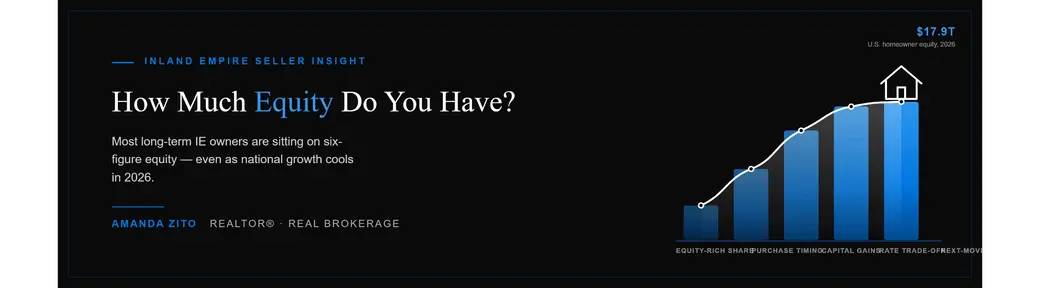
How much equity do Inland Empire homeowners have right now? Most long-term owners in Riverside and San Bernardino Counties are sitting on substantial six-figure equity, even as national equity growth has flattened heading into the second half of 2026.
Why This Question Matters More Than It Used To
For years, "how much equity do I have" was a nice-to-know number. In 2026, it's become one of the biggest factors in whether Inland Empire homeowners decide to sell, stay put, or tap that equity another way.
Here's what's changed: nationally, mortgaged homeowners are sitting on close to $17.9 trillion in combined equity, roughly five times what homeowners held 15 years ago. California has been one of the biggest beneficiaries of that run-up, with a large share of the state's mortgaged homes now classified as "equity-rich," meaning owners have at least 50% equity in their property. That includes plenty of ZIP codes across the Inland Empire.
But equity growth has cooled. After several years of rapid gains, homeowner equity nationally leveled off and even dipped slightly in late 2025, and California was among the states where average equity per borrower pulled back year over year. That doesn't mean IE homeowners lost their gains, it means the pace of new equity has slowed after an unusually strong run.
Where Inland Empire Equity Stands Today
Riverside and San Bernardino Counties came out of the last decade's recovery as two of Southern California's strongest long-term appreciation stories. Buyers who purchased anywhere from the mid-2010s through the pandemic-era boom in cities like Corona, Eastvale, Rancho Cucamonga, Redlands, Murrieta, and Temecula have generally seen their home values climb well above their original purchase price, even accounting for the more modest price adjustments the region has seen over the past year.
That's the key distinction for Inland Empire sellers right now: short-term price movement and long-term equity position are two different conversations. A home that's worth slightly less than it was 12 months ago can still represent a six-figure equity gain compared to what the owner paid.
Why This Matters If You're Thinking About Selling
Home equity isn't cash sitting in a bank account. It only becomes usable once you sell, refinance, or borrow against it, and each of those paths comes with its own math.
A few things worth thinking through if you're an Inland Empire homeowner weighing a move:
- Capital gains exposure is a bigger deal than it used to be. Nationally, a growing share of California sellers now clear more than $500,000 in profit when they sell their primary residence, which is the threshold where married couples can start owing capital gains tax under federal rules that haven't been updated since the 1990s. If you've owned your Inland Empire home for a decade or more, it's worth running your numbers before you list, not after.
- "Golden handcuffs" are real. Many owners with a low mortgage rate from a few years ago are hesitant to sell, because moving means giving up that rate along with the home. That's a legitimate trade-off, but it's a financial decision worth running the numbers on rather than an automatic reason to stay.
- Equity can fund your next move without a second mortgage payment. If you're planning to buy your next home in the Inland Empire or relocate elsewhere, your current equity often determines your down payment, your new monthly payment, and how competitive your offer can be.
None of this replaces a real conversation about your specific property, loan balance, and goals, but it's the framework worth starting from.
How to Find Out Exactly How Much Equity You Have
The only way to know your real number is to start with what your home would actually sell for today, not a national average or a Zillow estimate. That means pulling recent, comparable sales in your specific Inland Empire neighborhood and weighing them against your current loan balance.
That's a five-minute conversation, and it gives you a real number instead of a guess.
FAQ
Do all Inland Empire homeowners have the same amount of equity? No. Equity depends heavily on when you purchased, what you paid, your loan balance, and your specific neighborhood. Someone who bought in 2012 is in a very different position than someone who bought in 2022.
Does slowing home price growth mean I'm losing my equity? Not necessarily. A slight dip in your home's value over the past year doesn't erase years of prior appreciation. Most long-term Inland Empire owners still hold significantly more equity than they did five or ten years ago.
Is now a good time to sell and use my equity toward a new home? It depends on your goals, your current mortgage rate, and where you're moving. Owners planning to buy again in the Inland Empire, or relocating out of state, often use their equity to make a stronger offer or lower their new payment. It's worth reviewing your specific numbers before deciding.
Curious what your Inland Empire home is actually worth and how much equity you've built? Call or text me and I'll walk you through your numbers.
Amanda Zito Real Brokerage Serving the Inland Empire
Sources: Cotality Homeowner Equity Report (Q4 2025, Q1 2026); ATTOM Q4 2025 U.S. Home Equity & Underwater Report.
Categories
Recent Posts











“Your goals come first. My job is to help you make the right move.”