

How Much Is an ADU Worth When You Sell? An Inland Empire Seller's Guide
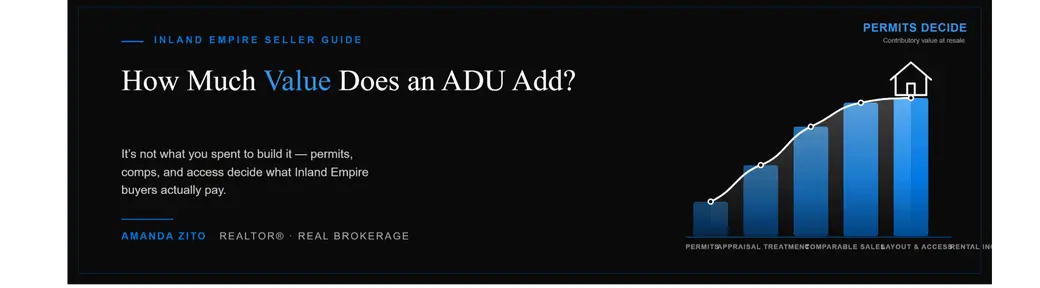
How much does an ADU add to your home's value when you sell? In the Inland Empire, a permitted ADU adds contributory value — what a buyer will pay above a comparable home without one. That's usually a fraction of what you spent to build it, and permits, access, and comps decide the number.
Start Here: Build Cost and Resale Value Are Two Different Conversations
If you spent $180,000 converting your garage or dropping a detached unit in the backyard, it's natural to assume your home is now worth $180,000 more. That's almost never how it plays out at the closing table.
The number that matters when you sell isn't what the ADU cost you. It's what a buyer in Riverside or San Bernardino County is willing to pay for your house with the ADU versus an otherwise identical house without one. Appraisers call that contributory value, and it's the figure that shows up in your appraisal, your net sheet, and your bank account.
The good news: in the Inland Empire, where multigenerational households and rental demand are both real, that number is frequently substantial. The catch is that it's driven by a short list of specific factors — and most of them are decided long before you list.
Why the Percentages You See Online Don't Apply to Your House
Search "how much value does an ADU add" and you'll find figures like 20–35%, sometimes higher. Most of those numbers come from builders and ADU companies, and they're describing a national or statewide average, not your street.
Here's a cleaner data point. The Federal Housing Finance Agency tracks appraised values for California properties with and without ADUs. In 2023, the median appraised value was $1,064,000 for California properties with an ADU and $715,000 for those without.
That gap looks enormous — and it's widely misread. It mostly reflects where ADUs get built. California ADUs cluster in expensive coastal metros with high land costs, so the homes carrying them were already worth more before a single permit was pulled. It is not a measurement of what an ADU adds to a home in Corona, Eastvale, or Redlands.
Your ADU's value is a local question with a local answer.
The Four Things That Actually Set Your ADU's Value
1. Permits — This Is the Big One
A permitted ADU with a final inspection sign-off is an asset. An unpermitted conversion is a negotiation problem.
Appraisers are required to note unpermitted structures, and most will not assign value to improvements that lack proper permits. In some cases an unpermitted unit reads as a liability to the lender rather than a feature, because it introduces questions about safety, insurability, and legal use. Buyers using FHA or VA financing — a meaningful share of the Inland Empire market — often can't get past it at all.
If your permits are clean, pull the paperwork now. If they're not, that's a conversation to have before you list, not after an offer falls apart.
2. How the Appraiser Is Required to Treat It
This surprises a lot of sellers: your ADU's square footage does not simply get added to your home's living area.
Under Fannie Mae's Improvements Section of the Appraisal Report guidance, an ADU is defined as additional living space independent of the primary dwelling — with its own sleeping, cooking, and bathroom facilities on the same parcel. It's reported and adjusted for separately, not folded into the main house's gross living area.
Fannie Mae also draws a line between a one-unit property with an ADU and a two-to-four-unit property. Per its special property eligibility considerations, that determination rests on characteristics like separate utility meters, a unique postal address, and whether the unit can be legally rented — and the appraiser makes the call as part of the highest-and-best-use analysis.
Why you should care: that classification affects which financing your buyers can use, which shapes your buyer pool, which drives your price.
3. Comparable Sales — and the Shortage of Them
Appraisers value your ADU primarily by finding recent sales of similar homes that also have one, then isolating the premium buyers paid. In markets like Rancho Cucamonga, Ontario, and Murrieta, ADU comps have gotten easier to find than they were five years ago, but they're still thin in many neighborhoods.
When good comps don't exist, the adjustment gets conservative. This is exactly where listing strategy matters — a well-documented ADU with a strong comp package handed to the appraiser tends to appraise better than one left to be discovered on inspection day.
4. Layout, Privacy, and Access
Two ADUs of identical square footage can carry very different value. Buyers pay a premium for:
- A separate entrance that doesn't route through the main house or a shared living space
- Separate utility metering
- Its own parking or driveway access
- Real privacy between the unit and the primary home's yard
- Finish quality that matches or approaches the main house
A converted garage with a shared laundry and a door off the kitchen is a different product than a detached unit with its own gate and meter — even at the same square footage.
Does the Rental Income Count?
Partly, and it depends on who's looking.
To an investor buyer, documented rent is the whole story — they're underwriting your $1,800-a-month unit as income. To an appraiser working a standard residential assignment, comparable sales usually lead, with the income potential supporting the adjustment rather than driving it. To an owner-occupant buyer looking to house a parent or an adult child, the rent number may not matter at all; the flexibility does.
You're not marketing to one of those buyers. You're marketing to all three, which means your listing needs to speak to income and to flexibility.
If the ADU is currently rented, gather the lease, payment history, and rent roll before you list. It strengthens the story and it prevents surprises during escrow — including the very practical question of whether your buyer inherits a tenant.
Can You Just Sell the ADU by Itself?
For nearly every Inland Empire homeowner, the answer today is no.
California's AB 1033 created a path for ADUs to be sold separately as condominiums — but it's local-option, meaning a city or county has to adopt its own ordinance before anyone can use it. As of spring 2026, only a small number of California jurisdictions had opted in, including San Jose, Santa Monica, and unincorporated San Diego County. San Jose recorded the state's first separate ADU sale in 2025, and in July 2026 a 749-square-foot San Jose ADU closed on its own deed for $530,000.
None of the Inland Empire's major cities were among the early adopters, and the conversion process itself is involved — condominium mapping, CC&Rs, an HOA, county recording, and lender consent if there's a mortgage on the property. If you're curious whether your city has adopted an ordinance, it's worth checking directly. For most sellers in Riverside County and San Bernardino County, though, the ADU sells with the house.
What to Do Before You List
- Locate your permits and final sign-off. Scan them. Have them ready for the appraiser.
- Get accurate square footage and a floor plan for the ADU, separate from the main house.
- Document the income — lease, rent history, or a supportable market rent if it's vacant.
- Note the separations — meters, entrance, parking, address.
- Ask your agent to build the comp package, not to hope the appraiser finds one.
- Disclose everything, including any permit gaps. Problems disclosed up front cost far less than problems discovered in escrow.
Frequently Asked Questions
Does an unpermitted ADU add any value when selling? Sometimes, but far less, and less reliably. Appraisers generally won't assign value to unpermitted improvements, and many lenders treat them as a risk. You'll often draw a smaller buyer pool — frequently cash or investor buyers — and a lower price than the same unit would command with clean permits.
Will my ADU appraise for what it cost to build? Rarely dollar-for-dollar. Appraisals measure what buyers pay for the feature, not what you spent creating it. A well-built, permitted, private detached unit in a neighborhood with rental demand recovers more of its cost than an interior conversion with shared access.
Should I rent the ADU out while my house is on the market? It depends on your timeline and your likely buyer. Documented income strengthens your position with investors, but a tenant in place can complicate showings and limit owner-occupant buyers who want the unit available at closing. This is worth mapping out before you list.
Let's Figure Out What Yours Is Worth
Every ADU is different, and the difference between a strong number and a disappointing one usually comes down to documentation and positioning — both of which are fixable before you go live.
If you have an ADU on your Inland Empire property and you're thinking about selling in the next year, call or text me. I'll walk your property, pull the ADU comps in your specific area, and give you a straight answer on what it's likely to contribute.
Amanda Zito REALTOR® | Real Brokerage Serving the Inland Empire — Riverside, Corona, Eastvale, Ontario, Rancho Cucamonga, Redlands, Murrieta, and Temecula CA DRE #01740063
Categories
Recent Posts











“Your goals come first. My job is to help you make the right move.”