

How Multiple Offers Really Work
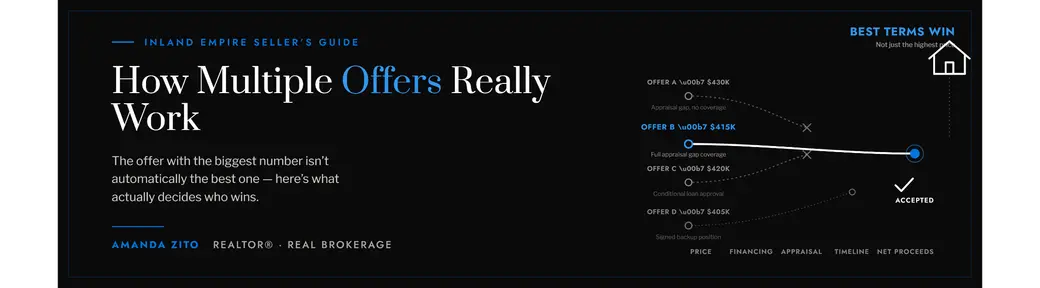
How do multiple offers work when you're selling a home in the Inland Empire? When several buyers submit offers on your home, your agent presents all of them, and you can accept one, counter one, counter several, or ask everyone for their highest and best terms. Price is only one factor.
The offer with the biggest number isn't automatically the best one
Most sellers picture multiple offers the same way: a stack of envelopes, a quick scan of the price lines, and a circle around the largest one. That's not how it plays out.
In Riverside and San Bernardino County transactions, the offer that closes cleanly is often not the one at the top of the price column. It's the one with financing that holds up, an appraisal plan that survives contact with reality, and a buyer whose timeline matches yours. A $15,000 higher offer that falls apart on day 22 costs you far more than the $15,000 — you lose your momentum, your listing goes back on the market with a stale date, and buyers start asking what went wrong.
Here's how the process actually works, and what to look at when the offers land.
What creates a multiple-offer situation
Multiple offers aren't luck, and they aren't a market condition you either get or don't get. Three things drive them:
- Price positioning. A home priced at or slightly below where the comparable sales support it draws a wider pool. A home priced above the comps draws showings but few written offers.
- Exposure in the first ten days. Your listing gets the most traffic in its first week and a half. Professional photography, syndication to the major portals, and a well-written MLS description do the heavy lifting during that window.
- Condition and presentation. Buyers in Corona, Eastvale, and Rancho Cucamonga are comparing your home against everything else they toured that weekend. Clean, decluttered, and well-lit competes. Deferred maintenance invites a discount request later.
When those three line up, you get more than one buyer writing at the same time. That's the whole strategy behind pricing well rather than pricing high.
What happens the moment offers start coming in
Your agent has a duty to present every written offer to you. You are not required to respond to all of them, and you're not required to take the highest one. Your realistic choices:
- Accept one offer as written. Cleanest path. Everyone else moves on or asks to be backup.
- Counter a single offer. You negotiate with one buyer at a time and keep the others in reserve.
- Counter multiple buyers at once. In California this is done with a multiple counter offer, and it's important to understand that even if a buyer signs it, you still have to accept their signed counter for a contract to exist.
- Call for highest and best. You set a deadline and ask every buyer to submit their strongest terms.
There's no obligation to tell buyers what the other offers say. Some sellers choose to disclose that multiple offers exist — which is allowed — but sharing specific numbers is a strategic decision, not a requirement, and it can backfire by giving one buyer a target to beat by a dollar.
Price is one line on a long document
When you compare offers, you're really comparing net proceeds and probability of closing. Look at these side by side:
| What to compare | Why it matters |
|---|---|
| Purchase price | Starting point, not the answer |
| Financing type and lender | A local lender who answers the phone beats a rate-shopping call center |
| Down payment amount | More cash down usually means less appraisal risk |
| Appraisal contingency | Waived or capped changes everything if the appraisal comes in low |
| Loan contingency and timeline | Shorter is stronger, but only if the lender can actually perform |
| Earnest money deposit | Signals how serious the buyer is about their own money |
| Requested credits or repairs | Comes straight out of your net |
| Closing date and possession | A rent-back can be worth more than a few thousand dollars |
Two offers can be $10,000 apart on price and land in the opposite order once you account for a repair credit and a 45-day close.
The appraisal is where over-list offers get tested
This is the part sellers underestimate. If a buyer is financing and writes above your list price, the lender still has to see an appraisal that supports the number. If the appraisal comes in below the contract price, the lender lends against the lower figure.
At that point you have three outcomes: the buyer brings the difference in cash, you reduce the price, or the deal renegotiates or dies. That's why an offer with appraisal gap coverage — a written commitment to cover a specific dollar amount above appraised value — can be stronger than a higher offer with a full appraisal contingency. You can read more about how appraisals function in the lending process from the Consumer Financial Protection Bureau.
Financing type: what it does and doesn't tell you
Conventional, FHA, VA, and cash offers each behave a little differently on timeline and property condition requirements. What matters is the strength of the specific buyer and lender, not the label on the loan.
VA loans in particular carry outdated reputations. In the Inland Empire, with a large military and veteran buyer population, VA-financed purchases close routinely and the borrower has already been vetted. A pre-approval that shows a fully underwritten file is worth more than the loan program name on the front page. Ask your agent to call the lender on the top offers — that ten-minute conversation tells you more than the paperwork does.
Mistakes that cost Inland Empire sellers money
- Choosing on price alone and finding out in week three that the buyer's approval was conditional.
- Calling for highest and best too early, before the weekend of showings that would have brought a fourth buyer.
- Losing a strong buyer by countering aggressively on a home that had one great offer and two weak ones.
- Accepting buyer letters without understanding that personal letters raise fair housing concerns. Many brokerages, including in California, discourage them entirely for that reason.
- Skipping the backup offer. A signed backup keeps a second buyer in position at no cost to you.
FAQ
Do I have to take the highest offer on my house? No. As the seller, you choose which offer to accept based on any lawful factor — price, terms, timeline, or certainty of closing. Your agent must present all written offers to you, but the decision is yours.
Can my agent tell buyers what the other offers are? Only with your permission. Sellers in California can authorize their agent to disclose the existence of other offers or specific terms, but there's no requirement to do so, and many sellers choose to keep the details private.
What is a highest and best deadline? It's a request for every buyer who has written an offer to submit their strongest terms by a set date and time. It works best when you genuinely have several interested buyers, and it can hurt you if you only have one.
Talk it through before you're staring at four offers
The time to build a multiple-offer strategy is before the sign goes in the yard — how you price, how long you hold offers, and what terms actually matter for your situation.
If you're thinking about selling in the Inland Empire, call or text me and we'll walk through it.
Amanda Zito, REALTOR® Real Brokerage | Inland Empire, California 📞 949-484-9486 | ✉️ soldbyzito@gmail.com CA DRE #01740063
Market data and consumer resources: National Association of REALTORS® and the California Association of REALTORS®.
Categories
Recent Posts











“Your goals come first. My job is to help you make the right move.”