

How Revenue Share Works at Real Brokerage (2026)
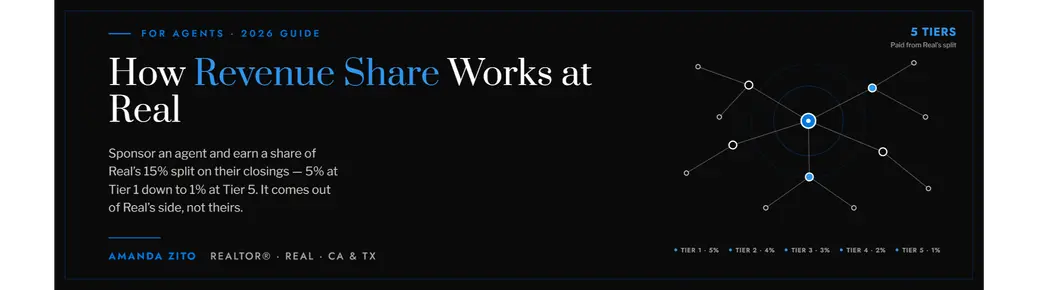
How does revenue share work at Real Brokerage? When you sponsor an agent who joins Real, you earn a percentage of the company's 15% commission split on that agent's closings — 5% at Tier 1, down to 1% at Tier 5. It comes out of Real's side, not the agent's.
If you've talked to an agent at Real for more than ten minutes, revenue share has probably come up. And if you're coming from a traditional brokerage, it can sound like one of two things: either a magic money printer, or something that smells vaguely like a pyramid scheme.
It's neither. It's a marketing budget.
Most brokerages spend money on recruiters, ad campaigns, and glossy pitch decks to grow their agent count. Real spends that money on the agents who do the growing. That's the whole idea. But the mechanics matter, and there's a real difference between what revenue share can pay and what it will pay. Here's the honest version, whether you're an agent in the Inland Empire, out in Lake Travis, or anywhere in between.
Where the Money Actually Comes From
Start with the split. At Real, agents keep 85% of their commission, and 15% goes to the brokerage until they hit their annual cap. Real's revenue share is paid out of that 15% company split — not out of the sponsored agent's paycheck.
This is the part people get wrong most often. If you sponsor an agent into Real, they don't earn less. Their 85% stays 85%. Real simply keeps a smaller slice of its own 15% and routes the rest to you.
Real's own example runs the math: an agent closes a $500,000 buyer-side deal at 3%, pays a referral fee, and nets $11,250 in commission. Fifteen percent of that ($1,688) would normally go to Real. Instead, the sponsor receives 5% ($563), and Real keeps 10%. Note that the referral fee was carved out before the calculation — Real never collected a split on that portion, so there was nothing to share.
That's the core loop. Everything else is structure on top of it.
The Five Tiers
Agents you personally sponsor sit in your Tier 1. Agents they sponsor land in your Tier 2, and so on down to Tier 5. The percentage you earn shrinks as the tiers get further from you:
| Tier | Revenue share | Max per capping agent, per year |
|---|---|---|
| Tier 1 | 5% | $4,000 |
| Tier 2 | 4% | $3,200 |
| Tier 3 | 3% | — |
| Tier 4 | 2% | — |
| Tier 5 | 1% | — |
The $4,000 ceiling on a Tier 1 agent isn't arbitrary. It's 5% of the $12,000 cap. Once that agent caps out, they stop paying a split to Real — which means there's no longer any revenue to share.
Worth sitting with for a second: your revenue share from any one agent has a hard annual ceiling, and it resets when their cap resets. Real is explicit that $4,000 is a maximum, not a guarantee — agents on lower cap plans stop generating revenue share sooner.
Tiers Don't Come Free
Tier 1 is automatic. Tiers 2 through 5 have to be unlocked, and Real offers three separate paths to do it:
Path 1 — Tier 1 Producing Path. Based on how many producing agents you've personally sponsored: 5 for Tier 2, 15 for Tier 3, 20 for Tier 4, and 25 for Tier 5.
Path 2 — Attractor Path. Based on total network size across all tiers: 750–999 agents unlocks Tier 3, 1,000–1,499 unlocks Tier 4, and 1,500+ unlocks Tier 5.
Path 3 — Producer Path. Based on your own production. Hit your full $12,000 cap and you unlock up to Tier 3 the next day. Reach Elite Status and you unlock up to Tier 5.
Path 3 is the one I'd point out to any high-producing agent reading this. You don't have to build a downline of 25 people to reach into deeper tiers — capping your own business gets you there.
One caution on Path 1: it's checked continuously, not once. Real's example walks through a sponsor who drops from 5 producing Tier 1 agents to 4 when one of them goes six months without a closing — and her Tier 2 locks, so she collects nothing from Tier 2 activity that month. Tiers can close as easily as they open.
The Requirements Nobody Mentions in the Recruiting Pitch
You have to be producing. To collect revenue share at all, you must meet Real's Producing Agent Policy — contributing at least $450 in revenue to Real over a rolling six-month period. Revenue share is designed to reward working agents, not retired ones.
There's a six-month grace period when you join. New agents can receive revenue share for their first six months without meeting the producing requirement or the tier-unlock requirement. It's granted once.
Your sponsor is locked in permanently. You must be named as the Sponsoring Agent on the joining agent's Independent Contractor Agreement, and once that ICA is signed, the name doesn't change — for any reason. If you're the one helping an agent evaluate Real, have that conversation before they sign, not after.
Not every dollar counts. Personal deal fees, brokerage fees, CBR fees, and post-cap fees don't generate revenue share, because they don't generate a commission split for Real.
There are fees. Real charges a $175 annual revenue share participation fee, deducted from your first payment of your anniversary year, plus a 1.2% processing fee on each subsequent payment.
And a 2026 change to put on your calendar: starting September 1, 2026, U.S. agents must have a Real Wallet Business Checking Account to receive revenue share payments. If you're already earning, set that up now rather than discovering it when a payment doesn't land.
What This Realistically Looks Like
Real's own illustration: bring five capping agents to Real and you're looking at roughly $20,000 a year. If each of those five brings five capping agents of their own, that's 25 people at the Tier 2 level — about $80,000 more, for $100,000 total.
Take that as a ceiling, not a forecast. It assumes every agent caps every year, and most don't. The more useful way to think about it is per-agent: one genuinely productive agent you sponsor is worth up to $4,000 a year. Five of them, realistically producing at mixed levels, might be $8,000–$12,000. That's not life-changing on its own. Compounded over several years with agents you actually help succeed? That's a different conversation.
Which is the real point. Real ties this to the sponsor's obligation directly: once an agent joins, you work with them to be successful — and you only earn if they do. Revenue share isn't a finder's fee for making an introduction. It's a long-term bet on people you're willing to mentor.
Frequently Asked Questions
Does revenue share come out of the agent's commission? No. It's paid from Real's 15% company split. The sponsored agent keeps their full 85% either way, which means sponsoring someone costs them nothing.
What happens to my revenue share when my sponsored agent caps? It stops for the rest of their anniversary year. Once an agent caps, they no longer pay a split to Real, so there's no revenue available to share. It resumes when their cap resets.
Can I earn revenue share if I'm not actively selling? Not indefinitely. Sponsors must meet the Producing Agent Policy — $450 in revenue contributed to Real within a rolling six months — to remain eligible.
Do the agents in my network have to be producing for me to get paid? Not to earn on their closed transactions. But they do have to meet the producing requirement to count toward unlocking a new tier.
Thinking About Whether Real Is the Right Move?
Revenue share is one piece of a bigger picture — the split, the cap, the stock programs, and honestly, whether the culture fits how you want to run your business. Numbers on a page don't answer that.
If you're an agent in the Inland Empire — Riverside, Corona, Eastvale, Rancho Cucamonga, Temecula — or over in the Lake Travis area, I'm happy to walk through the math for your actual production and talk about what the transition looks like. No pitch deck, no pressure.
Reach out to schedule a private conversation.
Amanda Zito REALTOR® | Real Brokerage Inland Empire, California & Lake Travis, Texas
Sources: Real Brokerage — How Does Revenue Share Work? (U.S.), Real Brokerage — How much Revenue Share can I earn?, Real Brokerage — Producing Agent Policy. Program terms are current as of July 2026 and subject to change; verify details with Real directly before making a decision.
Categories
Recent Posts










“Your goals come first. My job is to help you make the right move.”