

How to Choose the Right Listing Agent in the Inland Empire
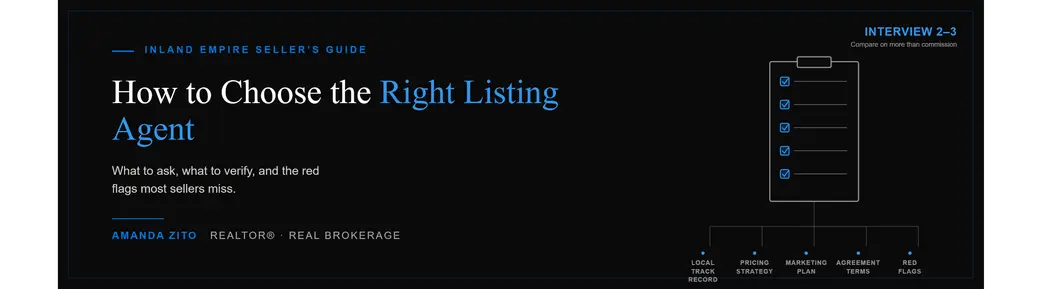
How do you choose the right listing agent to sell your home in the Inland Empire? Compare at least two or three agents on local track record, pricing strategy, and marketing plan — not commission alone. The right listing agent explains how they arrived at your price and shows you exactly how your home will be marketed.
Most sellers interview one agent. Usually it's someone a friend recommended, or the name on a postcard that showed up at the right moment. Then they sign a listing agreement that controls the single largest financial transaction of their life for the next six months.
That's a lot of weight to put on one conversation.
Choosing a listing agent in Riverside, Corona, Eastvale, Ontario, or anywhere across San Bernardino and Riverside counties isn't about finding someone likeable. Plenty of agents are likeable. It's about finding someone whose pricing is grounded in real data, whose marketing goes past the MLS, and who will tell you things you don't want to hear before those things cost you money.
Here's how to run that process properly.
Start With Local Track Record, Not Total Sales Volume
An agent who sold 40 homes last year across Los Angeles, Orange County, and the Inland Empire knows less about your ZIP code than an agent who sold 15 homes within five miles of your front door.
Ask for specifics:
- How many homes have you sold in my city in the last 12 months?
- What was your average list-to-sale price ratio?
- How many of your listings sold, and how many expired or were withdrawn?
That last question matters more than most sellers realize. An expired listing means the home sat, went stale, and came off the market unsold. An agent with a pattern of expired listings usually has a pattern of overpricing to win the listing.
You can verify licensing independently. The California DRE public license lookup shows an agent's license status, expiration, and any disciplinary history. It takes about 30 seconds and almost no seller does it.
Make Them Defend the Price
Any agent can hand you a number. The right listing agent walks you through how they got there.
A real comparative market analysis should include recent closed sales of genuinely comparable homes — similar square footage, similar lot, similar condition, similar neighborhood. It should also account for what's currently active and pending, because those are the homes your buyer is comparing yours against right now.
Watch for the agent who gives you a price noticeably higher than everyone else's without evidence to support it. This is one of the oldest problems in the business: an inflated number wins the listing, and then the price reductions start six weeks later. By that point your listing has lost the attention it gets in its first two weeks on market, and buyers are asking why it hasn't sold.
Ask directly: "What would you price this at if you weren't trying to win my business?"
Then ask what happens if the home doesn't get an offer in 21 days. An agent with a plan will describe one. An agent without a plan will tell you not to worry about it.
Look at the Actual Marketing Plan
"I'll put it on the MLS and Zillow" is not a marketing plan. Every listing goes on the MLS and syndicates out to the portals. That's the floor, not the strategy.
Ask to see the last three listings the agent marketed. Look at:
- Photography. Professional photos with proper lighting, or phone shots with a crooked horizon?
- Listing remarks. Written to describe the home specifically, or generic filler that could describe any house in the Inland Empire?
- Video and floor plans. Increasingly expected at higher price points, and useful for out-of-area and relocating buyers.
- Distribution. Where does the listing actually go beyond the portals — email database, social, agent-to-agent outreach, broker previews?
According to the National Association of REALTORS® Home Buyers and Sellers Generational Trends report, the overwhelming majority of buyers begin their search online. That means your listing's first showing is a photo on a screen. If those photos are weak, you lose buyers before anyone opens a lockbox.
Understand the Agreement Before You Sign
The listing agreement is a contract. Read the terms.
- Length. Three to six months is typical. A 12-month agreement with no cancellation provision leaves you stuck if things go badly.
- Cancellation. Ask what happens if you're unhappy. Many agents will cancel on request; get the answer before you sign, not after.
- Commission. Following the 2024 NAR settlement changes, compensation is negotiable and buyer-agent compensation is handled differently than it used to be. The California Association of REALTORS® publishes consumer-facing guidance on the current forms and practices.
On commission: the lowest number isn't automatically the best deal. If a discounted fee comes with no professional photography, no proactive marketing, and an agent who doesn't return calls, saving one percent on the commission can cost you five percent on the sale price. Judge the fee against what's actually included.
Red Flags Worth Walking Away From
- The price they quote climbs during the appointment as they sense hesitation
- They can't name recent comparable sales in your neighborhood
- They pressure you to sign that day
- They dismiss your questions about their marketing rather than answering them
- They're difficult to reach before you've hired them — that rarely improves afterward
What the Right Agent Actually Does
Beyond price and marketing, your listing agent is the person negotiating on your behalf when offers come in, coordinating inspections and appraisal, managing repair requests, and keeping escrow on schedule. Around half the deals that go sideways go sideways after the offer is accepted.
So the question isn't only "who can get my home sold." It's "who do I want in my corner when the appraisal comes in low or the buyer's loan hits a snag three days before closing."
Interview two or three. Ask hard questions. Choose the one whose answers held up.
FAQ
How many listing agents should I interview before choosing one? Two or three is usually enough. Interviewing more than that tends to add confusion rather than clarity. What matters is asking each of them the same questions so you can compare answers directly — especially on pricing rationale and marketing.
Should I hire a friend or family member as my listing agent? Only if they'd also be your choice as a stranger. Selling a home involves candid conversations about price, condition, and offers, and personal relationships can make both sides less direct. Hold a friend to the same standards you'd hold anyone else.
Is a lower commission worth it if the agent offers fewer services? It depends entirely on what's being cut. If a lower fee means no professional photography, no meaningful marketing, and limited availability, the reduced exposure can easily cost more than the savings. Ask for a written list of what's included at any fee.
What's the difference between a listing agent and a buyer's agent? A listing agent represents the seller and has a fiduciary duty to the seller's interests — pricing, marketing, and negotiating for the highest and best terms. A buyer's agent represents the buyer. In some transactions one agent may represent both parties, which requires written disclosure and consent in California.
Thinking about selling in the Inland Empire?
If you're weighing your options, I'm glad to walk you through pricing, timing, and what your home would realistically bring in today's market — no pressure and no obligation.
Amanda Zito, REALTOR® The Zito Group | Real Brokerage Serving Riverside, Corona, Eastvale, Ontario, Rancho Cucamonga, and the greater Inland Empire 📞 Call or text: 949-484-9486 ✉️ soldbyzito@gmail.com CA DRE #01740063
Categories
Recent Posts











“Your goals come first. My job is to help you make the right move.”