

How to Know If Real Is the Right Fit for You
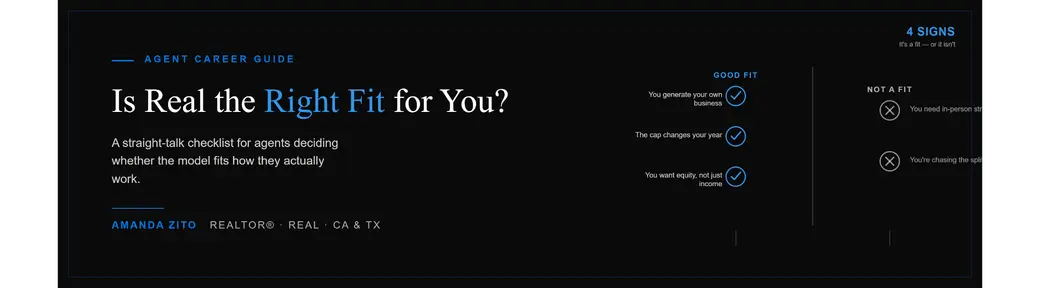
How do you know if Real is the right brokerage for you? Real is usually the right fit for agents who already generate their own business and want to keep more of it, build equity, and work from a cloud-based platform instead of a physical office. It's a poor fit for agents who need daily in-person management or company-provided leads.
Start with the honest question
Most agents don't leave a brokerage because of the split. They leave because the value they're getting stopped matching what they're paying for. The desk fee, the franchise fee, the royalty, the technology fee — none of that bothers you when the brokerage is actively growing your business. It bothers you when you realize you built the business yourself and you're still writing the check.
That's the real question behind "should I join Real?" It isn't whether Real's numbers are good. Plenty of brokerages can produce a slide that makes their numbers look good. The question is whether the way Real is built matches the way you already work.
I've been licensed since 2006 and I've made this decision myself, so here's the framework I use when another agent asks me about it — including the part where I tell people it's not for them.
What Real actually is
Real Broker (NASDAQ: REAX) is a technology-powered, cloud-based brokerage. There are no physical offices, no franchise layer, and no desk fees. Support, training, and community happen through the platform and through the agent network rather than through a branch manager down the hall.
The financial model is deliberately simple: an 85/15 commission split with a $12,000 annual cap, no monthly fees, and per-transaction fees after you cap. On top of that sit two things traditional brokerages generally don't offer — a five-tier revenue share program and stock awards tied to production and agent attraction. Real publishes the mechanics of all of it on its <a href="https://support.therealbrokerage.com/hc/en-us/articles/5978187681303-8-Ways-to-Earn-Income-at-Real-US-Agents">agent support site</a>, which is worth reading before you talk to anyone about joining.
That structure creates a specific kind of fit. Here's how to tell if it's yours.
Sign 1: You already generate your own business
This is the threshold question, and everything else depends on it.
If your pipeline comes from your database, your sphere, your content, your open houses, and your reputation, then a cloud brokerage takes almost nothing away from you and hands you back the money you were paying for overhead you weren't using.
If your pipeline comes from company-provided leads, floor time, or walk-ins from a storefront, you'd be trading a real source of business for a better split. That math rarely works. Be honest about which one you are — not which one you plan to be.
Sign 2: The numbers change your year, not just your quarter
Run your own version of this before you decide anything. Take your gross commission income from the last twelve months. Calculate what you paid your brokerage in splits, then add every fee — monthly desk, technology, E&O, franchise royalty, transaction fees, mandatory marketing.
Now run the same volume against an 85/15 split with a $12,000 cap and no monthly fees.
For most producing agents, the gap isn't small. And notice what the cap does: once you hit it, the rest of the year is yours. If the difference you calculate isn't meaningful, switching isn't worth the disruption — and I'd tell you that directly.
Sign 3: You want to own something, not just earn something
Commission income stops the day you stop working. That's the structural problem with a real estate career, and it's the thing Real's model is built to address.
Two pieces matter here:
- Equity. Real grants stock when you hit your annual cap and when a producing agent you sponsored closes their first qualified transaction. Agents can also buy REAX stock directly out of commissions and receive bonus shares on that purchase. Stock is not cash — it can go down as well as up, and it comes with vesting and tax considerations — but it means your production builds an asset, not just a deposit.
- Revenue share. Real pays sponsoring agents a defined portion of company revenue from agents in their network, across five tiers, paid from Real's side of the split rather than out of the sponsored agent's pocket. Production requirements apply, and revenue share only exists where a transaction actually generates revenue to Real.
If those two things sound like noise to you and all you want is a bigger check per closing, Real still works — you just won't be using half of what you're eligible for.
Sign 4: You're thinking past your own production
Team leaders, brokerage owners, and agents who mentor naturally tend to fit Real well, because the model doesn't punish you for helping other agents succeed. There's no office to fill, no territory to defend, and no franchise agreement dictating who you can bring in or where you can operate. Real supports agents across all 50 states and Canada on one platform, which matters if you're licensed in more than one state like I am.
Who Real is not right for
This is the section most recruiting content skips.
You need in-person structure. If you do your best work because someone expects you at a desk at 8 a.m. and checks your numbers on Friday, a cloud brokerage will expose that. The support at Real is real, but you have to reach for it.
You're brand new with no plan. New agents can absolutely succeed at Real, but not passively. If you're expecting a mentor to physically ride along on your first ten transactions and hand you leads to practice on, you need to line up that mentorship deliberately before you join — not assume it comes with the platform.
You dislike technology. The brokerage runs on its platform. If learning a new system feels like a burden rather than a tool, you'll be frustrated in month one.
You're leaving for the split alone. Agents who chase splits tend to move again in two years. Look at the whole model — support, culture, equity, longevity — or you're just renting a better rate.
What the RE/MAX combination means for your decision
If you're evaluating Real in 2026, you can't ignore the bigger story. Real announced a definitive agreement to acquire RE/MAX Holdings in April 2026, in a deal valuing the franchisor at roughly $880 million and creating a holding company called Real REMAX Group. <a href="https://investors.onereal.com/news/news-details/2026/Real-and-REMAX-Holdings-Securityholders-Approve-Proposed-Combination/default.aspx">Shareholders of both companies approved the combination on August 14, 2026</a>, and the deal is expected to close in the second half of 2026, subject to remaining conditions. Coverage from <a href="https://www.housingwire.com/articles/real-to-acquire-remax-880-million-real-remax-group/">HousingWire</a> lays out the structure if you want the full picture.
For an agent making a personal decision, the practical read is this: consolidation is happening across the industry, and scale tends to bring more resources and more brand reach. But the details of how any combination affects day-to-day agent economics get worked out over time. Ask specific questions about it rather than treating it as either a selling point or a red flag.
Questions to ask before you sign anything
- What happens to my active listings and pending transactions during the transition?
- Who will actually answer my compliance question at 7 p.m. on a Friday?
- What are the post-cap fees, in writing?
- What are the production requirements to earn and keep revenue share?
- What does the stock vest schedule look like, and what are the tax implications for me specifically?
- Who would be my sponsor, and what does their support look like six months after I join?
If someone recruiting you can't answer those clearly, that tells you something about the support you'd get afterward.
FAQ
Is Real Broker good for experienced agents? Generally, yes — experienced agents with an established pipeline benefit most, since they're already generating their own business and the cap means high producers keep substantially more of what they earn. The tradeoff is that you manage your own structure and accountability.
Do I have to recruit agents to make Real worth it? No. Revenue share and attraction-based stock awards are optional income streams, not requirements. The 85/15 split, $12,000 cap, and lack of monthly fees stand on their own for a producing agent.
How long does it take to transfer to Real? Most transfers move quickly once your paperwork and state license transfer are submitted, though timelines vary by state licensing board and by what you have in escrow. Plan the move around your current transactions rather than a calendar date.
Is Real Broker a pyramid scheme? No. Revenue share is paid from the brokerage's share of commissions on actual closed real estate transactions — there's no buy-in, no inventory, and no requirement to recruit. Agents earn primarily by selling real estate.
Let's have the honest conversation
If you're weighing this, the most useful thing isn't another comparison chart — it's running your own numbers against your own production and talking to someone who'll tell you when it isn't a fit.
I'm happy to do that with you, no pressure and no pitch. Call or text me at 949-484-9486, or email soldbyzito@gmail.com.
Amanda Zito, REALTOR® | Real Broker Licensed in California (DRE #01740063) and Texas (TREC #840088) Serving the Inland Empire, High Desert, and Lake Travis markets
Categories
Recent Posts











“Your goals come first. My job is to help you make the right move.”