

How to Transfer Your Real Estate License to Real Brokerage in California
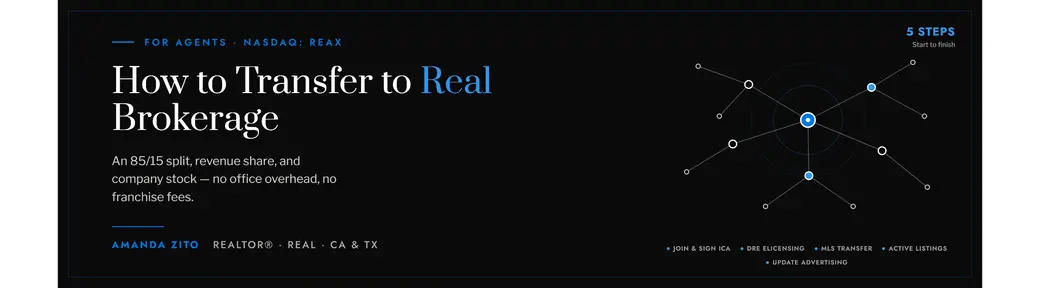
How do you transfer your real estate license to Real Brokerage in California? You complete Real's join application, then log in to the California DRE eLicensing system and change your responsible broker to Real's brokerage license number. Your board and MLS transfers happen separately.
Most California agents assume changing brokerages is a bureaucratic ordeal. It isn't. The California Department of Real Estate handles broker changes almost entirely online, and the part that actually takes the longest usually has nothing to do with the state — it's your local association, your MLS, and your active listings.
I've made this move myself and walked other agents through it. The agents who have a rough transition are almost always the ones who did the steps out of order: they submitted the eLicensing change before signing their Real paperwork, or they announced the move before figuring out what happens to their pending escrows.
Here's the sequence that works, from an agent licensed in California who has already been through it.
First, Understand What the DRE Actually Requires
In California, your salesperson license is tied to a responsible broker. When you change brokerages, you're not surrendering or reapplying for anything — you're updating the broker on your license record.
Two things matter here:
- You notify the DRE. This is done through eLicensing or by mailing a Salesperson Change Application (RE 214). Online is faster and it's what Real's onboarding process is built around.
- You notify your current broker. California requires you to give notice of termination of affiliation to the broker you're leaving. Do this professionally and in writing, even if the relationship is a good one. It protects you.
You cannot perform licensed activity or be compensated for it under a broker you aren't registered with. That's why the timing of your eLicensing change matters more than most agents realize — especially if you have a deal closing that week.
Step 1: Complete Your Real Application and Sign the ICA
Start here, not with eLicensing. Real needs your application on file before your license transfer can be accepted on their end.
You'll create your login (remember it — it becomes your reZEN login), sign the Independent Contractor Agreement, and pay the application fee. Have these ready:
- Your DRE license number and expiration date
- Your board and MLS information
- A photo of the front of your driver's license
- Estimated closed sales volume for the last 12 months
- Banking info for commission deposits (routing and account number)
- Tax ID information
The ICA is also where you name your sponsor — the agent who brought you to Real. This field determines your placement in Real's revenue share structure permanently, so put thought into who you want in that spot before you sign. It can't be changed later.
If you're advertising as a team, flag that during the application so Real sets your team up correctly from day one instead of untangling it after your first closing.
Step 2: Change Your Responsible Broker in DRE eLicensing
This is the actual license transfer, and it takes about ten minutes.
- Log in to your California DRE eLicensing account.
- Choose Change Responsible Broker (agents currently affiliated with another brokerage) rather than "Add Responsible Broker," which is for newly licensed agents.
- Enter Real's brokerage license number: 02022092 for a residential agent, or 02228473 if you're joining as referral-only.
- Save the broker information.
- When asked whether the broker is available to confirm the transfer, select NO.
- When asked whether you want to enter your responsible broker's email address, select YES, and enter Real's California broker email: cabroker@therealbrokerage.com.
- Confirm the email and save.
Real's California designated broker then receives notice from the DRE and certifies the transfer. Once your license shows as affiliated with Real and your application is approved, you'll get a welcome email with your next steps.
Broker-associates use a different path. If you hold a broker license and are affiliating as an associate, you'll go through the responsible broker section of your DRE account, and you may also need to file the Broker-Associate Affiliation Notification (RE 215). Verify with the DRE which form applies to your situation.
Step 3: Transfer Your Board and MLS Membership
The DRE change does not move your MLS access. This is a separate process, and in Southern California — CRMLS, and associations across Riverside and San Bernardino County — every board handles it slightly differently.
Contact your local association and MLS for their transfer or office change form. Most require the new designated broker's signature. Real routes California signature requests through casign@therealbrokerage.com using an electronic signing platform.
Do this the same week as your eLicensing change. Agents who let this sit are the ones who end up locked out of the MLS with a listing appointment on the calendar.
You'll need Real's California brokerage details:
| Field | Detail |
|---|---|
| Brokerage name | Real Brokerage Technologies |
| DRE license number | 02022092 |
| Mailing address | 39899 Balentine Dr., Suite 200, Newark, CA 94560 |
| Broker team email | cabroker@therealbrokerage.com |
| Signature requests | casign@therealbrokerage.com |
Step 4: Deal With Your Active Listings and Pending Escrows
Your listings belong to your current brokerage, not to you. Whether they come with you depends on your listing agreements and your broker's policy — read your independent contractor agreement with your current brokerage before you give notice.
If your sellers agree to move with you, the listings are re-listed under Real, with new paperwork submitted for the designated broker's signature. Pending escrows are usually cleaner to close out at your current brokerage, but that's a conversation to have before you announce, not after.
This is the single biggest reason to plan your transfer around your pipeline. Mid-January and mid-summer tend to be quieter windows for most Inland Empire agents than the back half of spring.
Step 5: Update Your Advertising
California has specific advertising rules, and Real is strict about them. Every advertisement in California must include the brokerage name, your license number, your phone number, and Real's logo. If you include an office address, it has to be the main office address unless a branch office is registered with the DRE.
Team names have their own rules: the name must include the surname of at least one member, followed by a word like Team, Group, or Associates.
Budget a weekend for this. Signs, business cards, your website footer, your Instagram bio, your email signature, your headshot branding — it all has to change.
Special Situations Worth Knowing About
If you're in your license renewal period: If your current brokerage has already signed and submitted your renewal application, the transfer has to wait until the DRE approves the renewal. If they haven't submitted it yet, there's a paper process involving the DRE's Renewal License Checklist (RE 216a) and your CE certificate, mailed to Real's broker for signature. Expect four to six weeks.
If you hold a restricted license: Real's onboarding team reviews these case by case before accepting the transfer, and the process uses the wet-signed RE 214A form by mail. Also plan on four to six weeks.
How Long Does the Whole Thing Take?
For a standard, unrestricted salesperson license outside a renewal window, the state side moves quickly — the eLicensing change is immediate on your end, and certification follows. Real's onboarding team typically makes contact within 48 hours of your application.
The realistic bottleneck is your MLS and association paperwork, plus whatever your current brokerage requires on the way out. Give yourself one to two weeks to be fully operational, and don't schedule your transfer for the week a deal is closing.
Frequently Asked Questions
Do I have to be released by my current broker before transferring in California? California's process differs from states where a formal release is required first. You initiate the responsible broker change yourself through eLicensing, but you're still required to notify your current broker that you're terminating the affiliation. Handle it directly and in writing.
What happens to my pending transactions when I switch brokerages? Pending escrows generally stay with the brokerage where they originated, and commissions are paid through that broker. Your independent contractor agreement with your current brokerage governs this, so review it before giving notice.
Can I transfer my license to Real if I'm licensed in both California and Texas? Yes. Real operates in both states, but each license transfers through its own state process — California through DRE eLicensing, Texas through TREC. You complete one Real application and your onboarding team adds the second license to your account.
If you're weighing a move to Real and want a straight answer about how it would work for your business — your pipeline, your MLS, your timing — call or text me. I'm licensed in California and Texas, I've been through this transfer personally, and I'll tell you honestly whether it's the right fit for where you are.
Amanda Zito REALTOR® | California DRE #01740063 | Texas TREC #840088 Real Brokerage | Inland Empire, High Desert & Lake Travis
Categories
Recent Posts










“Your goals come first. My job is to help you make the right move.”