

Moving Out of California? What IE Sellers Should Know
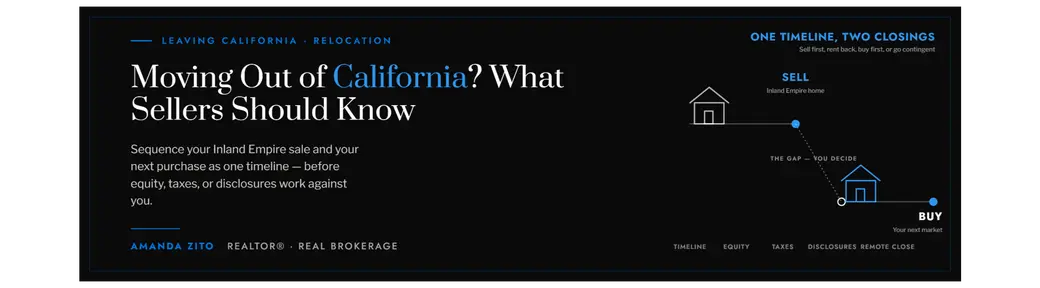
What should you know before selling your Inland Empire home and moving out of California? Plan the sale and the purchase as one connected timeline, understand how your equity travels, and get clear on the tax and disclosure rules before you list — not after you've accepted an offer.
Most people who leave California don't leave because of one thing. It's a new job, a grandchild in another state, a retirement number that finally works somewhere else, or simple math on what the same money buys in Texas, Arizona, or Idaho. Whatever's driving it, the part that trips people up is almost never the moving truck. It's the sequencing.
You're selling in one market and buying in another, often with different customs, different closing timelines, and a buyer pool that has no idea what a Riverside County escrow looks like. I've done this move myself and I coordinate it for clients regularly between Southern California and Texas. Here's what actually matters.
Start With the Timeline, Not the Listing Date
The first question isn't "when should I list?" It's "when do I need to be there?"
Work backward from your hard date — the job start, the school year, the lease you already signed. In the Inland Empire, a well-priced home typically moves through marketing, offer negotiation, escrow, and funding on a schedule you can plan around, but you need to build in room for the appraisal, the buyer's loan approval, and any repair negotiation after inspections.
Then layer in the other side: how long it takes to find and close on the next home in your destination market. Those two timelines almost never line up perfectly, which is fine — as long as you decide in advance which gap you're willing to live with.
Know Which Sequencing Option Fits You
There are really only four ways to do this, and the right one depends on your equity, your income, and your tolerance for moving twice.
- Sell first, then buy. Cleanest financially. You know your exact number and you're a non-contingent buyer in the new market, which carries real weight. The tradeoff is a temporary rental or a rent-back.
- Rent-back after closing. You close on your Inland Empire home and stay in it for an agreed period while you finalize the purchase. Negotiated up front as part of the offer terms.
- Buy first, then sell. Requires qualifying for both, or a bridge product. Lower stress on the moving side, higher cost and more exposure if your California sale takes longer than expected.
- Contingent purchase. Your offer on the new home depends on your current home selling. Acceptance depends entirely on how competitive the destination market is.
If you're relocating for work, ask whether your employer's package includes any relocation assistance before you commit to a structure. It changes the math more often than people expect.
Your Equity Is the Whole Point — Protect It
For most Inland Empire homeowners, the home is the relocation. Equity built up in Riverside or San Bernardino County is what makes the next chapter possible, whether that's a larger property, a smaller mortgage, or no mortgage at all.
That's exactly why the pricing decision matters more on a relocation sale than a typical one. When you have a deadline, the temptation is to overprice early "just to see," then chase the market down with reductions. That pattern costs sellers more than pricing correctly from day one, because the deepest buyer interest happens in the first couple of weeks and it doesn't come back.
Net proceeds also aren't the sale price. Commission, escrow and title fees, county and any city transfer taxes, prorated property taxes, HOA transfer fees, and negotiated repair credits all come out before the wire hits your account. Ask for a written net sheet before you list, and update it when you accept an offer. Current rate conditions matter to your buyer pool too — <a href="https://www.freddiemac.com/pmms">Freddie Mac's weekly mortgage rate survey</a> is a reliable place to track where financing stands.
The Tax and Legal Questions Worth Asking Early
I'm a REALTOR®, not a CPA or an attorney, and this is the part where you should absolutely loop in yours. But here's what to ask about:
The capital gains exclusion. Federal rules allow many homeowners who've owned and lived in the property as a primary residence for at least two of the last five years to exclude a substantial amount of gain from the sale. The <a href="https://www.irs.gov/taxtopics/tc701">IRS overview of the home-sale exclusion</a> lays out the ownership and use tests. If you've held your Inland Empire home a long time and appreciation has been significant, confirm where you land before you sign anything.
Your California residency for the year of the move. Part-year residency rules affect how income is reported in the year you leave. The <a href="https://www.ftb.ca.gov">California Franchise Tax Board</a> is the source for that, and it's a conversation for your tax professional.
Proposition 19 property tax transfers. Homeowners 55 and older, severely disabled homeowners, and wildfire or disaster victims may be able to transfer their property tax base — but that benefit applies to a replacement home within California. If you're leaving the state, it doesn't follow you. Details are on the <a href="https://www.boe.ca.gov/prop19/">California State Board of Equalization Prop 19 page</a>.
California's disclosure package. California requires substantial written disclosure from sellers, including the Transfer Disclosure Statement and natural hazard disclosures. Complete these carefully and honestly. Disclosure problems have a way of surfacing after you've already relocated, and dealing with them from another state is far worse than dealing with them now.
Selling From a Distance (Or About To Be)
Plenty of relocating sellers are gone before the property closes. That's manageable, but it takes setup:
- Handle prep work — paint, landscaping, decluttering, deferred repairs, photography — before you leave. Coordinating vendors remotely is slow and expensive.
- Ask about electronic signature and remote notarization options for your closing documents.
- Decide in advance whether you're selling occupied, vacant, or staged. Vacant Inland Empire homes photograph and show fine, but empty rooms make flaws louder, so the prep bar goes up.
- Give your agent written authority to coordinate access, inspections, and appraisal entry, and agree on how you want to be reached across time zones.
Frequently Asked Questions
Should I sell my Inland Empire home or keep it as a rental? It depends on your equity position, your existing interest rate, and whether the rent would realistically cover the mortgage, taxes, insurance, and management. Some sellers with very low locked-in rates find keeping the property makes sense. Others need the equity to buy in the new market. Run both scenarios with real numbers before deciding.
How far in advance should I contact an agent if I'm relocating? Ideally two to three months before your target move date. That gives room for a pricing strategy, prep work, and a coordinated plan with an agent in your destination market — which is the piece most people leave until it's too late.
Do I have to be in California to close on my home? No. Most closings can be handled remotely with electronic signatures and, where needed, a notary in your new location. Set the logistics up early rather than in the final week.
Let's Map Out Your Move
If you're thinking about leaving California in the next year, the smartest thing you can do right now is get a clear picture of your equity and a realistic timeline. That one conversation shapes every decision that follows.
Call or text me and we'll walk through your situation — what your Inland Empire home should sell for, what you'll net, and how to line up the sale with your purchase on the other end.
Amanda Zito, REALTOR® Real Brokerage | Inland Empire & High Desert, California Licensed in California (DRE #01740063) and Texas (TREC #840088) 📞 949-484-9486 | ✉️ soldbyzito@gmail.com
Categories
Recent Posts










“Your goals come first. My job is to help you make the right move.”