

Real Brokerage vs. Compass: Which Model Actually Fits Your Business in 2026?
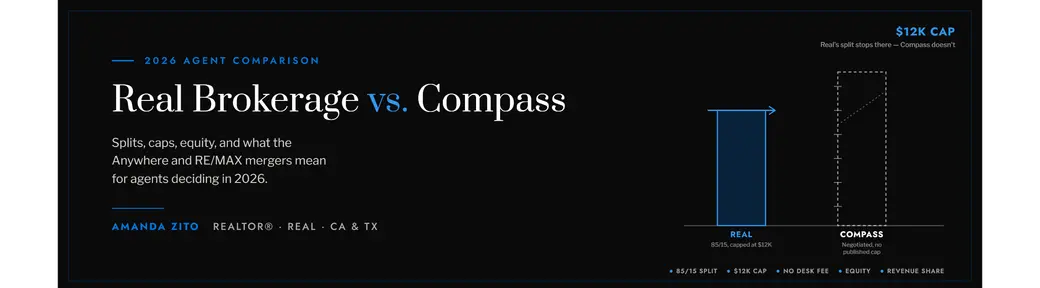
What's the difference between Real Brokerage and Compass? Real Brokerage runs a published 85/15 split with a $12,000 annual cap, plus stock awards and revenue share. Compass negotiates splits individually — commonly 70/30 to 90/10 — with no published cap and additional fees layered on top.
Both of these companies just got a lot bigger, and both did it in the same twelve months. Compass closed its acquisition of Anywhere Real Estate in January 2026, bringing Coldwell Banker, Century 21, Sotheby's International Realty, Corcoran, and Better Homes and Gardens under one corporate roof. Real Brokerage announced its own acquisition of RE/MAX in April 2026, with closing expected in the second half of this year.
So if you're weighing these two brokerages right now, you're not just comparing splits. You're choosing between two very different theories of what a brokerage is supposed to be — and both of them are in the middle of the biggest structural change the industry has seen in decades.
I'll be upfront: I'm a Real Brokerage agent, and I've been licensed since 2006 across California and Texas. That means I have a point of view. It also means I've sat through the recruiting pitch from nearly everyone, and I know which numbers people quote loudly and which ones they leave out. Here's the honest comparison.
The Two Models in One Line Each
Compass is a full-service, high-touch, company-owned brokerage. You get brand equity, physical offices, in-house marketing and design support, seller-facing tools like Concierge, and a compensation package you negotiate personally.
Real Brokerage is a technology-first brokerage with no physical offices. The economics are published and identical for everyone, and a meaningful chunk of the value comes back to agents through equity and revenue share instead of overhead.
Neither one is objectively better. They're built for different businesses.
Commission Splits and Caps
This is where the models diverge hardest, and not just on the numbers — on the transparency of the numbers.
| Real Brokerage | Compass | |
|---|---|---|
| Split | 85/15, published, same for everyone | Individually negotiated, commonly 70/30 to 90/10 |
| Annual cap | $12,000 (solo agents and team leaders); $6,000 for team members | No published national cap; varies by office and agreement |
| Post-cap | 100% of commission, minus transaction fees | Depends entirely on your agreement |
| Franchise/royalty fee | None | None on company-owned Compass offices |
At Real, you pay 15% of your gross commission income until you've paid in $12,000 for your anniversary year. At an 85/15 split, that happens at roughly $80,000 in GCI. After that, the company split stops for the rest of your year and you keep 100%, less fixed per-transaction fees.
At Compass, there is no published split schedule. Your number depends on your production history, your market, and how well you negotiate. A newer agent might land at 70/30. A proven top producer with real leverage might command 90/10 — better than Real's pre-cap split. The catch is that without a cap, that split applies to every dollar you earn, all year long.
That's the real structural difference. Real's model caps your cost. Compass's model scales with your production.
The Fees Behind the Split
Headline splits are the most misleading number in this entire industry. Run the full stack.
At Real Brokerage: a $249 sign-up fee, a $40 broker review fee per transaction, and a $285 post-cap transaction fee on sales ($125 on leases). Agents who reach Elite status get that post-cap fee reduced. There are no monthly fees, no desk fees, and no technology fees.
At Compass: agents commonly report a marketing or resource fee applied per transaction, annual E&O contributions, and in some markets a recurring monthly office or platform fee. A per-transaction fee introduced in 2026 has been the subject of litigation. Amounts vary by office and market — which is exactly the problem when you're trying to forecast a year.
The point isn't that one is cheap and one is expensive. It's that at Real you can calculate your annual brokerage cost on a napkin before you join, and at Compass you generally can't until you've seen your specific agreement and a few months of statements.
Equity: Who Actually Owns Something
Real is publicly traded on the Nasdaq under REAX, and equity is built into the agent experience rather than reserved for executives. Agents earn restricted stock units for hitting their annual cap, for attracting an agent who closes a qualifying transaction, and for reaching Elite Agent status. There's also a stock purchase plan where you can direct a percentage of each commission check into REAX and receive bonus shares on top. All awards carry a three-year vesting period, and the award amounts adjust as the company grows — the Elite Agent award is scheduled to change from $16,000 to $12,000 on September 1, 2026, so the current numbers matter if you're deciding this quarter.
Compass is also publicly traded, but ownership is not a standard part of the agent value proposition today. Early agents in certain markets received equity during recruiting; that's not the general offer for someone joining now.
If building an asset alongside your commission income matters to you, that's a genuine difference, not a marketing line.
Revenue Share vs. No Revenue Share
Real pays revenue share to agents who sponsor other agents, drawn from the company's split on those agents' eligible transactions. It's tiered, with higher percentages awarded on the earliest tiers. It's real income — Real's revenue share expense was $22.2 million in the second quarter of 2026 alone — but it's also frequently oversold. Revenue share only generates when the agents in your network are producing and haven't yet capped. It rewards genuine relationship building, not list-scraping.
Compass has no equivalent program. If attraction income isn't part of how you want to build, this section is simply irrelevant to your decision, and that's a legitimate position.
Brand, Support, and Marketing
Here's where Compass makes its strongest case, and I'd rather say so than pretend otherwise.
Compass offers in-house marketing and design teams, physical offices, a polished consumer-facing brand, and Concierge, which fronts the cost of pre-sale improvements like staging and paint and recovers it at closing. In high-end markets, that seller-facing toolkit wins listings. If you're a luxury agent who relies on brokerage-provided marketing production and an office culture you can walk into, Compass is built for you in a way Real is not.
Real's model assumes you'll handle your own marketing with the included technology stack and lean on virtual training and support instead of a physical office. That's a significant tradeoff, and it's the single most common reason agents leave Real. Be honest with yourself about which environment you actually perform in.
Scale and Consolidation: What Changed This Year
Compass International Holdings now sits at roughly 83,000 agents across its owned brokerage brands, with a franchise network on top of that — by size, the largest residential brokerage company in the world. That scale brings referral reach and institutional weight. It also brings integration, and integration always creates friction for the people inside it.
Real reported approximately 35,350 agents at the end of the second quarter of 2026, up 26% year over year, with revenue crossing $700 million for the first time and roughly 62,000 transactions closed in the quarter. Its RE/MAX acquisition, if approved and closed, changes that footprint substantially.
For an individual agent, the takeaway is the same either way: both companies are absorbing something large right now. Ask any recruiter at either one what specifically changes for you in the next eighteen months, and pay attention to how concrete the answer is.
Who Each Model Actually Fits
Real Brokerage tends to fit agents who market themselves, want predictable and published economics, care about equity and long-term income beyond commissions, work well without an office, or run a team where a $6,000 team-member cap materially changes the math.
Compass tends to fit agents who want brand recognition doing part of the work, rely on brokerage-provided marketing production, have the production history to negotiate hard, or work in a market where the Compass name is the price of entry at the high end.
How to Run Your Own Math
Do this before you talk to anyone about switching:
- Pull your last twelve months of GCI and transaction count.
- Calculate what you actually paid your current brokerage — split, cap, royalty, monthly fees, transaction fees, E&O, technology.
- Run that same production through both models, including every fee, not just the split.
- Then subtract the value of the support you genuinely use. If your brokerage's marketing department produces your listing materials and you'd have to replace that, price it.
A better split that costs you production isn't a better deal.
Frequently Asked Questions
Do you really keep 100% of your commission at Real after you cap? You stop paying the 15% company split for the rest of your anniversary year, so from a split standpoint, yes. You still pay fixed per-transaction fees, including the broker review fee and the post-cap transaction fee, so your true post-cap retention is slightly under 100%.
Is Compass better for luxury agents? It can be. Compass's brand recognition, in-house marketing production, and Concierge program are real advantages in high-end markets. Real has a luxury division and agents closing luxury business successfully, but the marketing execution is more on you. The right answer depends on whether your listings are won by the brokerage's name or by yours.
What happens to my active listings if I switch brokerages? Listings belong to the brokerage, not the agent, so transferring active inventory requires seller consent and cooperation from your current broker. Pending transactions are typically completed at the brokerage where they originated. Plan the timing of any move around your pipeline, and read your independent contractor agreement before you give notice.
Thinking About a Move?
If you're weighing these two and want someone to actually run your numbers with you — no pitch, no pressure, just the math on your production — call or text me. I'm happy to tell you when Real isn't the right fit, because sometimes it isn't.
Amanda Zito, REALTOR® Real Broker, LLC | Luxury & Military Divisions Serving the Inland Empire and High Desert, California, and the Lake Travis area, Texas CA DRE #01740063 | TX TREC #840088 📞 949-484-9486 | ✉️ soldbyzito@gmail.com
Sources: The Real Brokerage Q2 2026 results, Real's agent equity and fee documentation, HousingWire coverage of Compass Q2 2026, and Inman's reporting on the Compass–Anywhere merger. Compensation terms at both brokerages change; verify current figures directly with either company before making a decision.
Categories
Recent Posts











“Your goals come first. My job is to help you make the right move.”