

Real Brokerage vs. eXp Realty: Which Fits Your Business?
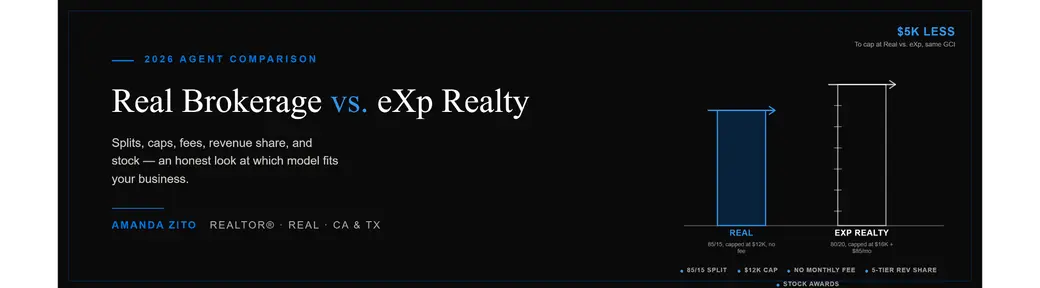
What's the difference between Real Brokerage and eXp Realty? Real Broker runs an 85/15 split with a $12,000 cap and no monthly fee. eXp Realty runs an 80/20 split with a $16,000 cap and an $85 monthly fee. Both are publicly traded cloud brokerages with revenue share and stock programs.
Two Cloud Brokerages, Two Different Bets
If you're comparing Real Broker and eXp Realty, you've already made the harder decision — you've decided the traditional franchise model isn't worth what it costs you. Now you're choosing between the two biggest players in the cloud brokerage space, and the marketing from both sides sounds nearly identical.
Here's what nobody tells you: the split difference between these two is real, but it's not the whole story. The bigger question in 2026 is which company's direction fits where you're taking your business over the next five years — because both of them just made moves that change what you're actually joining.
I'll give you the numbers, then the context. Full disclosure up front: I'm a Real Broker agent. I switched, I stayed, and I'll tell you plainly where eXp has the stronger argument, because you deserve real information, not a recruiting pitch dressed up as a blog post.
The Numbers Side by Side
| Real Broker | eXp Realty | |
|---|---|---|
| Commission split | 85/15 | 80/20 |
| Annual cap (solo) | $12,000 | $16,000 |
| GCI to cap | ~$80,000 | ~$80,000 |
| Monthly fee | None | $85 |
| Join fee | $249 one-time | $149 startup |
| Annual brokerage fee | $750, pulled from first 3 closings | None |
| Per-transaction fees | $40 compliance/broker review | $25 broker review + $40 risk management (annual limit applies) |
| Post-cap transaction fee | $285 ($129 Elite) | $250, dropping to $75 after a threshold |
| Revenue share | 5 tiers (5/4/3/2/1%) | 7 tiers (Tier 1 ≈ 3.5% of GCI) |
| Ticker | REAX (Nasdaq) | AGNT (Nasdaq) |
Important timing note: Real's fee schedule changes on September 1, 2026. The annual brokerage fee moves to $900, the per-transaction compliance fee moves to $50, and the Elite post-cap fee drops to $100. If you're running your own math this month, run it on the September numbers — that's what you'll actually live with. You can verify all of it directly in Real's agent support center rather than taking any recruiter's word for it, mine included.
Where the Split Difference Actually Shows Up
At roughly $80,000 in gross commission income, both agents cap. The difference is what you paid to get there.
At Real, you paid $12,000. At eXp, you paid $16,000 plus twelve months of $85 fees — about $17,000 all in. That's a $5,000 swing on the same production.
But the shape of that difference matters more than the size. Real charges nothing monthly, which means a slow quarter costs you nothing in overhead. eXp's $85 bills whether you close or not. For an agent with steady, predictable volume, $85 is noise. For an agent building back up after a move, a licensing change, or a life event, twelve months of fixed cost with no closings behind it is a different experience.
The flip side: eXp's post-cap transaction fee drops lower than Real's standard post-cap fee once you've hit their volume threshold. A very high-transaction-count agent — think 40+ sides a year — should model both post-cap structures carefully instead of assuming the better split wins automatically. It usually does. It doesn't always.
Revenue Share: Simpler vs. Deeper
This is where the two models genuinely diverge, and where most agents make the wrong call by focusing only on the top-line percentage.
Real's structure is five tiers, paying 5%, 4%, 3%, 2%, and 1%. Tier one pays 5% of what an agent you personally sponsored generates, up to a per-agent annual maximum. It's easy to explain and easy to project.
eXp's structure is seven tiers, with tier one paying roughly 3.5% of GCI, and additional layers that unlock as you sponsor more agents. The deeper tiers pay less per agent but reach further down the organization. eXp has been running this program far longer and has paid out substantially more in cumulative revenue share simply because of scale and time in market.
The honest read: if you're sponsoring a handful of agents, Real's front-loaded 5% tier pays you more, faster. If you're building a large organization over a decade — genuinely recruiting as a business line, not casually — eXp's deeper structure has more room at the bottom. There's also a difference in how each program passes to heirs. eXp's is willable from day one. Real's requires a multi-year production history first. If legacy income is part of your planning, ask both companies to put their current terms in writing.
Stock: Both Real, Both Conditional
Both brokerages award equity in a publicly traded company for hitting production and cultural milestones — eXp through its ICON program, Real through its Elite Agent program. Both vest over time. Both are subject to change, and Real's award structure is among the items shifting in September 2026.
Here's the part I'd want an agent to hear: stock awards are a bonus, not a business plan. Both stocks are volatile. Neither company guarantees the award structure will look the same in three years. Choose the brokerage on the split, the fees, the support, and the direction — and treat the equity as upside if it materializes.
The 2026 Context Most Comparisons Skip
Both companies made structural moves this year that change what you're evaluating.
Real announced an $880 million acquisition of RE/MAX in April 2026, creating a combined platform of more than 180,000 agents worldwide under a new holding company. The deal is expected to close in the second half of 2026, pending shareholder and regulatory approval. Real has stated it will continue operating as a separately branded owned brokerage.
eXp's parent company became AGNT, Inc., acquired the NextHome franchise, and moved its legal domicile to Texas. The eXp Realty brand and agent model continue as they were, but the parent is now explicitly a multi-model platform holding both a cloud brokerage and a franchise network.
Both companies are betting that scale and multi-model reach win the next decade. Neither move changes your split tomorrow. But if you're joining for a ten-year run, you should know that the company you research today is mid-transformation — and ask direct questions about what stays fixed.
So Which One Fits Your Business?
Real Broker likely fits better if: you want the lowest total cost of doing business, you value having zero monthly overhead, you're a solo agent or small team, or you're sponsoring a small number of agents and want that revenue share front-loaded.
eXp Realty likely fits better if: you're building a large sponsored organization as a deliberate second income stream, you want the longest operating track record in the cloud model, or you place real value on the established eXp World training and community infrastructure.
Neither fits if you need in-office accountability, daily desk-side mentorship, or provided leads. Both models assume you can run your own business. That's the actual dividing line — and it matters more than five percentage points.
Frequently Asked Questions
Can I keep my current listings if I switch brokerages? Listing agreements belong to the brokerage, not the agent, so your current broker has to release them. In practice many brokerages will, but it's negotiated, not automatic. Handle this conversation before you sign anything with a new company.
How long does it take to transfer my license? It depends on your state. In California and Texas, the paperwork itself is straightforward — the real timeline is set by how quickly your current brokerage releases you and how fast your state's licensing body processes the change. Plan for a few days to a few weeks, and time it around your pipeline.
Do I have to recruit at Real Broker or eXp Realty? No. Revenue share is available at both, and neither requires participation. Some agents build significant sponsored organizations; plenty of others never sponsor a single agent and simply keep more of their commission. Choose based on the split and fees first.
Let's Run Your Actual Numbers
Every comparison chart online — including this one — is a generalization. Your real answer depends on your GCI, your transaction count, your team structure, and whether you're growing or steadying.
If you want to sit down and run your specific numbers, call or text me at 949-484-9486. I'll walk you through the math honestly, including the places where the answer isn't Real. No pressure, no pitch — just a straight conversation between two agents about what the business actually costs.
Amanda Zito, REALTOR® — Real Broker | Licensed in California (DRE #01740063) and Texas (TREC #840088) | Serving the Inland Empire, the High Desert, and Lake Travis
Commission structures, fees, and equity programs change. Verify current terms directly with each brokerage before making a decision.
Categories
Recent Posts











“Your goals come first. My job is to help you make the right move.”