

Real Brokerage vs. Keller Williams: An Honest Comparison for Agents in 2026
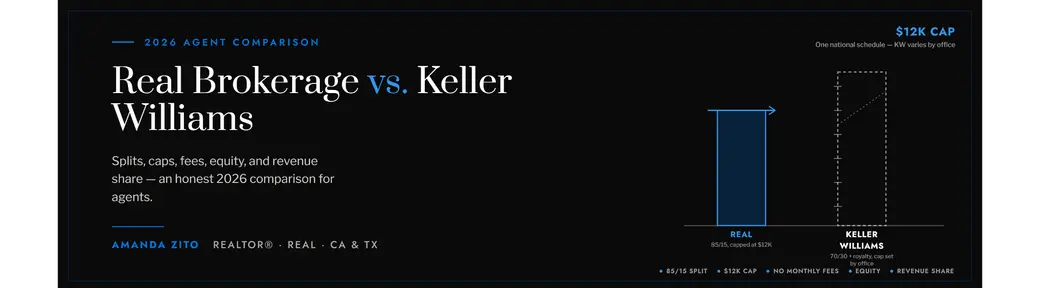
What's the difference between Real Brokerage and Keller Williams? Real Brokerage is a cloud-based brokerage with an 85/15 split, a $12,000 cap, no monthly fees, and stock and revenue share. Keller Williams is a franchise model with market center offices, a 64/36 effective split, locally set caps, and profit share.
Why This Comparison Comes Up So Often
Keller Williams built the modern agent-centric brokerage. For four decades it set the standard on training, culture, and the idea that agents — not the brokerage — own the business. If you've been licensed more than five years, you've almost certainly sat in a KW class, read one of their books, or worked a deal across the table from a market center.
Real Brokerage came at the same problem from a different direction: strip out the physical offices and franchise layer, publish one national fee schedule, and hand agents equity in the company instead of a share of local office profits.
Both models work. Agents are thriving at both. But they are structurally different companies, and the difference shows up in your bank account, your calendar, and what you own five years from now. I'm licensed in California and Texas, I've watched agents make this move in both markets, and I'm a Real agent myself — so read this knowing my seat at the table, and verify every number with both companies before you sign anything.
The Structural Difference: Franchise vs. Cloud
Keller Williams operates as a franchise network. Each market center is independently owned, which means the local owner sets the cap, the desk fees, the transaction fees, and the office culture. Two KW offices twenty miles apart in Southern California can have meaningfully different economics.
Real operates as a single national brokerage with no physical offices. One split, one cap, one fee schedule across all 50 states. Your terms in the High Desert are identical to your terms in Lake Travis.
That single distinction drives almost everything else in this comparison.
Splits, Caps, and Fees Side by Side
| Real Brokerage | Keller Williams | |
|---|---|---|
| Base split | 85/15 | 70/30, plus royalty (≈64/36 effective) |
| Company cap | $12,000 solo/team leader; $6,000 team member; $4,000 mega team | Set by each market center — commonly $15,000–$36,000+ |
| Franchise/royalty fee | None | 6% per transaction, capped at $3,000 annually |
| Monthly fees | None | Desk and office fees vary by market center |
| Per-transaction fee | $40 compliance/broker review pre-cap; $285 post-cap ($129 for Elite Agents) | Varies widely by market center |
| Annual brokerage fee | $750, collected from the first three closings of your anniversary year | Varies by market center |
| Sign-up fee | $249 one-time | Varies by market center |
Two things to flag on the Real column. First, several of those numbers change on September 1, 2026: the annual brokerage fee moves to $900, the per-transaction compliance fee moves to $50, and the Elite Agent post-cap fee drops to $100. If you're running the math this month, run it on both sets of numbers.
Second, "100% after cap" is marketing shorthand at every cloud brokerage, Real included. After you cap, Real stops taking the 15% split — but per-transaction fees continue. The honest framing is that your effective brokerage cost for a strong production year lands in the mid-to-high single digits as a percentage of GCI, not zero.
On the KW side, the number that surprises people is the royalty. The 70/30 split gets quoted, but the 6% franchise fee comes off the top until you've paid $3,000 for the year — which is why agents describe it as a 64/36 split in practice. Once you clear both the market center cap and the royalty cap, you're at 100% for the remainder of your anniversary year.
What You Build Beyond the Split
This is where the two companies diverge the most, and it's the part most agents underweight when they're comparing splits.
Keller Williams: Profit Share
KW distributes a portion of each market center's monthly profits to the agents who sponsored other agents into that office. The program runs seven levels deep and has created real, generational income for agents who recruited consistently in growing market centers.
The dependency is worth understanding: your profit share is tied to the profitability of local market centers. When offices are growing and profitable, the checks are meaningful. When they aren't, the checks reflect that.
Real Brokerage: Equity and Revenue Share
Real pays agents in two currencies. Revenue share comes out of Real's 15% company split across five tiers, weighted toward the earlier tiers rather than the deeper ones. Equity comes as restricted stock units with a three-year vesting period, awarded for capping, for production milestones, for attracting agents who close their first deal, and for reaching Elite Agent status. Agents can also elect to convert part of every commission into REAX stock at a discount.
Real's Elite Agent stock award is $16,000 today and moves to $12,000 for agents who reach Elite status on or after September 1, 2026, with a separate cultural award available on top. And starting that same date, U.S. agents need a Real Wallet business checking account to receive revenue share deposits.
Stock is not cash. REAX trades publicly, it moves, and RSUs vest over three years — you have to still be there. Anyone selling you Real equity as a guaranteed outcome is overselling it.
Training, Culture, and Support
Keller Williams' training is the strongest argument for the model, and I won't pretend otherwise. BOLD, the MREA framework, the in-person market center environment, weekly accountability, a team leader who knows your name and notices when you go quiet for a month — that structure has launched more successful real estate careers than any other system in the industry. For a new agent who needs a room to walk into, that's not a small thing.
Real's support is built differently: on-demand training through Real Academy, an internal community platform where thousands of agents answer questions in real time, private mastermind groups, and a mentorship program that pairs newer agents with producers. It's excellent if you're self-directed. It's thinner if what you actually need is someone physically expecting you at 8 a.m.
Be honest with yourself about which one you are. That single question predicts more switching regret than any fee schedule.
Technology
KW's Command platform, with Kelle and its newer AI layer, is a full CRM and transaction ecosystem built in-house — a genuine differentiator when it launched, and now backed by Stone Point Capital's investment in the company's tech spending.
Real's reZEN platform handles transactions and commission tracking, with Leo AI as the assistant layer and Real Wallet, One Real Title, and One Real Mortgage extending into fintech and ancillary services.
Both are capable. Neither should be the deciding factor. Agents rarely leave a brokerage over software, and rarely stay for it either.
Where Each Company Is Headed
Ownership changed at both companies recently, and it's fair to weigh that.
Keller Williams brought in Stone Point Capital as majority owner in March 2025, along with a new CEO, and has been spending on technology, marketing, and franchisee support since. Gary Keller remains executive chairman.
Real is publicly traded on NASDAQ under REAX and announced a definitive agreement in April 2026 to acquire RE/MAX Holdings in a transaction valuing the combined enterprise around $880 million, forming Real REMAX Group. The deal is pending shareholder and regulatory approval and is expected to close in the second half of 2026. If you're evaluating Real right now, that's a live variable — a much larger combined company with a franchise network attached is a different company than the one agents joined in 2023.
Who Each One Actually Fits
Keller Williams tends to fit newer agents who want in-person training and daily accountability, agents in a strong market center with a low cap and a leader they trust, and agents who have built profit share downlines they don't want to walk away from.
Real tends to fit producing agents whose current cap and fees exceed $12,000 a year, self-directed agents who don't need an office, agents who want ownership in the company they help grow, and agents licensed in multiple states — like California and Texas — who want one platform and one fee schedule instead of two market centers.
Questions to Ask Before You Switch
- What is my actual all-in cost at my current brokerage last year — cap, royalty, desk fees, transaction fees, tech fees, everything?
- What would that same production have cost me at the other brokerage, using this year's numbers and next month's?
- What am I walking away from, and what vests if I stay?
- What happens to my active listings and pendings during the transfer?
- Where do my leads actually come from, and does either brokerage change that?
Run the math on your own last twelve months. Not a hypothetical agent's. Yours.
FAQ
Is Real Brokerage cheaper than Keller Williams? For most producing agents, yes — Real's $12,000 cap with no monthly fees is lower than the combined market center cap, $3,000 royalty, and desk fees at most KW offices. But KW caps vary widely by market center, and a low-cap office with strong support can compete closely. Compare your specific numbers.
Can I keep my Keller Williams profit share if I leave? KW's profit share has vesting requirements tied to years of active status, and terms have changed over time. Get your current vesting status in writing from your market center before you make any decision — this is the single most common thing agents get wrong when they switch.
Does Keller Williams offer stock like Real does? Keller Williams does not have a universal agent equity program. Its agent wealth-building vehicle is profit share, funded by market center profits. Real's is company stock, awarded in RSUs and available through an elective purchase program.
Thinking About a Move?
If you're weighing Real Brokerage against Keller Williams, I'll run your actual numbers with you — your production, your current cap and fees, both fee schedules, no pressure and no pitch. If Real isn't the better answer for your business, I'll tell you that.
Call or text me at 949-484-9486, or email soldbyzito@gmail.com.
Amanda Zito, REALTOR® Real Brokerage | Licensed in California (DRE #01740063) and Texas (TREC #840088) Serving the Inland Empire, High Desert, and Lake Travis markets
Figures reflect publicly available terms as of August 2026 and are subject to change. Keller Williams terms vary by market center. Verify all current numbers directly with each brokerage before making a decision. Nothing here is financial or investment advice.
Categories
Recent Posts











“Your goals come first. My job is to help you make the right move.”