

Real Brokerage vs. RE/MAX: How the Two Models Actually Compare in 2026
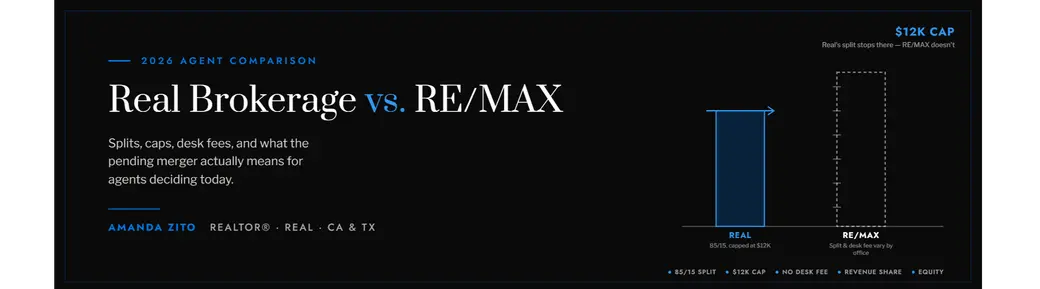
What's the difference between Real Brokerage and RE/MAX for agents? Real Brokerage is a company-owned cloud brokerage with one national plan — an 85/15 split and a $12,000 annual cap. RE/MAX is a franchise network, so your split, desk fee, and monthly costs are set by the individual office you join.
Here's the part that makes this comparison unusual right now: these two companies are in the middle of combining. On April 27, 2026, Real announced a definitive agreement to acquire RE/MAX Holdings in a deal with an implied enterprise value of roughly $880 million, creating a new holding company called Real REMAX Group. Shareholder votes are scheduled for August 14, 2026, antitrust review has already cleared, and the companies expect to close in the second half of 2026.
So does the comparison still matter? Yes — and more than you'd think. Both companies have said the brands will keep operating separately: RE/MAX continues as a franchise brand, and Real continues as a company-owned brokerage. If you're weighing where to hang your license, you're still choosing between two very different business models, two very different fee structures, and two very different ways of being supported.
I've been licensed since 2006, I work in both California and Texas, and I've had this conversation with a lot of agents. Here's the honest breakdown.
The Core Difference: Owned Brokerage vs. Franchise Network
Almost everything else flows from this one distinction.
RE/MAX is a franchisor. Individual brokers buy a franchise, open an office, hire staff, sign a lease, and then set their own agent compensation to cover that overhead. That's why two RE/MAX agents in the same county can be on completely different plans. The brand is national; the economics are local.
Real is a company-owned brokerage. There are no franchisees setting local terms. Every U.S. agent is on the same published plan, whether they're in Rancho Cucamonga, the High Desert, or Lakeway. There's no physical office, which is exactly why the fixed costs are lower — and exactly why some agents don't like it.
Neither model is better in a vacuum. They're built for different agents.
The Commission Math at Real
Real's plan is published and identical across all 50 states, which makes it easy to calculate.
| Real Brokerage (U.S.) | Amount |
|---|---|
| Commission split | 85/15 |
| Solo agent / team leader cap | $12,000 |
| Team member cap | $6,000 |
| Monthly fee | $0 |
| One-time sign-up fee | $249 |
| Annual brokerage fee | $750 |
| Compliance & Broker Review fee | $40 per transaction |
| Post-cap transaction fee (sale) | $285 |
| Post-cap transaction fee (lease) | $125 |
At an 85/15 split, you cap once you've paid Real $12,000 — which happens at roughly $80,000 in gross commission income. After that, the 15% stops for the rest of your anniversary year, though per-transaction fees still apply.
One thing to plan for: Real has scheduled fee changes effective September 1, 2026. The annual brokerage fee moves from $750 to $900, and the Compliance and Broker Review fee moves from $40 to $50 per transaction. If you're running a comparison right now, run it both ways so you know what a full year actually costs.
The Commission Math at RE/MAX
This is where it gets less tidy, because there isn't one RE/MAX plan — there are two general structures, and the specifics belong to the office.
The classic 95/5 plan. You keep 95% of your commission and pay a monthly desk fee that covers your share of the office overhead. Reported desk fees range from a few hundred dollars to well over $2,000 a month depending on the market and what's included. That fee is due whether you close three deals that month or zero.
The RE/MAX Alternative Payment Plan (RAPP). Instead of a monthly desk fee, you take a lower split — commonly starting around 60/40 for newer agents and improving to 70/30 or 80/20 with experience — until you reach an annual cap. After the cap, you move to the higher split for the rest of the year.
On top of either structure, most RE/MAX agents also budget for franchise fees on transactions and annual dues.
The takeaway: you cannot evaluate RE/MAX from a national article. You have to get the specific numbers from the specific office. Ask for the desk fee, the franchise fee, the cap, what's included, and what you'd owe in a slow month.
The Break-Even Question
The honest way to compare these two is not split versus split. It's total annual cost against total annual production.
A fixed-desk-fee model rewards volume. If you're closing consistently and your desk fee is spread across 30 transactions, the per-deal cost is small and a 95% split is genuinely hard to beat on paper. If your production dips — a slow quarter, a maternity leave, a market like the one we've had — that same fixed fee keeps billing.
A capped model rewards production too, but caps your downside. At Real, if you have a quiet year, you pay 15% of a smaller number and the cost scales down with you. If you have a strong year, you stop paying the split entirely once you hit $12,000.
Run your last 12 months. Total GCI, transaction count, every dollar you paid your brokerage — splits, desk fees, franchise fees, tech fees, E&O, everything. Then run that same production through each model. The answer is usually obvious once the number is in front of you, and it's often not the answer the recruiting pitch predicted.
What You Get Beyond the Split
Money isn't the only variable, and any agent who tells you it is has something to sell you.
RE/MAX brings a physical office, decades of brand recognition, and in many locations a real bench of experienced producers down the hall. For an agent who wants somewhere to bring a client, a broker to walk into unannounced, and a local culture to plug into, that has genuine value — and it's the thing agents most often miss when they leave.
Real brings lower fixed overhead, a cloud platform, revenue share, and equity. Agents can earn stock through production and Elite Agent programs, which is a different kind of compensation than a commission check — it can appreciate, and it can also decline. Treat it as upside, not as income you're counting on.
Support is where I'd push you hardest to do your own diligence at either company. At Real, your sponsor and your local network matter enormously; at RE/MAX, the quality of your specific broker matters just as much. Both models can leave a newer agent underserved if you pick the wrong person.
Who Each Model Tends to Fit
RE/MAX often fits agents who want a physical office and daily in-person structure, value the established local brand in their farm area, produce enough volume that a fixed desk fee gets diluted across many transactions, and have a broker they genuinely want to work under.
Real often fits agents who already have a lead source that works, don't use an office enough to justify paying for one, want predictable annual brokerage costs, are comfortable building their own brand rather than leaning on a franchise, and are interested in revenue share or equity as part of their long-term picture.
And there's a third group worth naming: agents who are fine where they are. A better split will not fix weak lead generation. If your business is stalled, changing your brokerage logo rarely restarts it.
What the Merger Might Change
Nobody can tell you exactly how the combined company will operate, and I'd be skeptical of anyone who claims otherwise. What has been publicly stated is that both brands will continue, Real CEO Tamir Poleg is expected to lead the combined company, and the combined network would total roughly 180,000 agents worldwide. Industry coverage has framed the deal as part of a broader consolidation wave that also includes Rocket–Redfin and Compass–Anywhere.
For an agent making a decision this month, the practical guidance is simple: evaluate the plan in front of you today. Your split, cap, and fees are governed by the agreement you sign, not by a headline about a pending transaction.
FAQs
Is Real Brokerage cheaper than RE/MAX? It depends entirely on your production and which RE/MAX plan you're comparing. Real's cost is capped at $12,000 in splits plus fixed fees. A RE/MAX 95/5 plan with a $1,000 monthly desk fee costs $12,000 a year in desk fees alone before franchise fees — but a high-volume agent may still net more there. Run your own 12-month numbers.
Will RE/MAX agents automatically become Real agents when the merger closes? Based on what the companies have announced, no. RE/MAX and Motto Mortgage are expected to continue operating under their current brands as franchise networks, with Real continuing as a separate owned brokerage. Anything beyond that is speculation until the deal closes.
What happens to my active listings if I switch brokerages? Listing agreements are between the seller and the brokerage, not the agent, so transferring pending or active listings requires cooperation from your current broker and, in most cases, written consent from your clients. This is the single most important logistics question to sort out before you give notice — talk it through in detail with both brokers.
Thinking It Through?
If you're comparing brokerages and want someone to look at your actual numbers instead of a recruiting deck, I'm happy to do it. I'll run your last 12 months through both models and show you the math — including the parts that don't favor a move.
No pitch, no pressure. Just call or text.
Amanda Zito, REALTOR® The Zito Group | Real Brokerage Serving the Inland Empire, the High Desert, and the Lake Travis area CA DRE #01740063 | TX TREC #840088 📞 949-484-9486
Fee figures reflect Real's published U.S. plan as of August 2026 and are subject to change. RE/MAX splits, desk fees, and franchise fees are set by individual franchise offices and vary by market — confirm all figures directly with the brokerage you're considering.
Categories
Recent Posts











“Your goals come first. My job is to help you make the right move.”