

Should You Accept the Highest Offer?
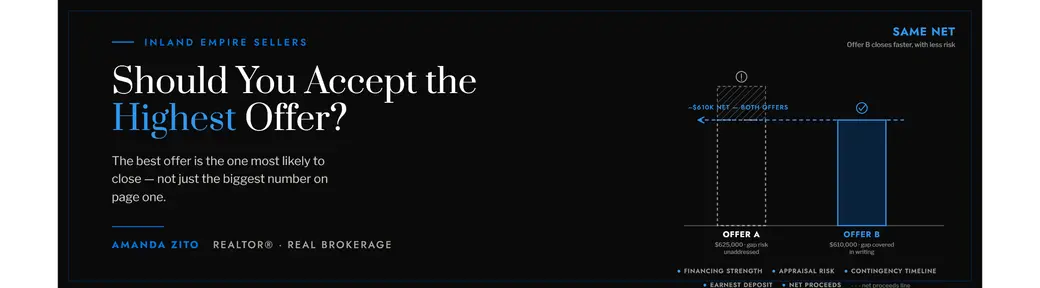
Should you accept the highest offer on your home? Not automatically. In the Inland Empire, the best offer is the one most likely to actually close — and that depends on financing, contingencies, and timeline as much as it depends on price.
The Number on Page One Is Only Part of the Story
Every seller I work with in Riverside and San Bernardino County has the same first reaction when offers come in: they go straight to the price. That's human. It's also the fastest way to end up back on the market in three weeks explaining to buyers why your listing "fell out."
Here's what actually matters. A purchase contract is a promise to buy — not a guarantee. Between acceptance and closing, that buyer still has to get an appraisal that supports the price, get final loan approval, complete inspections, and show up to sign. Every one of those steps is a place the deal can die. The offer with the biggest number is sometimes the one carrying the most risk in all four categories.
I've seen sellers in Corona and Eastvale take an offer that was $15,000 higher, lose 40 days when the buyer's financing collapsed, and eventually close for less than the offer they originally passed on. The highest offer isn't a prize. It's a proposal — and you should read all of it.
What I Compare Before I Look at Price
When offers land on one of my listings, I build a side-by-side comparison for my seller. Price is one column. Here's the rest.
Financing type and lender strength
Cash closes fastest and carries no appraisal or loan-approval risk, which is why cash buyers often win against higher financed offers. But most Inland Empire buyers are financing, and that's completely normal — the question isn't which loan program, it's how solid is this particular buyer.
What I look for: a full pre-approval (not a pre-qualification), a lender who answers the phone when I call, verified funds for the down payment and closing costs, and a loan officer who can tell me where the file already stands. A buyer whose income and assets are already documented is dramatically stronger than one who filled out an online form last Tuesday.
One note I'll make plainly, because it comes up constantly in a region with as many military and veteran buyers as ours: VA and FHA offers are not weak offers. They have specific appraisal and property-condition standards, and those are worth understanding, but a well-qualified VA buyer with a responsive lender routinely closes faster and cleaner than a conventional buyer who's shaky on paper. Evaluate the buyer, not the label.
Appraisal risk
This is the one that quietly kills high offers. If a buyer offers $40,000 over your list price and the appraisal comes in at list price, the lender will only lend against the appraised value. Someone has to cover that gap — and if the contract doesn't say who, it usually becomes a renegotiation where you're the one giving.
An offer that's $20,000 lower but includes an appraisal contingency waiver, or written appraisal gap coverage up to a stated dollar amount, can be worth more than the higher one. Ask your agent to spell out, in writing, exactly what happens if the appraisal comes in low. If nobody can answer that question, you don't have an offer — you have an opening bid. The Consumer Financial Protection Bureau has a good plain-English breakdown of how appraisals fit into the loan process if you want the buyer-side view.
Contingencies and timelines
In California, the standard residential purchase agreement gives buyers contingency periods for inspection, appraisal, and loan approval. Until those are removed in writing, the buyer can generally walk and keep their deposit.
So look at the clock:
- How many days for the inspection contingency? 17 is standard; 7 to 10 is stronger.
- Is the loan contingency shortened or removed?
- Is the appraisal contingency intact, shortened, or waived?
- Are there any unusual contingencies — like the buyer needing to sell their current home first?
A shorter contingency period means less time you're sitting exposed and off the market. The California Association of REALTORS® publishes the standard forms these timelines are built on, and a good listing agent should be able to walk you through each one line by line.
Earnest money deposit
The deposit is the buyer's skin in the game. A 3% deposit on a $650,000 home in Rancho Cucamonga signals a very different level of commitment than the minimum. It doesn't guarantee performance, but buyers who put up more money tend to behave like buyers who intend to close.
Closing date, possession, and extras
Do you need 45 days to coordinate your next purchase? Do you need a two-week rent-back after closing so you're not moving twice? An offer that matches your timeline has real dollar value — count what a short-term rental and a second move would actually cost you and you'll see it.
Also read the fine print for what the buyer is asking you to pay: closing cost credits, a home warranty, HOA transfer fees, requests to leave appliances. All of that comes out of your bottom line.
Price vs. Net Proceeds
This is the shift I want every Inland Empire seller to make: stop comparing offer prices and start comparing net proceeds — what actually hits your account at closing.
Here's a simplified illustration of two hypothetical offers on the same home:
| Offer A | Offer B | |
|---|---|---|
| Purchase price | $625,000 | $610,000 |
| Closing cost credit to buyer | $15,000 | $0 |
| Appraisal gap coverage | None | Up to $10,000 |
| Inspection contingency | 17 days | 7 days |
| Earnest money | 1% | 3% |
| Estimated seller net | ~$610,000 | ~$610,000 |
Same net. Wildly different risk. Offer B closes faster, protects you if the appraisal comes in soft, and puts more of the buyer's money at stake. Offer A only looks better in the MLS.
Your agent should hand you a written seller net sheet for every offer you're seriously considering. If you're getting a verbal "this one's higher," ask for the math.
When the Highest Offer Really Is the Best One
I'm not arguing you should reflexively pass on top dollar. Take it when the terms hold up:
- The buyer is well-qualified with a documented, verifiable pre-approval
- Appraisal risk is addressed in writing
- Contingency periods are short or partially waived
- The deposit is meaningful
- The closing timeline works for your move
- The lender is responsive and local enough to know Riverside County and San Bernardino County property nuances
When a high offer checks those boxes, it isn't just the highest — it's the strongest. Sign it.
The Real Question to Ask
Not "which offer is biggest?" but "which offer is most likely to close at this price, on my timeline, without a renegotiation halfway through?"
That's the question that protects your equity. And in a market like the Inland Empire — where inventory, buyer demand, and financing conditions vary noticeably between Redlands, Ontario, Murrieta, and the High Desert — the answer changes depending on where your home sits and what type of buyer it attracts. National data from sources like NAR's research center is useful context, but the offer on your kitchen table is a local decision.
Frequently Asked Questions
Can I counter more than one offer at the same time in California? Yes. Sellers can issue a multiple counter offer to several buyers simultaneously, but no contract is formed until you sign a buyer's acceptance of that counter. It's a legitimate strategy for improving terms across the board — just make sure your agent explains exactly how it works before you use it, because the mechanics matter.
What happens if I accept an offer and the appraisal comes in low? Depending on the contract, the buyer can request a price reduction, cover the difference in cash, or cancel and recover their deposit while the appraisal contingency is active. This is exactly why appraisal gap language matters more than headline price on aggressive offers.
Should I take a cash offer even if it's lower? Often, yes — but not blindly. Cash removes appraisal and loan risk entirely, which can be worth thousands in certainty. Verify proof of funds, check what contingencies remain, and run the net numbers before assuming cash automatically wins.
Do I have to accept the highest offer? No. As the seller, you choose which offer to accept based on price and terms, so long as your decision isn't based on a buyer's protected characteristics under fair housing law. Evaluate the contract, not the person.
Let's Look at Your Offers Together
If you have offers in hand — or you're getting ready to list and want to know what strong terms look like in your specific neighborhood — call or text me and we'll walk through it line by line. Fifteen minutes with a net sheet is usually all it takes to see which offer is actually the best one.
Amanda Zito, REALTOR® Serving the Inland Empire and High Desert, California Real Brokerage | CA DRE #01740063 📞 949-484-9486 | ✉️ soldbyzito@gmail.com
Categories
Recent Posts











“Your goals come first. My job is to help you make the right move.”