

The Biggest Mistakes Inland Empire Home Sellers Make
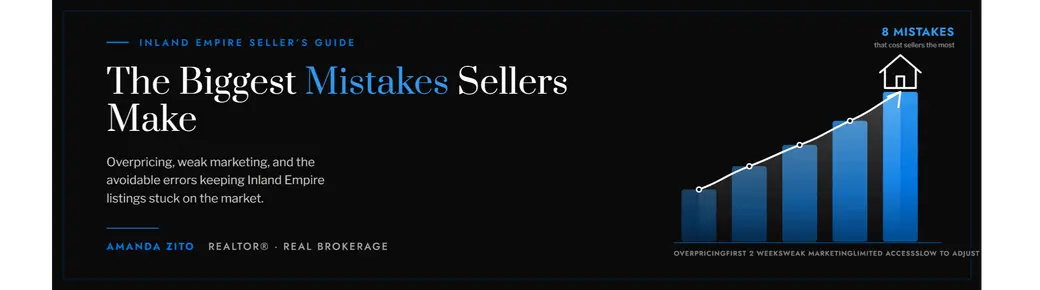
What are the biggest mistakes Inland Empire home sellers make? The most common mistakes are overpricing based on outdated comps, wasting the critical first two weeks on the market, skipping basic preparation, limiting showing access, and waiting too long to adjust when a listing stalls.
Most homes that sit on the market in the Inland Empire aren't sitting because of the market. They're sitting because of a decision that was made before the sign ever went in the yard.
That's the frustrating part. Sellers in Riverside and San Bernardino counties often do everything they think they're supposed to do — clean the house, hire an agent, list it — and still watch the listing go quiet after week three. By then the options have narrowed considerably, and the fix costs more than it would have at the start.
Here's what actually goes wrong most often, and what to do differently.
Mistake #1: Pricing from the Peak Instead of the Present
This is the big one, and it shows up in every Inland Empire submarket from Eastvale to Redlands.
Sellers anchor to what their neighbor got in 2022, or to a number they saw on an automated valuation site, or to what they need in order to make their next purchase work. None of those are what a buyer will pay today.
Buyers in Riverside County are shopping with payment calculators open. When mortgage rates move, their budget moves with them — and their sense of what's overpriced sharpens fast. Current pricing has to reflect what's closed in the last 60 to 90 days in your specific area, adjusted for condition, lot, and layout. You can track rate movement yourself through Freddie Mac's weekly mortgage rate survey and check local sale trends through Redfin's market data or the California Association of Realtors' market reports.
A price that's 5% high doesn't get 5% fewer showings. It often gets almost none.
Mistake #2: Treating the First Two Weeks Like a Warm-Up
Your listing gets its largest audience in the first 10 to 14 days. Every buyer already working with an agent in Corona, Ontario, or Murrieta sees it in that window, along with everyone who has a saved search matching your criteria.
If the price is wrong or the photos are weak during that stretch, you don't get a second first impression. You get a slow drip of leftover traffic and a days-on-market number that keeps climbing.
Launch as if it's the only chance you get, because functionally it is.
Mistake #3: Skipping Preparation Because "Buyers Will Just Renovate"
Some will. They'll also price the renovation into their offer at retail cost plus a margin for hassle — which is almost always more than what the work would have cost you.
The prep that consistently pays off in the Inland Empire isn't glamorous:
- Deferred maintenance that shows up in inspections — roof, HVAC, water heater, plumbing leaks
- Paint, especially anything bold or dated
- Landscaping and curb appeal, which matter more here than in cooler climates because dead or neglected front yards read as neglect everywhere else
- Decluttering, so rooms photograph at their actual size
You don't need a full remodel. You need the house to look cared for.
Mistake #4: Accepting Weak Marketing
Photos are your listing. In a market where most buyers filter on a phone screen before they ever step inside a home in Rancho Cucamonga or Temecula, mediocre photography is a pricing problem disguised as a marketing problem.
Ask what you're actually getting: professional photography, floor plan, video, syndication across the major portals, and a plan for how the listing gets in front of buyer agents. If the answer is "we'll put it in the MLS," that's the floor, not a strategy.
Mistake #5: Making the Home Hard to Show
Restricted showing hours. Twenty-four-hour notice. No lockbox. Pets that have to be arranged around.
Every restriction removes buyers. Agents in Riverside and San Bernardino counties often run tight tours across long distances — the 15 and the 91 don't cooperate — and a home that requires special coordination gets skipped for the one that doesn't.
Living in a home while it's listed is genuinely disruptive. But the disruption is shorter when access is easy, because the home sells faster.
Mistake #6: Taking the Inspection Personally
The inspection report will find things. It always does. Homes in the Inland Empire built in the 1980s and 1990s routinely turn up aging HVAC systems, original water heaters, and slab or plumbing items that need attention.
Sellers who react defensively — refusing everything on principle — often lose a qualified buyer and end up disclosing the same items to the next one anyway, with a longer days-on-market number working against them.
Separate what's negotiable from what's not. A credit is frequently cheaper than a cancellation.
Mistake #7: Waiting Too Long to Adjust
When a listing goes quiet, sellers tend to wait. Another two weeks. Another open house. Then a small reduction that lands below the next round-number search threshold — $10,000 off a $650,000 home doesn't reach anyone new.
If showings have stopped and there's no offer activity by week three or four, the market has already told you something. A meaningful adjustment made early costs less than three small ones made late, and it protects you from the perception problem that comes with a long price-drop history.
Mistake #8: Assuming the Whole Inland Empire Moves Together
It doesn't. Corona and Eastvale behave differently than Hesperia. Temecula wine country properties price on different logic than tract homes in Ontario. New construction competition in one corridor can flatten resale pricing three miles away while leaving another submarket untouched.
Regional headlines about California housing — including national coverage from sources like the National Association of Realtors — are useful context, not pricing guidance. Your comps need to come from your ZIP code, your price band, and your product type.
Frequently Asked Questions
How long does it take to sell a home in the Inland Empire? It depends on price point, condition, and location within Riverside or San Bernardino County. Well-priced, well-presented homes typically move considerably faster than the area average, while overpriced listings can sit for months and eventually sell for less than they would have at the right initial price.
Should I reduce my price or offer a buyer credit? Both work, but they solve different problems. A price reduction brings in new buyers who weren't seeing your listing at all. A credit toward closing costs or a rate buydown helps a buyer who already likes your home but is stuck on the monthly payment. If showings have stopped entirely, that's a price signal.
Is it worth renovating before selling in the Inland Empire? Usually not a full renovation. Targeted work — paint, flooring, landscaping, and resolving deferred maintenance — tends to return more than major kitchen or bath remodels done specifically for resale. The right answer depends on your home's condition relative to competing listings in your area.
Let's Talk Before You List
Most of these mistakes are avoidable, but only before the listing goes live. If you're thinking about selling anywhere in the Inland Empire — Riverside, Corona, Eastvale, Ontario, Rancho Cucamonga, Murrieta, Temecula, Redlands, or the High Desert — I'm happy to walk through your specific situation, what your home is realistically worth today, and what's worth doing before it hits the market.
Call or text me and we'll go through it.
Amanda Zito REALTOR® | Real Brokerage Serving the Inland Empire and High Desert CA DRE #01740063
Categories
Recent Posts











“Your goals come first. My job is to help you make the right move.”