

The First 7 Days on Market: What Really Happens to Your Inland Empire Listing
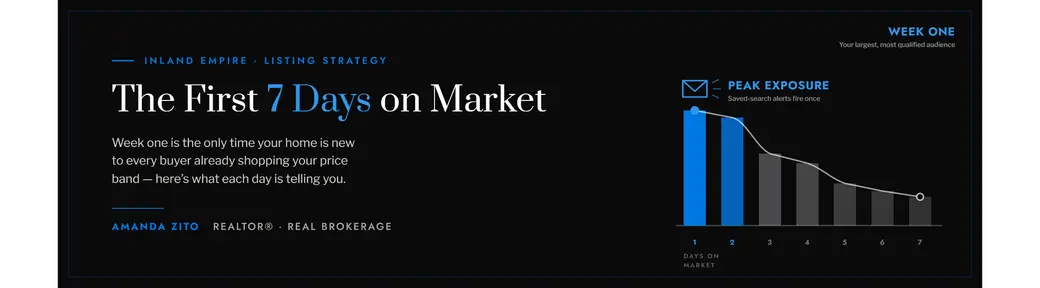
What happens during the first 7 days a home is on the market in the Inland Empire? Your listing reaches its largest and most qualified audience in week one, when saved-search alerts push it to every buyer already shopping your price band in Riverside and San Bernardino County.
Most sellers treat the first week as a waiting period. It isn't. It's the week your listing is tested by the buyers who have already toured comparable homes, already have a lender letter in hand, and already know what your price band should deliver. They form an opinion in the first few days, and most of them never revisit it.
By day seven you have real information — not a verdict, but a diagnosis. The problem is that most sellers don't know what they're looking at, so they either panic on day five or ignore a signal that's already blinking.
Here's what actually happens, day by day, and what each stage is telling you.
Why Week One Carries More Weight Than the Six That Follow
Every buyer working with an agent in the Inland Empire has automated searches running — price range, bedroom count, city, sometimes ZIP code. When your listing goes live, it lands in those inboxes at once. That is a one-time event. It does not repeat when you reduce the price later, and it does not repeat when you swap the photos.
That's the asymmetry. Week one is the only time your home is new to everyone. After that, you're marketing to buyers who have already seen it and passed, plus a thin trickle of newcomers entering the market.
The practical implication: pricing errors are expensive in week one and only get more expensive. A home in Riverside or Fontana that opens five percent above the market doesn't get a slow start — it gets a permanent handicap, because the buyers most likely to pay a strong price saw it first and moved on.
Day 0: Before the Sign Goes In the Ground
The work that determines week one happens before the listing is live.
Photos need to be shot, edited, and loaded before the listing goes active — not after. A listing that goes live with three phone photos and a "professional photos coming Friday" note has already spent its alert. Every buyer who got that email saw the placeholder version.
Syndication timing matters too. MLS data pushes out to Zillow, Realtor.com, Redfin, and the rest on a delay, and those platforms index differently. Going active on a Thursday or Friday morning gives the feeds time to populate before weekend showing traffic, which is when Inland Empire buyers actually tour.
Showing instructions, lockbox access, and a confirmed availability window need to be set before day one. The fastest way to lose a week is to have a buyer's agent request a Saturday showing and get no response until Monday.
Days 1–2: The Alerts Fire
This is peak exposure. Saved-search notifications go out, agents forward listings to their buyer lists, and online views spike higher than they will at any other point.
What you're watching here is view count relative to inquiry count. High views with no showing requests is the clearest early signal there is: buyers are seeing your home and declining it from the photos and the price. That is almost always a price or presentation issue, not an exposure issue.
The opposite pattern — modest views but immediate showing requests — usually means your price is accurate and your photos are doing their job.
Days 3–4: Showings Become the Signal
Now you're getting feedback from people who walked through.
Pay attention to what buyers' agents say, but pay more attention to what they don't. Vague positive feedback with no second showing and no offer is a polite no. Specific objections — the layout, the yard, the street, a deferred repair — are useful, because they're fixable or they're not, and either way you now know.
In this market, buyers are disciplined. They tour multiple homes in a weekend and compare directly. If your home is competing against a similar property in Eastvale or Menifee with newer flooring at the same price, buyers will say so through their behavior long before anyone says it to your agent's face.
Days 5–7: Read the Data Honestly
By the end of week one you should be able to answer three questions:
- How many showings did you get? Weak showing volume in an active price band points to price, plain and simple.
- Did anyone come back for a second look? Second showings are the strongest leading indicator of an offer.
- What are buyers comparing you to? Your agent should be able to name the two or three competing listings buyers are choosing between.
The Three Diagnoses
Almost every disappointing first week traces to one of three causes:
- Price. Plenty of online views, few or no showings. Buyers filtered you out before touring. This is the most common and the most fixable.
- Presentation. Decent showing volume, no second showings. The home doesn't deliver in person what the photos promised — usually condition, clutter, odor, or a layout the photos flattered.
- Exposure. Low views across the board. Rare, but it happens with incomplete MLS data, missing photos, or a listing that never syndicated correctly. Worth verifying before you touch the price.
What Inland Empire Buyers Are Actually Reacting To
Regional preferences show up fast in first-week feedback. Across Riverside County and San Bernardino County, buyers consistently weigh solar ownership status, RV parking, a permitted ADU, pool condition, three-car garage capacity, and single-story layouts. If your listing has one of these and the remarks bury it, you're losing buyers in the search filter, not the living room.
What Not to Do in Week One
Don't cut the price on day five. You don't have enough information yet, and a reduction that fast signals to agents that more are coming. Buyers wait for the next one.
Don't restrict showings. Every showing you decline is a buyer who tours a competing home instead.
Don't confuse "no offers yet" with failure. Week one is diagnostic. The decision point comes later.
The Real Deadline Is Day 10 to 14
Week one gives you the diagnosis. The 10-to-14-day mark is where you act on it.
That's the window where a listing either converts its early traffic into an offer or starts aging visibly — cumulative days on market climbs, the listing drops down search results sorted by newest, and buyers start assuming something is wrong with it. If week one told you the price is off, the correction belongs inside that window, not at day 45.
For a fuller picture of how this fits into the whole timeline — prep, active marketing, and escrow — see my breakdown of how long it really takes to sell a home in the Inland Empire.
Frequently Asked Questions
How many showings should a home get in the first week in the Inland Empire? There's no universal number — it varies by price band, city, and season. What matters more is the ratio: strong online views with almost no showing requests points to price, while steady showings with no second visits points to condition or presentation.
Should I reduce my price after the first week if I don't have an offer? Not automatically. One week tells you how buyers are reacting, not whether the price is wrong by a specific amount. The stronger move is to identify which of the three diagnoses applies, then act inside the 10-to-14-day window with a reduction large enough to reach a new set of search filters.
Does relisting a home reset days on market? It depends on your MLS rules and how long the property was withdrawn. Even where the days-on-market counter resets, cumulative days on market often remains visible to agents, and buyer agents routinely pull listing history. Treat a relist as a strategy of last resort, not a reset button.
What's the best day of the week to list a home? In the Inland Empire, going active Thursday or Friday morning generally works best. It gives listing feeds time to syndicate to Zillow, Redfin, and Realtor.com before weekend showing traffic, which is when most buyers tour.
Thinking About Listing?
If you're preparing to sell in Riverside, Corona, Eastvale, Ontario, Rancho Cucamonga, Murrieta, Temecula, or Redlands, the strategy for week one should be set before your home ever goes active — pricing, photos, syndication timing, and showing access.
Call or text me and we'll map out exactly what your first seven days should look like.
Amanda Zito, REALTOR® The Zito Group | Real Brokerage Serving the Inland Empire, High Desert, and Lake Travis, TX CA DRE #01740063 | TX TREC #840088 949-484-9486 | soldbyzito@gmail.com soldbyzito.com
Categories
Recent Posts











“Your goals come first. My job is to help you make the right move.”