

The "We'll Just Try This Price" Trap: What Testing a High Number Really Costs Inland Empire Sellers
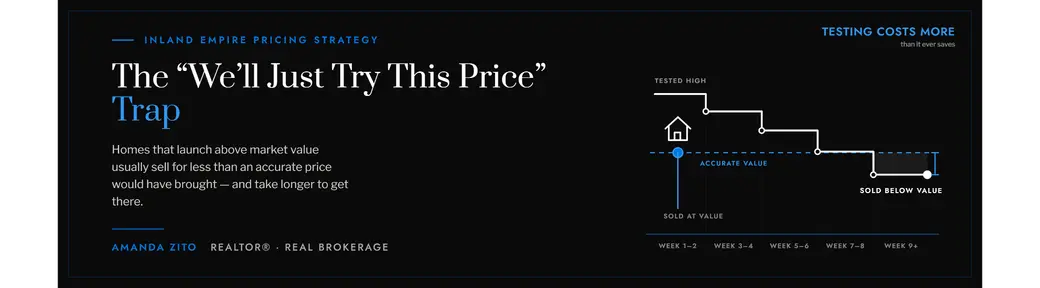
Does it hurt to list your home high and reduce the price later? Usually, yes. In the Inland Empire, homes that launch above market value typically sell for less than they would have at an accurate price — and take longer to get there.
Almost every seller says a version of the same sentence at the kitchen table: "Let's just try this price for a few weeks. We can always come down."
It sounds like a free option. Aim high, see what happens, adjust if the market disagrees. No harm done.
The problem is that the option isn't free, and the bill doesn't arrive until you've already lost the leverage to pay it. By the time most Riverside County and San Bernardino County sellers agree to reduce, they've spent the only thing that was ever truly scarce: the attention their listing gets in its first two weeks.
Why "Trying a Price" Feels Safe (and Isn't)
The logic assumes buyers behave like shoppers at a flea market — they see a high number, counter low, and you meet somewhere reasonable.
That's not how buyers shop for homes. They don't negotiate on properties they never see. They filter by price online, tour four or five homes in a weekend, and compare yours directly against every other option in that price band.
Price your Corona or Eastvale home above its band and you're not negotiating with buyers. You're invisible to them, while your listing quietly gets compared to nicer homes it can't beat.
What the Test Actually Costs, Week by Week
Week 1–2. This is your entire launch window. Your listing hits every buyer's saved search, every agent's hot sheet, every automated alert in the ZIP. If the price is wrong, the response is silence or polite showings with no follow-up. You cannot re-run this window later.
Week 3–4. Showing requests drop. Feedback starts arriving in the same three words: "priced too high." You start hearing about homes that sold nearby — the ones your buyers chose instead.
Week 5–6. You reduce, usually by an amount that made you comfortable rather than an amount the market required. The reduction generates a small bump in activity, then flattens, because a modest cut on an overpriced home is still an overpriced home.
Week 7 and beyond. Now days on market is doing the talking. Buyers who see a long-sitting listing don't think "opportunity." They think "what's wrong with it?" — and they write offers accordingly.
The seller who wanted to test a high price often signs a contract below where an accurate price would have landed them in week one. That's the trap: it isn't that you lose the extra money you hoped for. It's that you lose money you already had.
The Price Band Problem Most Sellers Never See
Buyer searches run in round numbers. Someone shopping in Rancho Cucamonga or Redlands sets a filter at $600,000, or $650,000, or $700,000 — not $612,500.
List at $625,000 when the honest value is $599,000, and you've done two things at once: removed yourself from every search capped at $600,000, and inserted yourself into a pool of homes with more square footage, newer finishes, or a better lot.
You didn't just ask for more money. You changed who you're competing against, and you picked a fight you can't win.
Three Costs That Never Show Up in the Conversation
- Carrying costs. Every extra month is another mortgage payment, another insurance and tax accrual, more maintenance. Two months of testing can quietly cost more than the gap you were trying to capture.
- Negotiating position. A seller in week two with three showings scheduled negotiates from strength. A seller in week nine negotiates from fatigue, and buyers can smell the difference.
- The appraisal. Even if a buyer agrees to your number, the lender's appraiser still has to support it with comparable sales in the same neighborhood. An inflated price doesn't survive an appraisal just because two people shook hands on it. You can track how sale prices are actually moving through public data from sources like Redfin's Data Center and the National Association of REALTORS®, and appraisers work from the same reality.
When Testing a Higher Price Is Actually Defensible
There are real exceptions, and pretending otherwise would be dishonest.
If your home is genuinely hard to comp — a custom build, acreage, a heavily upgraded property in a tract neighborhood, or something in the High Desert with no true equivalent within a mile — the market may legitimately not have told anyone what it's worth yet. In those cases, a strategic launch above the comp range is a real strategy, not wishful thinking.
The difference is the plan. A defensible test has a defined ceiling, a written checkpoint date, and agreed-upon metrics before the sign goes in the yard. A trap has none of those. It has hope and a vague promise to "see how it goes."
What to Do Instead
- Price into the band, not above it. Land at the top of a range you can defend with recent sales — and inside the round-number filter buyers are actually using.
- Set the checkpoint before you list. Agree in advance: if we haven't had X showings or an offer by day 14, we adjust by a specific amount on day 15. Decide it while you're calm, not while you're discouraged.
- Watch showings, not opinions. Ten showings and no offers is a condition or presentation problem. Two showings in two weeks is a price problem. The numbers tell you which one you have.
- Adjust meaningfully or not at all. A $5,000 cut on a $650,000 home changes nothing. If you're going to move, move enough to enter a new pool of buyers.
- Watch the rate environment. Buyer purchasing power shifts with financing costs — Freddie Mac's weekly survey is a straightforward place to see where rates stand before you set your number.
Pricing accurately isn't pessimism about your home. It's the fastest, most reliable route to competition — and competition is the only thing that has ever pushed a sale price up.
Frequently Asked Questions
How long should I test a high price before reducing? If you're going to test, cap it at 14 days. That's roughly the length of your peak exposure window, and it's short enough that a correction still reaches fresh buyers rather than recycled ones.
Will lowering my price make buyers think something is wrong with the house? An early, decisive reduction reads as responsive. Repeated small reductions over several months read as desperation. The stigma comes from the pattern and the days on market, not from a single adjustment.
Can't I just wait for the right buyer to come along? Waiting works when the price is right and the pool is small. When the price is above the market, waiting doesn't produce a buyer — it produces carrying costs and a weaker negotiating position for whoever finally shows up.
Let's Look at Your Number Together
If you're weighing a list price for your Inland Empire home, the useful conversation isn't "how high can we go." It's "what price puts you in front of the most buyers in the first ten days" — and what your walkaway number needs to be.
Call or text me and we'll go through the comps for your specific street, your timeline, and what a defensible launch price looks like for your home.
Amanda Zito, REALTOR® The Zito Group | Real Brokerage Serving the Inland Empire, San Bernardino County, Riverside County, and the High Desert CA DRE #01740063 | TX TREC #840088 SoldByZito.com
Categories
Recent Posts











“Your goals come first. My job is to help you make the right move.”