

Understanding Seller Closing Costs in California
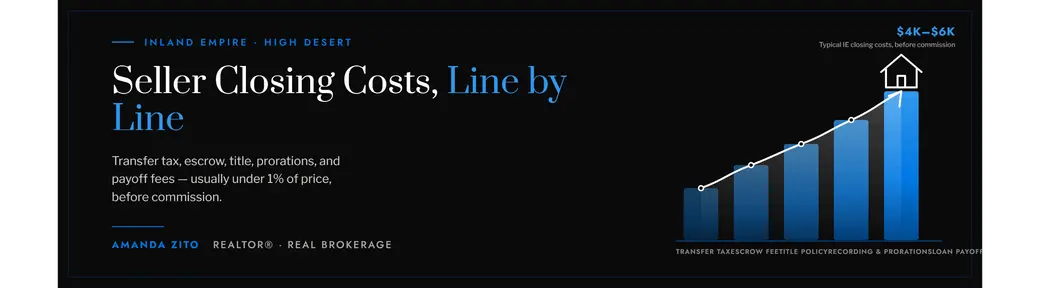
What are seller closing costs in California? Seller closing costs are the escrow-side charges deducted from your proceeds at closing — documentary transfer tax, escrow and title fees, recording charges, and prorations. In the Inland Empire and High Desert, they usually total under 1% of the sale price, before commissions.
The number that surprises sellers isn't the big one
Most Riverside County and San Bernardino County sellers walk into a listing appointment already braced for the commission conversation. That's the line item everyone knows about. What catches people off guard is the second page of the settlement statement — the one with fifteen smaller charges nobody warned them about, several of which are prorated in a way that isn't intuitive.
Individually, none of them are large. Together, on a median-priced Inland Empire home, they typically add up to somewhere in the $4,000 to $6,000 range — and that's before a single dollar of commission, repair credit, or loan payoff comes out.
This post breaks down each one: what it is, who customarily pays it in the Inland Empire and High Desert, and which ones are actually negotiable. If you want the wider picture that includes commissions and pre-listing prep, that's a separate conversation — this is strictly the escrow-side math.
Closing costs vs. selling costs: a distinction worth making
"Closing costs" gets used loosely to mean everything that reduces your net. It's more useful to separate them:
- Closing costs are transactional — fees charged by escrow, title, the county recorder, and the state to actually transfer ownership. They're largely fixed by custom and rate schedule.
- Selling costs are strategic — commissions, buyer credits, repair concessions, staging, pre-listing improvements. These are negotiated and vary widely deal to deal.
The first group is predictable. The second is where your agent earns their keep. Understanding which bucket a charge falls into tells you whether it's worth negotiating.
Documentary transfer tax
California charges a documentary transfer tax when a deed is recorded. The statewide county rate is $1.10 per $1,000 of sale price (technically $0.55 per $500 or fraction thereof), set under Revenue and Taxation Code §11911.
On a $635,000 sale in Riverside County, that's $698.50. On a $450,000 sale in the High Desert, it's $495.
Who pays it: In both Riverside County and San Bernardino County, local custom is that the seller pays the documentary transfer tax. It's customary, not statutory — the purchase agreement controls — but it's rarely renegotiated in a standard residential deal.
The city transfer tax question
This is where Inland Empire and High Desert sellers catch a genuine break. Roughly 40 California charter cities layer their own transfer tax on top of the county rate — Los Angeles, Culver City, Santa Monica, Berkeley, and Oakland among them. In Los Angeles, the Measure ULA surcharge can add several percent on high-value sales.
Most cities across Riverside County and San Bernardino County — including Corona, Eastvale, Menifee, Temecula, Victorville, Hesperia, and Apple Valley — charge no additional city transfer tax. Your escrow officer will confirm this for your specific address, but for the vast majority of IE and High Desert sellers, the county's $1.10 per $1,000 is the entire transfer tax bill.
If you're selling an Inland Empire property and buying in a coastal charter city, or vice versa, this is a line item worth modeling before you assume the two transactions are symmetrical.
Escrow fees
Escrow is the neutral third party that holds funds, collects signatures, and coordinates recording. Fees generally follow a formula in the neighborhood of $2 per $1,000 of sale price plus a base fee, though every company files its own schedule.
Who pays it: In Riverside County and San Bernardino County, the custom is a 50/50 split between buyer and seller. Your half on a $600,000–$700,000 Inland Empire sale typically lands somewhere around $900 to $1,400.
Owner's title insurance policy
There are two title policies in most transactions: the owner's policy, which protects the buyer's ownership interest, and the lender's policy, which protects the buyer's mortgage lender.
Who pays it: Throughout Southern California — including Riverside and San Bernardino counties — the seller customarily pays for the owner's policy, and the buyer pays for the lender's policy. In much of Northern California the custom flips. On an IE sale in the $600,000s, the owner's policy premium generally falls in the $1,800 to $2,600 range, based on rate schedules filed with the California Department of Insurance.
This is one reason relocating sellers from the Bay Area or Sacramento sometimes budget wrong. The custom you're used to may not be the custom where you're selling.
Recording fees — and the SB 2 fee that usually doesn't apply
The county recorder charges per-document fees to record the deed, the reconveyance, and related instruments. Budget roughly $150 to $250 total.
You may also hear about the SB 2 Building Homes and Jobs Act fee — a $75-per-document charge, capped at $225 per transaction, added to most California real estate recordings. Here's the useful part: under Government Code §27388.1, documents recorded in connection with a transfer that's subject to documentary transfer tax are exempt. A standard home sale where transfer tax is paid falls squarely into that exemption. You'll see this fee on a refinance; you generally won't see it on your sale.
Prorations: the ones that aren't fees at all
Prorations aren't charges for services — they're the accounting that divides shared expenses at the closing date. They can swing several thousand dollars either direction depending on timing.
Property taxes. California's tax year runs July 1 through June 30, with installments due November 1 and February 1. If you close in September, you'll owe a prorated share of taxes for the period you owned the home but haven't yet paid. If you close in March after paying both installments, you get credited back. Sellers who close right after making a payment are often pleasantly surprised.
Mello-Roos and special assessments. Newer Inland Empire and High Desert communities frequently sit inside a Community Facilities District. Those assessments prorate alongside your base property tax, and buyers will ask about the annual amount — have the number ready.
HOA dues and transfer fees. If your property is in an HOA, dues prorate to the closing date, and the association charges for the document package and ownership transfer. These fees are set by the association and management company, and they vary considerably.
Loan payoff charges
If you have a mortgage, expect a few small items tied to retiring it:
- Demand/beneficiary statement fee — what your lender charges to produce the official payoff figure
- Reconveyance fee — clearing the deed of trust from title
- Per-diem interest — interest accrues to the day funds are received, not the day you sign
- Prepayment penalty — rare on residential loans today, but worth confirming on older or non-conventional financing
That per-diem detail matters more than it sounds. A closing that slips from a Thursday to the following Monday adds days of interest to your payoff.
The smaller line items
- Natural hazard disclosure report — customarily a seller expense in California; flood, fire, seismic, and related zone disclosures
- Notary, wire, courier, and document fees — commonly $200 to $400 combined
- Home warranty — only if negotiated into the contract
- Point-of-sale compliance — a handful of California cities require inspections or retrofits before transfer; most IE and High Desert cities do not, but confirm for your address
What a median-priced Inland Empire sale looks like
Using a $635,000 sale price — near the Riverside County median for existing single-family homes as of mid-2026, per the California Association of REALTORS® — the escrow-side costs generally shake out like this:
| Line item | Typical seller cost |
|---|---|
| Documentary transfer tax | $698.50 |
| Escrow fee (seller's half) | $900 – $1,400 |
| Owner's title policy | $1,800 – $2,600 |
| Recording fees | $150 – $250 |
| Notary, wire, misc. | $200 – $400 |
| Subtotal | $3,750 – $5,350 |
Then add prorations, HOA charges, and payoff-related fees, which depend entirely on your closing date, your association, and your loan.
San Bernardino County runs lower on a percentage-neutral basis simply because prices are lower — the countywide median sat around $548,000 in mid-2026, per Redfin, and lower still across much of the High Desert. The line items are identical; the dollar figures scale with price.
What's actually negotiable
More than sellers assume, though not everything:
- Escrow and title provider is negotiable, and rate schedules differ between companies. You can request quotes.
- Who pays what is set by contract, not law. In a market where buyers have leverage, sellers sometimes absorb costs custom assigns to the buyer. When the reverse is true, that flexibility works in your favor.
- Transfer tax and recording fees are fixed. There's no shopping these.
- The closing date is a lever people forget. Timing affects tax prorations and per-diem interest.
The realistic goal isn't eliminating these costs — it's knowing them before you list, so the number on your settlement statement matches the number in your head.
Frequently asked questions
How much are seller closing costs in California? Excluding commissions, escrow-side closing costs for a California seller typically run under 1% of the sale price. On a median-priced Inland Empire home, that's roughly $4,000 to $6,000 including transfer tax, escrow, title, recording, and miscellaneous fees, before prorations and loan payoff charges.
Does the buyer or seller pay closing costs in Riverside County? Both, in different proportions. By local custom in Riverside and San Bernardino counties, the seller pays the documentary transfer tax and the owner's title policy, escrow fees are split 50/50, and the buyer pays the lender's title policy plus loan-related costs. All of it is negotiable in the purchase agreement.
Can seller closing costs be paid from sale proceeds? Yes. In a standard California sale, closing costs are deducted from your proceeds at closing rather than paid out of pocket. Escrow handles the math and wires you the net. That's exactly what a seller net sheet is designed to show you in advance.
Know your number before you list
The sellers who have a smooth closing aren't the ones who got lucky on fees. They're the ones who saw an accurate net sheet before the sign went in the yard — and priced accordingly.
If you're thinking about selling in the Inland Empire or High Desert and want a realistic estimate of what you'll actually walk away with, call or text me. I'll build the numbers around your specific property, loan balance, and target closing date.
Amanda Zito, REALTOR® Real Brokerage | CA DRE #01740063 Serving the Inland Empire and High Desert 📞 949-484-9486
Categories
Recent Posts









“Your goals come first. My job is to help you make the right move.”