

What Are Seller Concessions and When Should You Offer Them?
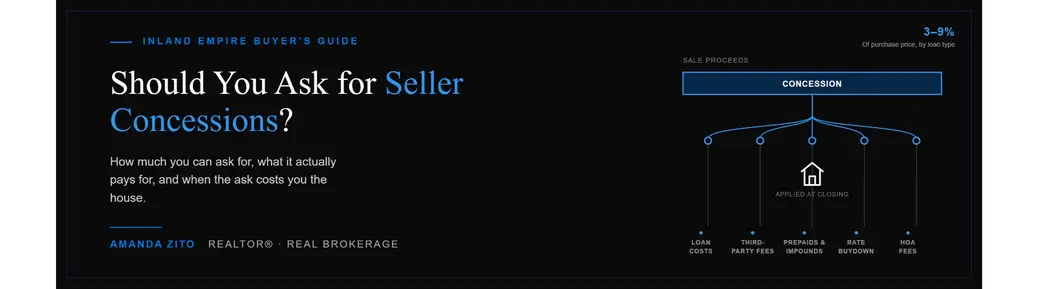
What are seller concessions? Seller concessions are costs the seller agrees to cover on the buyer's behalf — closing costs, prepaid taxes and insurance, or a mortgage rate buydown. In the Inland Empire, they're negotiated into the purchase contract and paid out of the seller's proceeds at closing.
The cash problem nobody warns you about
Most Inland Empire buyers spend months saving for a down payment and then get blindsided by the second number: closing costs. On a $600,000 home in Corona or Eastvale, you're often looking at another $12,000 to $20,000 for lender fees, escrow, title, appraisal, recording, and prepaid property taxes and insurance. That's real money on top of your down payment, and it's due at the closing table.
Seller concessions are the tool that solves this. Instead of asking the seller to drop the price, you ask them to cover a defined dollar amount of your costs. The seller nets slightly less. You show up to closing needing thousands less in cash. In a lot of Riverside County and San Bernardino County transactions, that trade works better for both sides than a price reduction does.
Here's how they actually work, what your loan will allow, and when asking for them helps you versus when it costs you the house.
What seller concessions can actually pay for
Concessions are not a check the seller hands you. The money is applied to specific, documented costs at closing. Typically:
- Loan costs — origination fees, underwriting, discount points
- Third-party costs — escrow, title insurance, appraisal, credit report, recording fees
- Prepaids and impounds — the first year of homeowners insurance, prorated property taxes, and the reserve account your lender sets up
- A mortgage rate buydown — temporary (like a 2-1 buydown) or permanent points that lower your rate for the life of the loan
- HOA transfer fees and up-front dues — relevant in a lot of newer Eastvale, Menifee, and Jurupa Valley communities
What they generally can't do: pay off your credit cards, fund your down payment, or come to you as cash after closing. Lenders scrutinize this closely, and anything undisclosed is loan fraud.
How much you're allowed to ask for
Your loan type sets a hard ceiling, and this catches buyers off guard constantly. If you negotiate more than your program allows, the excess gets stripped out at underwriting — you don't get to keep it.
| Loan type | Typical seller contribution limit |
|---|---|
| Conventional, primary residence, under 10% down | 3% of purchase price |
| Conventional, primary residence, 10–25% down | 6% |
| Conventional, primary residence, over 25% down | 9% |
| Conventional, investment property | 2% |
| FHA | 6% |
| VA | 4% in "concessions," plus the seller may pay customary closing costs |
| USDA | 6% |
These caps come from the agencies themselves — Fannie Mae's Selling Guide governs conventional loans, and VA's home loan program has its own rules that matter a great deal around March Air Reserve Base and for the many veteran families buying in the High Desert. Confirm your specific number with your lender before you write the offer, not after.
A quick example
You're buying at $575,000 in Rancho Cucamonga with 5% down on a conventional loan. Your cap is 3%, or $17,250. If your total closing costs run $16,000, you can ask the seller to cover all of it — and you keep that $16,000 in your bank account instead of wiring it to escrow.
When asking for concessions is the right move
When you're cash-tight but income-strong. This is the classic case. You qualify comfortably for the monthly payment but you're scraping to cover down payment plus closing costs. Concessions let you buy now instead of saving for another eight months while prices move.
When the payment is the real obstacle. Ask for a rate buydown instead of a price cut. A $15,000 price reduction on a $600,000 home lowers your payment by roughly $85 a month. That same $15,000 applied as a permanent buydown usually saves you significantly more, because you're attacking the interest rate rather than a small slice of the loan balance. Run both scenarios with your lender before you decide — the math shifts with where rates sit, and Freddie Mac's weekly rate survey is a good reality check.
When the home has been sitting. A listing that's been on the market 45+ days in Redlands or Fontana has a motivated seller. Concessions give them a way to help you without publicly cutting their list price, which many sellers strongly prefer.
When inspections turn up repairs. Rather than asking a seller to fix a water heater or an HVAC issue on their timeline and their contractor, ask for a credit and handle it yourself after closing. You control the quality of the work.
When you're buying new construction. Inland Empire builders routinely offer incentives through their own lender. Those are concessions by another name — and they're often more flexible than the resale market.
When asking will cost you the house
In a multiple-offer situation. If a Corona listing has five offers on it, a concession request is what separates your offer from the one that gets accepted. The seller nets less from you than from an identical offer without the ask. If you truly need the credit, offset it — offer a bit above list so the seller's net stays whole.
When you're already at the top of your price range. Sellers frequently respond to a concession request by countering with a higher price. If you can't absorb that, you've negotiated yourself into a corner.
When the appraisal is tight. Concessions don't create value. If the home appraises at exactly the contract price and you've pushed the price up to fund the credit, you risk an appraisal gap that you'll have to cover in cash.
When the seller has no equity. Some sellers genuinely cannot go below a certain net. A $20,000 ask on a home with thin equity is a non-starter no matter how reasonable it sounds.
How to actually ask
Put the request in your initial offer with a specific dollar amount, not a percentage — "$15,000 credit toward buyer's closing costs and prepaids" is clean and leaves nothing to interpret. Vague requests invite counteroffers.
Then give the listing agent the context. Sellers evaluate offers on net proceeds and certainty of closing. If your lender letter is strong, your earnest money is meaningful, and your timeline is clean, a concession request reads as reasonable rather than as a buyer who's stretched thin. That framing is most of the negotiation.
Frequently asked questions
Do seller concessions raise my purchase price? Not automatically, but often in practice. Sellers focused on net proceeds will frequently counter a concession request with a higher sale price so the two roughly cancel out. That can still be a win for you, since you're converting cash you need today into a slightly larger loan balance.
Can I get seller concessions on a VA loan in the Inland Empire? Yes. VA buyers can receive up to 4% of the purchase price in seller concessions, and separately the seller may pay customary closing costs. VA rules also limit which fees a veteran buyer can pay at all, so your lender should map this out before you write the offer.
Are concessions taxable income to me? No. Concessions reduce your cost basis in the home rather than counting as income to you. If you have a specific tax situation, confirm it with your CPA — that's outside what I can advise on.
Will a seller concession delay my closing? It shouldn't, as long as it's in the contract from the start and within your loan's limits. Concessions added late, after the appraisal or during underwriting, are what cause re-disclosures and delays.
Thinking about buying in the Inland Empire?
Whether to ask for concessions — and how much — depends on your loan type, your cash position, and how much competition is on that specific house. That's a 10-minute conversation, and it's worth having before you write an offer, not after.
Call or text me at 949-484-9486 and let's talk through your numbers.
Amanda Zito, REALTOR® Real Brokerage | Serving the Inland Empire and High Desert CA DRE #01740063
Information here is general and educational. Loan limits and program rules change — confirm specifics with your lender. See the Consumer Financial Protection Bureau's loan options guide for more on how different programs work.
Categories
Recent Posts











“Your goals come first. My job is to help you make the right move.”