

What Buyers Want Most in Inland Empire Homes Right Now
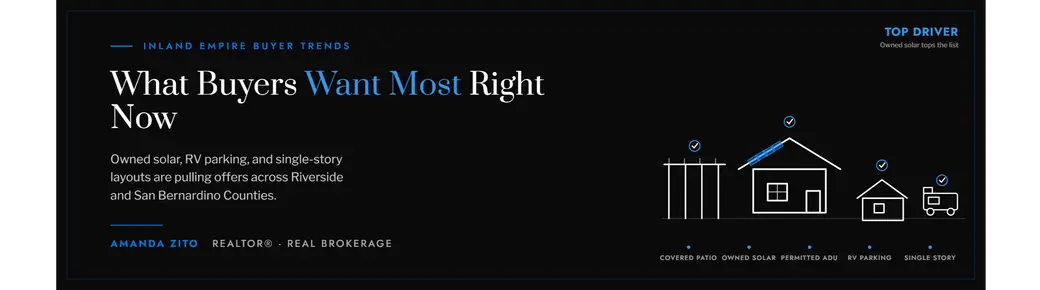
What do buyers want most in Inland Empire homes right now? Inland Empire buyers are prioritizing move-in-ready condition, lower monthly ownership costs, usable outdoor space, and flexible layouts — owned solar, RV parking, single-story floor plans, and permitted ADUs are the features drawing the strongest interest across Riverside and San Bernardino Counties.
The market shifted, and so did the shopping list
A few years ago, buyers in Riverside County and San Bernardino County were competing for whatever they could get. Condition was negotiable. Features were negotiable. Speed was the only thing that mattered.
That's not the market anymore. Inventory has climbed across much of the Inland Empire, and buyers who are out looking today are comparing five or six homes before they write anything. When shoppers have options, they get specific — and the homes that check the right boxes are the ones getting activity while the rest sit.
Here's what those boxes actually look like in 2026, based on what's moving in Corona, Eastvale, Ontario, Rancho Cucamonga, Riverside, Redlands, Murrieta, and Temecula — and what buyers have quietly stopped paying extra for.
1. Move-in-ready condition, above almost everything else
The single biggest divide in the Inland Empire market right now isn't price per square foot. It's condition.
Buyers stretching to afford a home at current rates don't have $30,000 sitting in reserve for flooring, paint, and a new HVAC system. A home that needs work gets discounted twice — once for the actual cost of the repairs, and once for the hassle of managing them.
What "move-in ready" means to a buyer in practice:
- Fresh, neutral paint and flooring that doesn't need immediate replacement
- A functioning HVAC system — non-negotiable in a valley where summer highs sit well over 100°
- A roof with visible life left in it
- No obvious deferred maintenance on the first walkthrough
You don't have to renovate. You do have to remove the reasons a buyer would mentally deduct from your price.
2. Anything that lowers the monthly payment
Affordability is driving buyer behavior more than any single feature. With <a href="https://www.freddiemac.com/pmms">30-year fixed rates</a> still meaningfully above where they sat in 2021, buyers are shopping the payment, not just the price.
That means they're paying attention to:
- Owned solar. This is the clearest value driver in the Inland Empire right now. A paid-off system that offsets a $400 summer electric bill is real money in a buyer's monthly budget. Leased systems are a different conversation entirely — more on that below.
- HOA dues and Mello-Roos. In newer communities across Eastvale, Menifee, and parts of Temecula, special assessments can add several hundred dollars a month. Buyers are running those numbers now in a way they weren't three years ago.
- Seller-paid rate buydowns and closing cost credits. Agent surveys consistently show buyers asking for credits more often than price cuts, because a buydown changes the payment more efficiently than a $10,000 price reduction does.
If your home carries low fixed costs, that's a marketing feature. Put it in the remarks.
3. Usable outdoor space with actual shade
Inland Empire buyers understand the climate. A big backyard on its own doesn't impress anyone — a big backyard with no shade is a liability from June through September.
What draws offers:
- Covered patios, pergolas, and alumawood structures
- Mature landscaping that provides shade and doesn't demand daily attention
- Pools that are clearly maintained, with recent equipment and, ideally, solar or variable-speed pumps
- Low-water landscaping that keeps summer water bills predictable
Pools remain a genuine value-add in this market in a way they aren't in cooler California regions — but only when they look cared for. A neglected pool reads as a five-figure problem.
4. Space that can flex
Multigenerational households and remote work reshaped what buyers need from a floor plan, and the Inland Empire has seen that shift more sharply than most Southern California markets.
Buyers are actively hunting for:
- Permitted ADUs and junior ADUs. These serve double duty — housing for a parent or adult child, or rental income that helps carry the mortgage. California's ADU rules have made these far more common, and buyers know how to spot the permitted ones.
- Downstairs bedrooms with a full bath. One of the most searched-for features in the region.
- A real office — a door that closes, not a corner of the dining room.
- Dual primary suites, especially among move-up buyers purchasing with extended family.
The word "permitted" is doing heavy lifting in that list. Unpermitted conversions create appraisal and financing complications, and experienced buyers now ask about permits early.
5. Parking and storage that fits real life
This is where the Inland Empire diverges from coastal buyer preferences. Trucks, boats, trailers, and toys are part of life out here, and homes that accommodate them draw a specific, motivated buyer.
- RV parking with gated access is a search filter, not a bonus
- Three-car garages carry a consistent premium over two-car
- Wide side yards and extended driveways matter more than square footage in some segments
If your property has any of these, it belongs in the first line of your listing description — not buried in the amenities list.
6. Single-story floor plans
Demand for single-story homes in Riverside and San Bernardino Counties continues to outpace supply. Downsizers, buyers planning to age in place, and anyone with mobility considerations will pay more and move faster for one level.
Two-story homes aren't at a disadvantage — but a well-kept single-story in a market like Redlands, Riverside, or the Menifee corridor competes in a much thinner field.
7. Location — still the first filter
According to <a href="https://www.nar.realtor/research-and-statistics/research-reports/home-buyers-and-sellers-generational-trends">NAR's research on buyer behavior</a>, buyers rank the location itself above nearly every property-level feature. In the Inland Empire, that usually translates to commute practicality: proximity to the 15, 60, 91, and 10, and travel time to job centers in Ontario, Riverside, and the logistics corridor.
Buyers also research this thoroughly before they ever call an agent. By the time someone tours your home, they already know the drive time, the comparable listings, and roughly what the home should be worth.
What buyers are not paying extra for
Just as useful to know:
- Leased solar. It complicates the transfer, and buyers often see the payment obligation as a negative rather than a feature.
- Highly personalized renovations. Bold tile, accent walls, and unusual color choices rarely return their cost.
- Unpermitted additions. Square footage that doesn't appear on record doesn't appraise.
- Luxury finishes in a mid-tier neighborhood. There's a ceiling in every price band, and over-improving past it doesn't get repaid.
What this means for you
If you're selling: Your competition is the four other homes a buyer will see that weekend. Condition, presentation, and monthly cost story are where listings win — and where a strategic $5,000 of pre-list work can outperform a $20,000 price reduction.
If you're buying: You have negotiating room that didn't exist in 2021. Credits, buydowns, and repair requests are back on the table, and homes sitting past 30 days are worth a serious look. For current inventory and pricing across the region, the <a href="https://www.homes.com/reports/inland-empire-housing-market/">Inland Empire market reports</a> and <a href="https://www.car.org/marketdata">C.A.R. market data</a> are good starting points — though neighborhood-level numbers tell a much more accurate story than metro averages.
Frequently asked questions
Does solar increase home value in the Inland Empire? Owned solar generally supports a stronger sale price here, because it directly reduces a buyer's summer electricity costs in a high-heat market. Leased or financed systems typically don't add value the same way, and can slow a transaction if the lease terms aren't handled early.
Is a pool worth it when selling an Inland Empire home? In this climate, a well-maintained pool is a real draw for many buyers and can help a home stand out. Condition drives everything — a pool with aging equipment or visible neglect often reads as a repair bill rather than an amenity.
Are Inland Empire buyers still competing for homes? It depends heavily on price point and condition. Well-priced, move-in-ready homes in the entry and mid-tier ranges still see multiple offers, while overpriced homes and those needing work are sitting considerably longer than they did a few years ago.
Let's talk about your specific situation
Every one of these features carries a different weight depending on your neighborhood, your price band, and who's actually shopping for a home like yours. If you're thinking about selling in the next 12 months — or trying to figure out which improvements are worth making first — I'm glad to walk through it with you.
Call or text 949-484-9486, or reach out to schedule a private consultation.
Amanda Zito, REALTOR® The Zito Group | Real Brokerage CA DRE #01740063 | TX TREC #840088 SoldByZito.com
Categories
Recent Posts








“Your goals come first. My job is to help you make the right move.”