

What Does It Really Cost to Sell a Home in Lake Travis, TX? A Seller's Guide to Fees and Expenses
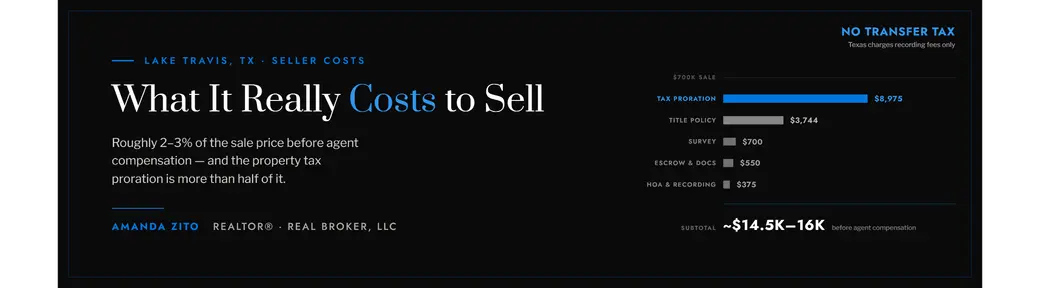
What does it cost to sell a home in Lake Travis, TX? Excluding agent compensation, most Lake Travis-area sellers pay roughly 2% to 3% of the sale price at closing — owner's title policy, escrow and recording fees, HOA documents, and a prorated property tax credit to the buyer. Agent compensation is negotiated separately and is usually the largest single line.
The number that surprises people isn't the one you'd guess
Ask ten homeowners in the Lake Travis area what selling costs, and nine will say "commission." Fair enough — that's the biggest line for most sellers, and it's the one everyone argues about.
But the line that actually catches people off guard on their closing statement is the property tax credit. Texas property taxes are billed in arrears, which means you owe the buyer cash for every day you owned the home this year. In a market with Lake Travis ISD tax rates, that credit can run five figures on a mid-year closing — larger than your title policy, escrow fees, HOA documents, and recording fees combined.
So let's do this the useful way: every line, what it actually costs, what's negotiable, and the local items that generic "Texas closing costs" articles leave out.
A worked example: a $700,000 Lake Travis sale
Here's what the non-commission side of a closing statement looks like on a $700,000 home in the Lake Travis area, closing September 30, with an assessed taxable value of $600,000 and a combined tax rate of roughly 2%.
| Line item | Who customarily pays | Estimated cost |
|---|---|---|
| Owner's title insurance policy | Seller (by custom in Travis County) | $3,744 |
| Escrow / settlement fee (seller's share) | Split or negotiated | $400 – $700 |
| Document prep, tax certificate, courier | Seller | $150 – $400 |
| Recording fees and lien release | Seller | $50 – $200 |
| Prorated property tax credit to buyer | Seller | ~$8,975 |
| Survey (if you provide a new one) | Negotiated | $500 – $900 |
| HOA resale certificate and doc fees | Usually seller | $150 – $600 |
| Home warranty (if offered) | Negotiated | $500 – $800 |
| Subtotal, before agent compensation | ~$14,500 – $16,000 |
That's a little over 2% of the sale price — and the tax proration is more than half of it.
Then there's agent compensation, which is negotiated between you and your agent. There is no standard, customary, or required rate in Texas or anywhere else. What that means in dollars is simple arithmetic: on a $700,000 sale, every 1% of total negotiated compensation equals $7,000. Whether you offer any compensation to a buyer's agent, and how much, is a separate decision you make in writing before your home goes on the market.
Owner's title policy: the one cost nobody can beat you down on
In Travis, Williamson, and Hays counties, the seller customarily pays for the buyer's owner's title policy. This is negotiable in the contract, but it's the default in most Austin-area transactions.
Here's what makes Texas unusual: title insurance premiums are set by the state, not by the title company. The Texas Department of Insurance promulgates the rates, and every title company in Texas charges the identical premium for identical coverage. The commissioner ordered a 6.2% rate reduction effective March 1, 2026 — you can see the current schedule in the TDI premium rate tables.
For homes priced between $100,000 and $1 million, the basic premium works out to: (sale price − $100,000) × 0.00494 + $780.
- $500,000 sale → about $2,756
- $700,000 sale → about $3,744
- $950,000 sale → about $4,979
Shopping title companies won't lower that premium. It will change the ancillary fees — escrow, doc prep, courier — which aren't regulated and do vary. Choose on service and responsiveness, not on the premium quote.
Property tax prorations: why your closing date matters
Texas property taxes for the 2026 calendar year aren't due until early 2027. When you sell in September, you haven't paid a dime toward the year you've been living there — so at closing, you hand the buyer a credit covering January 1 through your closing date, and the buyer pays the full bill later.
Three things about this that trip people up:
It's based on assessed value, not your sale price. If you've had a homestead exemption in place for years, the 10% annual cap may have kept your taxable value well below what your home is now worth. Check your current value with the Travis Central Appraisal District before you estimate.
Your tax rate depends on which entities you're inside. Lake Travis ISD adopted a rate of about $1.03 per $100 of value for 2026, and Travis County adds roughly $0.38. Layer on your city, your emergency services district, and any WCID or MUD, and combined effective rates across the Lake Travis area generally land somewhere between roughly 1.8% and 2.5%. Two homes on the same road can sit in different districts.
Timing changes the number, not the total. A January closing means a small credit; a December closing means a large one. This isn't a reason to rush or delay a sale — the tax is owed either way — but it belongs in your net proceeds math.
You can look up the entities and rates that apply to your specific address through the Texas Comptroller's property tax resources.
Costs that are specific to selling near Lake Travis
This is where the generic Texas closing cost articles stop being useful. Homes in the Lake Travis corridor carry systems and permits that a home in a Round Rock subdivision simply doesn't have.
Septic (OSSF) systems
Many Lake Travis area properties are on an on-site sewage facility rather than city sewer. Buyers routinely request an inspection, and if the system is aerobic, they'll want the maintenance contract and service records. Expect to pay for an inspection or pump-out if you agree to one, and budget for repairs if the system hasn't been serviced consistently. Locating the permit and transferring the maintenance contract takes time, so start early.
Wells and water systems
If the property is on a private well, buyers commonly ask for a flow test and water quality testing. Who pays is negotiated, and it's a smaller expense than septic repairs, but it's an item that appears on lakeside acreage transactions and almost never on suburban ones.
Boat docks and shoreline permits
If your property has a dock, boat lift, retaining wall, or shoreline improvement on Lake Travis, that structure is permitted through the Lower Colorado River Authority, and the permit has to be transferred to the new owner. There's a process and a fee, and if the structure was built without a permit or was modified after it was permitted, that gets resolved before closing — not after. Confirm the current requirements directly with the LCRA. Pull your dock paperwork the week you decide to sell, not the week you go under contract.
Surveys on hill country lots
Texas sellers can often satisfy the survey requirement by providing an existing survey along with a signed T-47 residential real property affidavit, which avoids the cost of a new one. That works well on a flat, rectangular subdivision lot. On steep, irregular waterfront and acreage parcels — where there may be shoreline changes, easements, or added structures since the last survey — a new survey is more likely to be required, and it costs more than a standard suburban survey.
WCID and MUD accounts
If you're inside a water control and improvement district or a municipal utility district, there are account transfer requirements and sometimes district-specific transfer fees. These are small, but they're one more thing that has to be requested rather than assumed.
What Texas doesn't charge you
Two genuinely good pieces of news for Lake Travis sellers:
There is no real estate transfer tax in Texas. No state transfer tax, no county transfer tax, no city transfer tax. Sellers in California, New York, Washington, and much of the East Coast pay a percentage of the sale price to the government just for the privilege of transferring the deed. In Texas, you pay recording fees measured in the low hundreds of dollars.
There's no attorney requirement. Texas closings are handled by title companies, so there's no separate attorney fee on your settlement statement the way there is in states that require legal representation at closing.
If you're a California homeowner who has sold there before, this is the single largest structural difference in your net sheet — and it's a real one. It also cuts the other direction on the annual side: Texas has no state income tax, but property taxes here run well above the national average, which is exactly why the proration line is so large.
The costs before the closing statement
Your settlement statement won't show what you spent getting the home listed, but your bank account will:
- Pre-listing repairs and deferred maintenance. On Lake Travis area homes, this often means roof and gutter work, deck and dock repair, exterior wood and paint, and irrigation. Sun and weather are hard on these properties.
- Cleaning, landscaping, and staging. Views sell homes out here, which means window cleaning and tree trimming genuinely change the photos.
- Moving and storage, especially if you're relocating out of state and need a gap between closings.
- Seller concessions. With Austin-area inventory well above the levels of a few years ago, more sellers are contributing toward buyer closing costs or an interest rate buydown. This isn't a fee — it's a negotiated term — but it comes out of the same proceeds, and in the current market it's worth planning for rather than reacting to.
How to get your actual number
Percentages are a planning tool. They're not your number.
Your number depends on your assessed value, your closing date, your HOA, whether you're on septic or sewer, whether you have a dock, what you negotiate with your agent, and what you agree to in the contract. The right time to see it is before you list — not after you're under contract and it's too late to change your pricing strategy.
A net sheet takes an experienced listing agent about twenty minutes to prepare, and it should show you a realistic range, not one flattering number.
Frequently asked questions
How much are seller closing costs in Texas? Excluding agent compensation, Texas seller closing costs typically run about 2% to 4% of the sale price — mostly the owner's title policy, prorated property taxes, and title and escrow fees. Including negotiated agent compensation, total seller costs commonly land in the 6% to 9% range, depending entirely on what you negotiate.
Who pays for title insurance in Travis County? By local custom, the seller pays for the buyer's owner's title policy in Travis County and most of Texas, while the buyer pays the $100 simultaneous-issue premium on the lender's policy. This is negotiable in the contract, and the premium itself is set by the Texas Department of Insurance rather than by the title company.
Do I owe property taxes when I sell my home in Texas? Yes — as a credit to the buyer. Texas taxes are paid in arrears, so at closing you credit the buyer for the portion of the year you owned the home, and the buyer pays the full bill when it comes due. On a mid-year Lake Travis area closing, that credit is frequently the largest non-commission line on the seller's settlement statement.
Does Texas have a real estate transfer tax? No. Texas has no state or local real estate transfer tax. Sellers pay county recording fees, which typically total under a few hundred dollars.
Let's run your numbers before you list
If you're thinking about selling in the Lake Travis area — this year or next — I'll put together a net sheet for your specific address: your assessed value, your tax entities, your HOA, your likely closing window, and a realistic range for what you'd walk away with.
No pressure and no obligation. Just the actual math, so you can make the decision with real numbers in front of you.
Call or text me at 949-484-9486, or email soldbyzito@gmail.com to schedule a private consultation.
Amanda Zito, REALTOR® The Zito Group | Real Broker, LLC Serving the Lake Travis area, Texas and the Inland Empire and High Desert, California Texas TREC #840088 | California DRE #01740063 SoldByZito.com
This article is for general information and is not tax, legal, or financial advice. Title premiums, tax rates, and district fees change; confirm current figures with your title company and the appropriate taxing authorities.
Categories
Recent Posts











“Your goals come first. My job is to help you make the right move.”