

What Happens During Escrow in California?
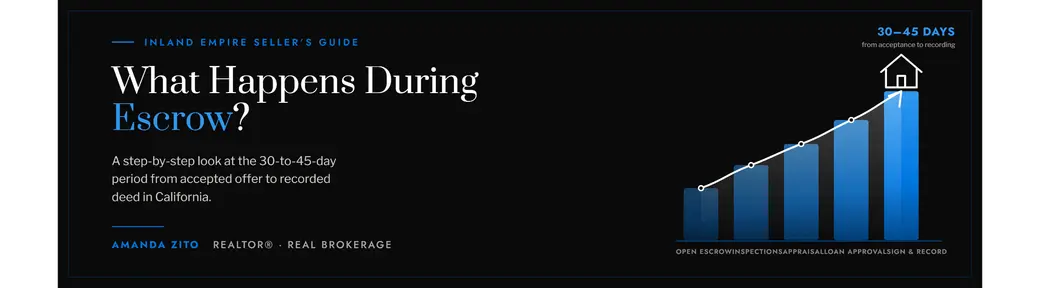
What happens during escrow in California? Escrow is the 30-to-45-day period after you accept an offer when a neutral third party holds the buyer's deposit, collects documents from both sides, and coordinates inspections, loan approval, title, and signing until the deed records at the county.
You accepted an offer on your Riverside or San Bernardino County home. Congratulations — and now everything goes quiet for a few days, and most sellers start wondering whether anything is actually happening.
It is. Escrow is the least visible and most consequential stretch of a home sale. A neutral escrow holder is now sitting between you and the buyer, collecting money, documents, and instructions from both sides, and nothing changes hands until every condition in your purchase agreement has been met.
Here's what that actually looks like, step by step, from the seller's side of the table in the Inland Empire.
What Escrow Means in California
California is an escrow state, not an attorney state. Instead of hiring a real estate attorney to close the sale, both parties agree on a neutral escrow holder who follows written instructions from both sides and can't take direction from just one of you.
That neutral party may be an independent escrow company licensed by the California Department of Financial Protection and Innovation, or an escrow division operated under a title company or a real estate broker's license. Whoever it is, their job is narrow and important: hold the funds, gather the paperwork, follow the instructions exactly, and make sure the deed records only when everything lines up.
In most Inland Empire transactions, the buyer's agent and listing agent agree on the escrow holder as part of the offer negotiation. If you have a preference, that's a conversation to have before you accept an offer, not after.
Week One: Opening Escrow
Once your acceptance is signed, escrow opens and the clock starts. A few things happen almost immediately:
- The buyer deposits earnest money. Typically 1% to 3% of the purchase price, wired to escrow within three business days of acceptance. This is the buyer showing they're serious — and the money they stand to lose if they walk without a valid contingency.
- Escrow instructions go out. You'll receive a packet from the escrow officer confirming the sale price, the parties, and the terms as they understand them. Read it carefully. If anything doesn't match your contract, say so right away.
- A preliminary title report is ordered. This is the title company's look at what's recorded against your property: your mortgage, any liens, easements, tax assessments, HOA claims. Surprises here are common in older Inland Empire neighborhoods — an old contractor's lien, a solar UCC filing, a mechanic's lien nobody released.
- Your disclosure package is due. In California, sellers deliver a substantial set of disclosures, including the Transfer Disclosure Statement, the Seller Property Questionnaire, and a Natural Hazard Disclosure report. Complete disclosure is your best protection against a claim after closing. When you're unsure whether something belongs on the form, the answer is almost always to disclose it.
Weeks One to Three: The Buyer's Investigation Period
This is the part of escrow where a sale most often changes shape, and where sellers feel the least in control.
Inspections
The buyer will typically schedule a general home inspection within the first week, often followed by specialty inspections — roof, sewer line, pool, HVAC, or a wood-destroying pest inspection. In the High Desert and older parts of the Inland Empire, sewer scopes and roof inspections are the two that most often produce findings.
The California residential purchase agreement gives the buyer a default investigation period of 17 days unless you negotiated something different. During that window, the buyer can cancel for inspection-related reasons and keep their deposit.
The Appraisal
If the buyer is financing, the lender orders an appraisal. In Riverside and San Bernardino County neighborhoods with a wide mix of home sizes, ages, and lot conditions, appraisals can come in below contract price. If that happens, you have options — the buyer brings the difference in cash, you meet somewhere in the middle, or you provide the appraiser with additional comparable sales for reconsideration. It's a negotiation, not an automatic price cut.
The Request for Repairs
After inspections, the buyer may submit a request for repairs or a credit. You're not required to say yes. You can accept, decline, or counter — and the right answer depends on the item, your buyer's alternatives, and how your home would look to the next buyer if this one cancels.
Contingency Removal
As each condition clears, the buyer removes contingencies in writing: investigation, appraisal, and loan. Once contingencies are removed, the buyer's deposit is generally at risk if they cancel. This is the moment most sellers stop holding their breath.
Weeks Three to Five: Loan Approval and Closing Preparation
While the buyer's lender finishes underwriting, escrow is quietly assembling the closing file on your side:
- A payoff demand is ordered from your existing mortgage lender, plus any second loan, HELOC, or solar lease.
- HOA documents are ordered if your property is in an association — common across Eastvale, Menifee, and much of the newer Inland Empire inventory. HOA document delivery is a frequent cause of delay, so order early.
- A property tax proration is calculated so you pay only through your last day of ownership.
- Your estimated closing statement arrives. This shows your sale price, your loan payoff, commissions, escrow and title fees, county transfer tax, prorations, and your net proceeds. Review it line by line and ask about anything you don't recognize.
Who pays for what is negotiable in California, and local custom varies by county. Don't assume — confirm the allocation in your contract and on your estimated statement.
The Final Days: Signing, Funding, and Recording
Your signing appointment usually happens a few days before closing. As the seller, you'll sign the grant deed transferring ownership, and it must be notarized. You'll also sign the final escrow instructions and closing statement. Mobile notaries are widely available across the Inland Empire if you've already moved out of the area — including out of state.
Then:
- The buyer signs loan documents and their lender funds the loan by wiring money to escrow.
- Escrow confirms all funds are in and all conditions have been satisfied.
- The deed is recorded with the county recorder — the Riverside County Assessor-County Clerk-Recorder or the San Bernardino County Assessor-Recorder-County Clerk, depending on where your home sits. Recording is the legal moment of transfer, and it happens on business days only.
- Escrow disburses your proceeds, usually by wire the same day or the next business day.
Possession normally transfers at close of escrow unless you negotiated a rent-back or a delayed possession date.
What Sellers Most Often Get Wrong About Escrow
Assuming silence means trouble. Most of escrow is background work. Ask your agent for a weekly status check instead of guessing.
Ignoring wire fraud risk. Escrow and wire fraud is a real and ongoing problem in California real estate. Never accept wiring instructions by email alone. Call your escrow officer at a number you independently verified and confirm the details by voice before any money moves.
Changing the property mid-escrow. Removing a fixture the buyer expected to stay, letting the landscaping go, or starting a repair without written agreement all create problems at the final walkthrough.
Waiting until the last week to plan the move. Your closing date can shift by a few days. Build a little flexibility into your moving plans.
Frequently Asked Questions
How long does escrow take in California? Most financed sales in the Inland Empire close in 30 to 45 days. Cash purchases can close in 10 to 14 days because there's no lender, appraisal, or underwriting timeline. VA and FHA loans sometimes run slightly longer due to appraisal and repair requirements.
Can a seller cancel escrow in California? Not simply because you changed your mind. Once you're under contract, you're obligated to perform unless the buyer fails to meet their obligations or you both agree in writing to cancel. If a buyer misses a contractual deadline, the process usually starts with a Notice to Perform rather than an immediate cancellation.
Who chooses the escrow company in California? It's negotiated between buyer and seller as part of the offer, and it varies by transaction. Because the escrow holder is neutral, either side can propose one — but it should be agreed on before you sign your acceptance.
When do I get my money after closing? Escrow typically disburses seller proceeds the same day the deed records or the next business day, usually by wire transfer to the account you verified during signing.
Thinking About Selling in the Inland Empire?
Escrow goes much smoother when your disclosures are complete, your title is clean, and your pricing holds up to an appraisal — and all of that is decided long before an offer arrives.
If you're planning a sale in Riverside County, San Bernardino County, or the High Desert and want a clear picture of what your timeline and net proceeds would look like, call or text me. I'll walk you through it honestly, whether you're selling next month or next year.
Amanda Zito, REALTOR® Real Brokerage | CA DRE #01740063 Serving the Inland Empire and High Desert
Categories
Recent Posts











“Your goals come first. My job is to help you make the right move.”