

What Happens to Your Listings When You Switch Brokerages?
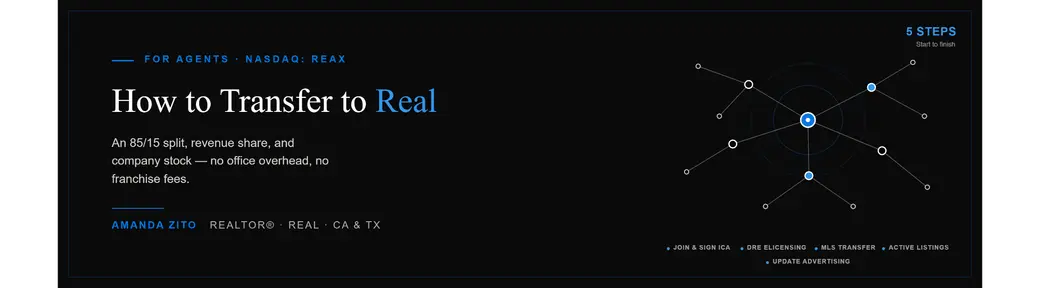
What happens to your listings when you switch brokerages? Your listing agreements belong to your broker, not to you personally. To bring a listing with you, your seller has to be released by your current brokerage and sign a new agreement with the one you're joining.
That single fact is the reason most agents stall out on a move they've already decided to make. They've run the numbers on the split, they've talked to the people they'd be joining, and then they look at five active listings and three pendings and think, I'll deal with this after the spring. Spring turns into summer, and nothing changes.
The move is more manageable than it looks — but only if you understand the mechanics before you give notice. Here's how listings, pendings, and MLS data actually transfer, whether you're licensed in California, Texas, or both.
Your Listings Belong to Your Broker, Not to You
Every listing agreement you've ever signed names the brokerage as the party to the contract. You signed as an agent of that broker. The seller hired the firm; you're the person who does the work.
This isn't a technicality your broker invented to keep you in place — it's how licensing law is structured in both California and Texas. A salesperson or sales agent operates under a sponsoring broker, and the broker holds the agreement, the trust account, and the liability.
So when you leave, your listings don't leave with you automatically. They stay with the brokerage unless the brokerage releases them and the seller chooses to follow you.
In practice, most sellers do follow. They hired you. But "most" isn't "all," and the process still has to be done correctly.
Read Your Independent Contractor Agreement First
Before you tell anyone anything, pull up your ICA and your office policy manual. You're looking for four things:
- Listing release policy. Does the brokerage release listings on request, release them for a fee, or retain them outright?
- Pending transaction terms. Do you finish escrows there, and at what split?
- Company-generated leads. Referral or relocation business is often contractually theirs, even if you nurtured it for two years.
- Notice, non-solicitation, and database language. Some agreements restrict when and how you can approach clients about the move.
If the language is ambiguous, that's worth a conversation with a real estate attorney in your state — not a group chat. A ten-minute read now prevents a commission dispute later.
What Happens to Active Listings
For each active listing you want to bring with you, the sequence is generally the same:
- Your current brokerage signs a cancellation or release of the listing agreement.
- Your seller signs a new listing agreement with your new brokerage.
- The old broker withdraws or cancels the listing in the MLS.
- The listing is re-entered under the new broker, with new photos-to-remarks continuity, updated brokerage information, and a compliant disclosure package.
What Your Seller Needs to Hear
Sellers don't care about splits, caps, or stock awards. They care whether their home is going to sit dark for a week and whether they're signing something that costs them money.
Keep it short and factual: you're changing brokerages, their listing terms carry over, the paperwork takes a signature, and the property will be re-entered with the same price and terms. Give them the specific date it happens. Then send confirmation once it's live again.
Handle it in a phone call, not a mass email. These are the same people who will decide whether to refer you next year.
What Happens to Pending Transactions
Deals already under contract are the more common sticking point, and the answer usually lives in your ICA rather than in state law.
Most brokerages take one of two approaches. Either you close the transaction under the old brokerage and get paid on the split you had when the contract was written, or the file is transferred to the new brokerage along with the escrow. Transferring a pending file mid-escrow means new broker paperwork, an amended commission instruction to escrow or title, and, in some cases, a cooperating-broker acknowledgment.
The cleanest version is usually the boring one: finish what's in escrow where it started, and move everything else. Fewer moving parts, fewer chances for a commission check to go sideways.
What Happens in the MLS
Because the listing has to be cancelled and re-entered under a different broker of record, your MLS history changes shape.
Days on market is the piece to watch. Rules vary by MLS — some associations treat a re-entered listing as a new listing, others carry the cumulative DOM forward or flag relisting patterns. Check your local MLS rules directly rather than assuming, especially if you operate in more than one system. An Inland Empire agent working under CRMLS and an Austin-area agent working under ACTRIS aren't playing by identical rulebooks.
Two things to confirm before you re-enter anything:
- Whether photos, virtual tours, and video need to be re-uploaded or can be carried over
- Whether your syndication to consumer portals resets, and how long it takes to repopulate
Lockbox access typically runs through your association rather than your brokerage, so that usually stays put — but verify it rather than finding out on a showing.
What Doesn't Move With You
Some things simply stay behind. Plan for it:
- Yard signs, riders, and lockbox tags with old brokerage branding
- Brokerage-branded websites, IDX feeds, and email addresses
- Marketing collateral — brochures, listing presentations, mailers with the old logo
- Company-provided leads, if your ICA assigns them to the brokerage
- Team listings, if you're on a team and the listings were taken in the team lead's name
Order signs before your effective date. An agent with no signage for two weeks looks like an agent in trouble, and sellers notice.
Timing the Move
The best window is when your pipeline is thinnest — after a closing cluster, before you take on new listings. Waiting for zero listings and zero pendings means waiting forever, so don't hold out for a perfect month.
If you're deep in listing season with eight active properties, consider stopping new intake for two weeks, moving, and restarting under the new brand. Two quiet weeks costs less than a year of staying somewhere that isn't working.
FAQ
Can my broker refuse to release my listings? Yes. Listing agreements are the brokerage's contracts, and there's no automatic right to take them with you. Most brokerages release them because the seller can cancel and relist anyway, but the policy is set in your ICA and office manual.
Do I lose my pending commissions if I leave before closing? Usually not, but the split may follow the agreement in place when the contract was written. Some brokerages also apply a departing-agent fee. Confirm the terms in writing before you give notice.
Will switching brokerages reset days on market? Sometimes. Because the listing is cancelled and re-entered under a new broker, MLS DOM handling depends on your local association's rules. Verify with your MLS before you make representations to a seller.
How long does the whole process take? The license transfer itself is typically quick once paperwork is submitted to the state. Moving listings, signage, and marketing assets is what takes real time — plan for one to two weeks of overlap.
Thinking About Making a Move?
If you're weighing a brokerage change and trying to figure out what it would actually mean for your listings, your pendings, and your clients, I'm happy to talk it through — including the parts that argue against moving right now.
I've been licensed for 20 years, I hold licenses in both California and Texas, and I've made this exact transition. Call or text me and I'll walk you through the sequence for your situation.
Amanda Zito | REALTOR® | CA DRE #01740063 | TX TREC #840088 Real Brokerage (CA) | Real Broker, LLC (TX) Serving the Inland Empire and High Desert, California, and the Lake Travis area near Austin, Texas
This post is general information for licensed agents, not legal advice. Review your independent contractor agreement and consult an attorney in your state before making a change. Licensing requirements are governed by the California Department of Real Estate and the Texas Real Estate Commission; professional standards guidance is available through the National Association of REALTORS®.
Categories
Recent Posts











“Your goals come first. My job is to help you make the right move.”