

What I'd Tell an Agent Who Is Quietly Thinking About Joining Real Brokerage
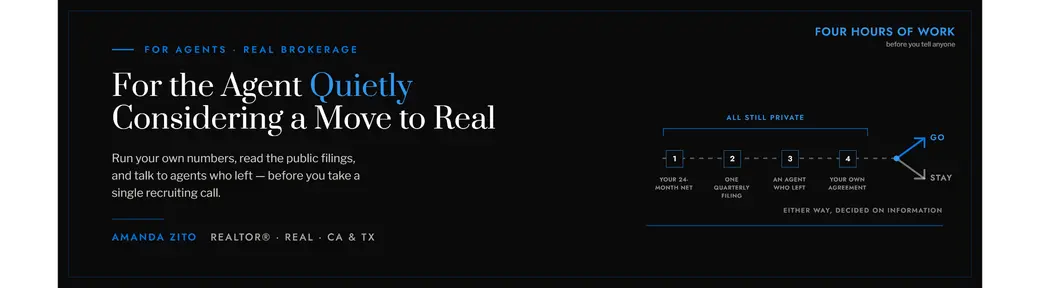
What should you do if you're privately considering a move to Real Brokerage? Run your own numbers before you take a recruiting call, talk to agents who left Real as well as agents who stayed, and read the company's public filings yourself.
There's a specific kind of agent I hear from more than any other. They're not unhappy enough to complain. They haven't told their broker anything. They haven't told their spouse much either. They've just been reading, late at night, on their phone, with the app closed before anyone walks in the room.
If that's you, the first thing worth saying is that the quiet part is normal. Agents don't research brokerages loudly because real estate is a small business in a small town, no matter how big the metro is. Word travels. You have a pipeline, a team lead who has been good to you, and clients who chose you partly because of the sign in the yard. Keeping your research private isn't disloyalty. It's basic professional caution.
The second thing worth saying is less comfortable: most agents in this phase stall for a year or more, and the reason usually isn't the numbers. It's the conversation they don't want to have. So let's separate those two problems.
Start with your own math, not somebody's pitch
Before you talk to a single recruiter — me included — build your own spreadsheet.
Pull your last 24 months of closed transactions. Write down what you actually netted per deal after your split, your desk fees, your franchise fees, your tech fees, your E&O, your marketing charges, and anything else that came out before the money hit your account. Not the advertised split. The real number.
Do this before you hear any presentation, because once you've seen someone else's model you'll unconsciously anchor to it. Your own baseline is the only honest comparison point you'll ever have.
Then, and only then, model the same production against Real Brokerage's structure — the cap, the post-cap transaction fees, the fee structure published on joinreal.com. Do it at your current volume, then at 70% of your current volume, because business dips happen and a model that only works in a good year isn't a model.
[Important] If the math is close, the money isn't your reason. That's useful information. Move on to the other questions.
The three questions that actually predict fit
Splits get all the attention and predict the least. In my experience, these three matter more:
Where does your business come from? If your leads come primarily from your brokerage — floor time, company-generated referrals, a team lead's pipeline — a cloud model will feel like a pay cut regardless of the split, because you're paying for infrastructure you don't currently pay for. If your business comes from your own database and sphere, you're already carrying the cost that a traditional split is supposed to cover.
How much structure do you need to perform? Some agents run better with an office, a schedule, and someone expecting them at a Tuesday meeting. That's not a weakness. It's a work style, and it costs real money to replace on your own if you leave an environment that provides it.
Are you building an asset or earning an income? Revenue share and equity programs are long-horizon plays. They only matter if you intend to still be doing this in a decade and are willing to build something beyond your own production.
Doing your homework without tipping anyone off
Here's what quiet due diligence actually looks like:
- Read the public filings. Real is a publicly traded company, which means it files audited financials. Go to investors.onereal.com and read them yourself instead of taking anyone's summary of them. Very few agents do this, and it's the single most objective source available to you.
- Read the support documentation. Real's agent support library is public. You can see exactly how onboarding, transaction management, and commission disbursement work before you ever fill out an application.
- Talk to agents who left. Not just the happy ones on stage. Find someone who tried Real and went back somewhere else, and ask why. If a recruiter can't point you to anyone, that's your answer about how honest the conversation is going to be.
- Ask about your specific state. Brokerage support quality varies by market. What's true in Florida may not be true in California or Texas.
- Check your current agreement. Look at your independent contractor agreement now, quietly, for notice periods, referral obligations on pending business, and anything covering your database. Do this before you have a conversation, not after.
The loyalty question nobody says out loud
This is the real reason most agents stay stuck, so let's name it.
Your broker gave you a start. Your team lead answered the phone at 9 p.m. when a deal was falling apart. You feel like leaving would make you the person who took and didn't give back.
Here's the honest reframe: your broker is running a business, and so are you. Good brokers know agents move. The ones worth their reputation will handle your departure professionally, and the ones who won't have just told you something about the relationship you were feeling guilty about.
What you owe is a clean exit — finishing your pendings properly, handing off what needs handing off, and not recruiting on your way out the door. What you don't owe is the rest of your career.
Who Real isn't right for
I'd rather lose you as a recruit than have you join and be miserable, so here's the version you won't hear on a recruiting webinar:
Real is probably not right for you if:
- Your leads are handed to you and you don't yet have a self-generated pipeline. You'd be trading income for independence you can't monetize yet.
- You need in-person, same-building mentorship daily. Real's support is real, but it's distributed and largely virtual. If you won't ask for help in a chat channel, you won't get help.
- You dislike figuring out software. The technology is a genuine advantage, but you have to actually use it.
- You want someone else to be accountable for your production. In this model, nobody is going to chase you.
- You're joining because of revenue share alone. Revenue share and stock programs are subject to company terms, requirements, and change, and no outcome is guaranteed. Treat any income projection anyone shows you — including mine — as a hypothetical, not a promise.
Real tends to fit agents who already generate their own business, want to keep more of what they earn, care about long-term wealth building alongside commission income, and are comfortable being self-directed.
What to do this week
You don't have to decide anything. You do have to stop circling.
- Build the 24-month net-income spreadsheet.
- Read one quarterly filing.
- Have one honest conversation with an agent who has no financial interest in your decision.
- Reread your current agreement.
That's four hours of work, and it's all still private. If the answer after that is "stay," you've settled a question that's been costing you attention. If the answer is "go," you'll be making that decision with actual information rather than a feeling.
Frequently Asked Questions
Will my broker find out I'm researching other brokerages? Not from reading public filings or company websites. Where agents get caught is in group chats, at association events, and by asking questions in agent Facebook groups. Keep your early research to sources that don't require you to identify yourself.
Do I have to wait until my current listings close to switch brokerages? No, but how active listings and pending transactions transfer depends on your independent contractor agreement, your brokerage's policies, and your local MLS rules. Review your agreement first, and expect to leave pendings with your current brokerage in most cases.
Is it a bad time to switch brokerages if my pipeline is slow? A slow stretch is often the cleanest time to move, because you have fewer transactions in flight to untangle. The harder question is whether a slow pipeline is a brokerage problem or a lead-generation problem — changing brokerages won't fix the second one.
Let's Have the Quiet Conversation
If you want to talk this through with someone who isn't going to pressure you, call or text me. No presentation, no group Zoom, no adding you to a mailing list. If Real isn't the right fit for your business, I'll tell you that — I've told other agents exactly that.
Amanda Zito, REALTOR® The Zito Group, Powered by Real Brokerage CA DRE #01740063 | TX TREC #840088 📞 949-484-9486 | 📧 soldbyzito@gmail.com 🌐 SoldByZito.com
This post is for informational purposes only and is not an offer of employment, financial advice, or a securities recommendation. The Real Brokerage Inc. is a publicly traded company; program terms, fees, and equity offerings are subject to change and to eligibility requirements. Review official company documents and consult your own advisors before making a business decision.
Categories
Recent Posts











“Your goals come first. My job is to help you make the right move.”