

What I Wish I Knew Before Joining Real Brokerage
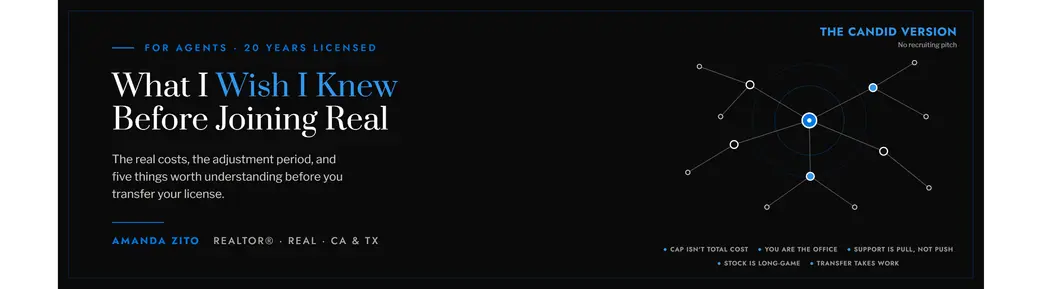
What should agents know before joining Real Brokerage? Real offers an 85/15 split with a $12,000 annual cap, stock awards, and revenue share — but it is a cloud brokerage, which means no physical office, no floor time, and no one managing your business but you.
Most of what gets written about Real is written by people trying to recruit you. That includes plenty of agents I respect. But recruiting content tends to lead with the upside and leave the adjustment period out, and the adjustment period is the part that actually determines whether a move works.
I've been a full-time REALTOR® since 2006, I'm licensed in both California and Texas, and I run The Zito Group under Real. I'd make the same decision again. That said, there were several things I understood only after I was already there — some of them financial, most of them operational.
Here's what I'd want to know if I were sitting where you are.
1. The Cap Is Not Your Total Cost
The headline number is clean: 85/15 until you've paid $12,000 in splits for your anniversary year, then you're at 100%. Agents on a team cap at $6,000, and mega team members cap at $4,000.
The part I underestimated was everything sitting outside the cap. As of now, Real lists a one-time $249 sign-up fee and a $750 annual brokerage fee collected in $250 installments from your first three closings of the year — with that annual fee scheduled to increase to $900 as of September 1, 2026. Every transaction also carries a $40 Compliance and Broker Review fee, and post-cap transactions carry a $285 transaction fee, which drops to $129 once you reach Elite status.
None of that makes the math bad. On most production levels it's still meaningfully cheaper than a 70/30 franchise split with a $20,000+ cap. But "100% after cap" isn't literally 100%, and you should build your model with the fees included rather than the split alone. Real publishes the current numbers in its agent help center — check them yourself rather than trusting any recruiter's screenshot, including mine.
What I'd do differently: I'd have built a full-year cost projection at my actual transaction count before I transferred, not after.
2. You Are the Office
This is the single biggest adjustment, and it has nothing to do with money.
At a traditional brokerage, structure is ambient. There's a physical office, floor time, someone at the front desk, a manager whose door you can knock on, a printer, a conference room for listing appointments. At a cloud brokerage, all of that is your responsibility to replace or replicate.
For me that meant deciding where I meet clients, how I handle printing and signage, how I build my own weekly accountability, and how I create a work rhythm without an office to drive to. My Tom Ferry coaching structure carried a lot of that weight — I'd been in that system for years before the move, and it's the reason the transition didn't cost me momentum.
If your current production depends on your office environment providing discipline, you'll want a plan for that before you switch. Not a vague intention — an actual plan.
3. Support Is Excellent, But It's Pull, Not Push
Real's broker support and agent community are genuinely strong, and I get answers on contract questions faster than I did in a physical office. Designated brokers are accessible, and the internal community platform is active around the clock.
The catch is directional. That support is available when you go get it. Nobody is walking past your desk noticing you look stuck. If you're the kind of agent who asks questions readily, you'll be fine. If you tend to sit on a problem quietly, a cloud model will let you.
That's a real limitation and I'd rather say it plainly than pretend it isn't there.
4. Revenue Share and Stock Are Long-Game, Not Income Replacement
Real offers revenue share on agents you attract to the brokerage, plus stock award programs tied to capping, attraction, and production. Both are real, and over time they matter.
Two things I wish had been framed more carefully for me:
- Revenue share is not passive. It compounds slowly and it is built on relationships and follow-up, which is work. Agents who join expecting a second income stream inside twelve months are usually disappointed.
- Stock is equity, with everything that implies. Awards are subject to vesting schedules, and share value moves with the market. Real trades publicly as REAX. That's ownership, not a bonus check, and it shouldn't be counted as spendable income when you're modeling your year.
If the commission math doesn't work on its own, revenue share and stock are not the reason to move. Treat them as upside on a decision that already makes sense.
5. Your Business Doesn't Transfer Itself
Transferring a license is administrative and fast. Transferring a business is neither.
Your active listings need broker-to-broker handling, your pending files need a clean path to close, your MLS and association records need updating, your signage and marketing need rebranding, and your database needs to hear the news from you before it hears it from someone else. I'm licensed in two states, which meant running that process twice, with two sets of state rules and two designated brokers.
Budget two to four weeks of real attention for the changeover, and start the listing conversations early. Sellers handle a brokerage change well when you tell them first and explain what stays the same. They handle it badly when they see a new sign in the yard and nobody called.
6. The Company Keeps Changing — On Purpose
Real moves quickly. Tools get released, fee schedules get updated, programs get restructured. If you want a brokerage where the model is identical in three years, this isn't it.
The clearest current example: in April 2026, Real announced an agreement to acquire RE/MAX Holdings, and in August 2026 securityholders of both companies approved the combination, with closing pending final conditions. That would create a combined platform spanning roughly 180,000 agents globally.
I think that's a positive for agents. But it's a fair thing to weigh honestly if predictability is what you value most in a brokerage. You can follow the filings directly through Real's investor relations page rather than relying on secondhand summaries.
Who Real Fits — And Who It Doesn't
Strong fit: Self-directed agents with an existing pipeline, agents building a team, agents who want ownership in what they're helping build, and producers who are tired of paying $20,000+ caps and franchise royalties for services they don't use.
Weaker fit: Agents who need daily in-person management, brand-new licensees without a mentor plan in place, and anyone joining primarily for revenue share rather than the underlying economics.
There's no version of this where one brokerage is right for everyone. The model rewards agents who already run their own business and asks a lot of agents who don't.
Frequently Asked Questions
How much does it cost to join Real Brokerage? Real currently lists a one-time $249 sign-up fee, plus a $750 annual brokerage fee collected from your first three transactions each anniversary year (scheduled to move to $900 as of September 1, 2026). Splits run 85/15 up to a $12,000 solo cap, with per-transaction fees on top. Verify current figures with Real directly, since they change.
Can I keep my listings when I transfer to Real? In most cases yes, but listings belong to the brokerage, not the agent, so the release has to be handled between your current broker and Real. Start that conversation before you sign anything, and check your independent contractor agreement for notice requirements.
Is Real a good brokerage for new agents? It can be, but only with structure in place — a mentor, a coaching program, or a team. The economics are favorable for low-volume years since you keep 85% from your first dollar, but the cloud model provides very little built-in supervision of your daily activity.
Thinking About the Move?
If you're weighing a change, I'm happy to walk through your actual numbers with you — your transaction count, your current cap and fees, and what the year would look like side by side. No pitch, no pressure, and I'll tell you if it's not a fit.
Call or text me at 949-484-9486 for a private conversation.
Amanda Zito, REALTOR® The Zito Group | Real Brokerage CA DRE #01740063 | TX TREC #840088 soldbyzito.com
Nothing in this post is investment, tax, or legal advice. Compensation and equity program details are set by Real and subject to change — confirm current terms directly with the brokerage before making a decision.
Categories
Recent Posts











“Your goals come first. My job is to help you make the right move.”